The 2026 Restaurant AI Visibility Study: 551 Answers From ChatGPT, Gemini and Perplexity
When a diner asks AI where to eat, a handful of names come back and there is no page two. Here is what actually gets a restaurant onto that shortlist, what turns out to be wasted effort, and what to fix first, measured across hundreds of real answers.


We asked ChatGPT, Gemini and Perplexity where to eat 551 times, across twelve US cities, phrased the way real diners type: best pizza, best brunch, somewhere to take a client. Every question twice, because the answers change. The point: learn what gets a restaurant named when the entire answer is a handful of names. One in five US consumers already asks this way, per Popmenu’s February 2026 survey, and most still use Google too, so call it a second front rather than a replacement. What came back behaves less like a ranking than a slot machine with a long memory. The levers that move it are not the ones restaurant marketing usually talks about.
TL;DR: What 551 AI answers showed about restaurant AI visibility
- The same question, asked twice, returns a different list. The two answers matched 46.7% of the time.
- The three engines are three separate channels. Only 4.8% of names made all three lists.
- Reddit is the most-read source by a wide margin. It was cited in 58% of all answers.
- Three in four ChatGPT answers carried an ad. Gemini and Perplexity carried none.
- A complete profile separates nobody. Both the most-named restaurants and the once-named had one, at 97%.
- Photos are the real divider. The most-named restaurants had nearly four times as many as those named once.
A restaurant’s AI visibility is how often an engine names it when someone asks where to eat, measured as a rate across repeated questions rather than as a yes or no. That definition is doing real work here. Checked once, a restaurant either appears or it doesn’t. That result means almost nothing. Checked twenty times across three engines, a number emerges that can be tracked, compared between locations, and moved. One answer is weather. The rate is climate.
The eight questions diners actually ask
Every question below was put to ChatGPT, Gemini and Perplexity, in all twelve cities, twice each. They are written the way a diner types, not the way a marketer searches, and they were chosen to span the range of occasion and price tier where restaurants actually compete.
| # | Question | What it tests |
|---|---|---|
| 1 | best restaurants in {city} | The broad, unqualified ask |
| 2 | best pizza in {city} | A single category, high-volume |
| 3 | where should I take a client for dinner in {city}? | Occasion, high spend, low price sensitivity |
| 4 | best family friendly restaurants in {city} | A constraint the engine must find evidence for |
| 5 | best brunch in {city} | Daypart |
| 6 | I'm visiting {city} this weekend, where should I eat? | Conversational, no category given |
| 7 | best cheap eats in {city} | The price tier where multi-unit brands operate |
| 8 | best late night food in {city} | Availability rather than quality |
The last two carry more weight than they look. Questions one to six pull almost entirely toward chef-led independents, which is not where most restaurant groups operate. Cheap eats and late night are the tier where multi-unit brands appear at all, and they produced the strangest answers in the study.
What the engines named, city by city
Eight questions, three engines, asked twice each. Pick a city to see how many different restaurants came back and which ones every engine agreed on.
Named most often
Out of every answer recorded for this city
Named by all three engines
The only overlap between ChatGPT, Gemini and Perplexity here
Antico Pizza Napoletana · Aria · Bacchanalia · Bones · Fellini’s Pizza · La Grotta · Lazy Betty · Miller Union · Mujō · The Optimist · The Varsity · Varuni Napoli
How wide a net each engine casts
Different restaurants each engine named across its own answers for this city. A wider net means a longer list, not a better one, and it is why the three so rarely agree.
- ChatGPT 78 restaurants named
- Gemini 48 restaurants named
- Perplexity 43 restaurants named
Named most often
Out of every answer recorded for this city
Named by all three engines
The only overlap between ChatGPT, Gemini and Perplexity here
Galleria Umberto · Giulia · Grill 23 & Bar · Neptune Oyster · Regina Pizzeria · Sorellina · Yvonne's
How wide a net each engine casts
Different restaurants each engine named across its own answers for this city. A wider net means a longer list, not a better one, and it is why the three so rarely agree.
- ChatGPT 80 restaurants named
- Gemini 39 restaurants named
- Perplexity 54 restaurants named
Named most often
Out of every answer recorded for this city
Named by all three engines
The only overlap between ChatGPT, Gemini and Perplexity here
Alinea · Au Cheval · Girl & the Goat · Kasama · Lou Malnati's · Lula Cafe · Monteverde · Oriole · Pequod's Pizza · Smyth
How wide a net each engine casts
Different restaurants each engine named across its own answers for this city. A wider net means a longer list, not a better one, and it is why the three so rarely agree.
- ChatGPT 97 restaurants named
- Gemini 88 restaurants named
- Perplexity 21 restaurants named
Named most often
Out of every answer recorded for this city
Named by all three engines
The only overlap between ChatGPT, Gemini and Perplexity here
Bird Pizzeria · KID CASHEW · La Belle Helene · Lang Van · Mert's Heart And Soul · Sabor Latin Street Grill · Steak 48 · Superica · The Capital Grille · The Fig Tree Restaurant
How wide a net each engine casts
Different restaurants each engine named across its own answers for this city. A wider net means a longer list, not a better one, and it is why the three so rarely agree.
- ChatGPT 104 restaurants named
- Gemini 76 restaurants named
- Perplexity 29 restaurants named
Named most often
Out of every answer recorded for this city
Named by all three engines
The only overlap between ChatGPT, Gemini and Perplexity here
Al Biernat's Oak Lawn · Birdie's Eastside · Bread Winners Cafe & Bakery · Cane Rosso · Cattleack Barbeque · El Carlos Elegante · Gemma · Jimmy's Food Store · Monarch · Partenope Ristorante · Serious Pizza · The Charles · The Henry · The Mansion Restaurant · Town Hearth
How wide a net each engine casts
Different restaurants each engine named across its own answers for this city. A wider net means a longer list, not a better one, and it is why the three so rarely agree.
- ChatGPT 84 restaurants named
- Gemini 73 restaurants named
- Perplexity 53 restaurants named
Named most often
Out of every answer recorded for this city
Named by all three engines
The only overlap between ChatGPT, Gemini and Perplexity here
Brennan's of Houston · Dot Coffee Shop · Hugo's · Star Pizza · State of Grace · The Original Ninfa's on Navigation · Truth BBQ · Xochi
How wide a net each engine casts
Different restaurants each engine named across its own answers for this city. A wider net means a longer list, not a better one, and it is why the three so rarely agree.
- ChatGPT 110 restaurants named
- Gemini 74 restaurants named
- Perplexity 33 restaurants named
Named most often
Out of every answer recorded for this city
Named by all three engines
The only overlap between ChatGPT, Gemini and Perplexity here
Bazaar Meat by José Andrés · Good Pie · Hash House A Go Go · Pizza Rock · Prime Steakhouse · Rainforest Cafe · Restaurant Guy Savoy · SW Steakhouse · Secret Pizza · Tacos El Gordo · Village Pub & Cafe
How wide a net each engine casts
Different restaurants each engine named across its own answers for this city. A wider net means a longer list, not a better one, and it is why the three so rarely agree.
- ChatGPT 91 restaurants named
- Gemini 85 restaurants named
- Perplexity 56 restaurants named
Named most often
Out of every answer recorded for this city
Named by all three engines
The only overlap between ChatGPT, Gemini and Perplexity here
Apollonia's Pizzeria · Canter's Deli · Holbox · Leo's Tacos Truck · Pizzeria Mozza · Pizzeria Sei · Providence · Quarter Sheets · Redbird · République
How wide a net each engine casts
Different restaurants each engine named across its own answers for this city. A wider net means a longer list, not a better one, and it is why the three so rarely agree.
- ChatGPT 91 restaurants named
- Gemini 98 restaurants named
- Perplexity 48 restaurants named
Named most often
Out of every answer recorded for this city
Named by all three engines
The only overlap between ChatGPT, Gemini and Perplexity here
Ariete · COTE · El Rey de las Fritas · Frankie's Pizza · Joe's Stone Crab · La Leggenda Pizzeria · La Sandwicherie · MILA · Mister O1 Extraordinary Pizza · The Surf Club Restaurant · The Taco Stand · Zuma
How wide a net each engine casts
Different restaurants each engine named across its own answers for this city. A wider net means a longer list, not a better one, and it is why the three so rarely agree.
- ChatGPT 91 restaurants named
- Gemini 67 restaurants named
- Perplexity 49 restaurants named
Named most often
Out of every answer recorded for this city
Named by all three engines
The only overlap between ChatGPT, Gemini and Perplexity here
Bastion · Biscuit Love · Bourbon Steak by Michael Mina · City House · Five Points Pizza · Hattie B's Hot Chicken · Locust · Mas Tacos Por Favor · Monell's · Mother's Ruin · Robert's Western World · The Butter Milk Ranch · The Catbird Seat · The Loveless Cafe
How wide a net each engine casts
Different restaurants each engine named across its own answers for this city. A wider net means a longer list, not a better one, and it is why the three so rarely agree.
- ChatGPT 78 restaurants named
- Gemini 72 restaurants named
- Perplexity 37 restaurants named
Named most often
Out of every answer recorded for this city
Named by all three engines
The only overlap between ChatGPT, Gemini and Perplexity here
Atomix · Balthazar · Birria-Landia · Clinton St. Baking Company · Empanada Mama · Ess-a-Bagel · Gramercy Tavern · Joe's Pizza · John's of Bleecker Street · Katz's Delicatessen · Le Bernardin · Los Tacos No. 1 · Lucali · Mamoun's Falafel · Scarr's Pizza · Semma · Sunday in Brooklyn · The Grill · Torrisi · Veselka
How wide a net each engine casts
Different restaurants each engine named across its own answers for this city. A wider net means a longer list, not a better one, and it is why the three so rarely agree.
- ChatGPT 98 restaurants named
- Gemini 107 restaurants named
- Perplexity 61 restaurants named
Named most often
Out of every answer recorded for this city
Named by all three engines
The only overlap between ChatGPT, Gemini and Perplexity here
Aerlume · Canlis · Delancey · Dick's Drive-In · Din Tai Fung · Lupo · Metropolitan Grill · My Friend Derek’s · Pike Place Chowder · Portage Bay Cafe · Rocco's · Spinasse · Sushi Kashiba · The 5 Point Cafe · The Walrus and the Carpenter · Toulouse Petit Kitchen & Lounge
How wide a net each engine casts
Different restaurants each engine named across its own answers for this city. A wider net means a longer list, not a better one, and it is why the three so rarely agree.
- ChatGPT 79 restaurants named
- Gemini 88 restaurants named
- Perplexity 56 restaurants named
Why does AI name different restaurants each time?
Ask an engine the same dining question twice and two overlapping but different shortlists come back. Across 269 repeat pairs, the two answers shared 46.7% of their names on average.
This is not a bug report. These engines do not keep a league table of restaurants the way a search index keeps a ranking of pages. Each question sends the engine out for fresh groceries, and whatever the market had that day ends up in the answer. Gemini’s bag changed the most. ChatGPT and Perplexity were steadier, Perplexity partly because naming so few places makes agreeing with yourself easier.
For an operator the consequence is practical and slightly annoying. Checking AI visibility once tells you nothing. A single miss might mean a real problem, or it might mean somebody asked on a Tuesday. Appearance rate across a dozen asks is the only number worth writing down.
A restaurant that appears in six answers out of ten and one that appears in one out of ten look identical if you only check once. The first has a position worth defending. The second has a problem. Same screenshot, opposite situations.
Do ChatGPT, Gemini and Perplexity recommend the same restaurants?
The overlap between engines is far smaller than most marketing plans assume. Counting only the matchups where all three engines answered the same question about the same city, they surfaced 2,158 names between them and agreed on 103. That is 4.8%, fewer than one name in twenty. The three engines agree the way food critics agree, which is mostly on the existence of food.
Pairwise, the picture holds. ChatGPT and Gemini shared about a fifth of their names; with Perplexity the overlap fell to roughly a tenth. Whatever these systems are converging on, it is not each other.
They behave differently inside the answer, too. ChatGPT names about ten restaurants and sorts them by occasion, a concierge with a laminated list. Gemini writes a magazine column, a similar count with neighbourhoods and chef credits attached. Perplexity is the friend who answers “where should we eat” by sending you three articles: in a quarter of its answers it declined to pick at all, describing which publications keep lists rather than choosing from them. Twenty-three times it named nothing whatsoever.
So “are we visible in AI” is the wrong question. There are three answers, only loosely related.
What the restaurants AI recommends most have in common
Knowing which restaurants get named says nothing about why they do. So the 36 most-named restaurants across the twelve cities were profiled against 34 named exactly once in the same cities, using their Google listing data.
The control group matters here. These are not restaurants nobody has heard of. They are real restaurants in the same markets that at least one engine did surface, once. So the matchup is winners against runners-up, not winners against the phone book. That makes the comparison harder to win, and it means anything that still separates the two groups is doing real work.
The anatomy of a restaurant AI keeps naming
Median Google listing values for the 36 most-named restaurants against 34 named exactly once, in the same twelve cities.
Named most often Named once Hover or focus a row for the reading
-
Photos on the listing
Every photo is a customer or an operator adding evidence. The widest gap in the study.
-
Google reviews
Depth behaves like a floor, not a ranking factor. Almost half the rarely-named sit under a thousand.
-
Star rating
Effectively identical. Above roughly 4.4 the number stops carrying information.
-
Listing attributes filled in
Both groups fill in almost everything. This is the entry fee, not the advantage.
-
Reservation link present
A twenty-point gap. Being bookable travels with being recommended.
-
Menu link present
A smaller gap, and the same direction: the engines prefer a place they can describe concretely.
-
Claimed listing
Identical. Claiming your profile does not distinguish you from anyone; not claiming it just removes you.
-
Under 1,000 reviews ↓
The single cleanest split in the whole comparison.
The result is not what the standard advice predicts.
Completeness is the entry fee, not the advantage: claimed listings sat at 97% in both groups. On descriptions, hours, websites and attributes the two groups sit within a few points of each other, all of them near the ceiling. Every restaurant in this sample had already done the profile hygiene, and half of them still got named once in 551 answers. Advice to “complete your Google Business Profile” describes the price of a ticket, not a seat.
Accumulated evidence is the advantage, and photos carry more of it than reviews. The most-named restaurants had a median 3,979 photos on their listing; those named once had about a thousand. Reviews showed the same tilt, only half as steep. Four thousand photos is four thousand small witness statements about the room, the plates and who eats there, and no marketing calendar produced them. Customers did.
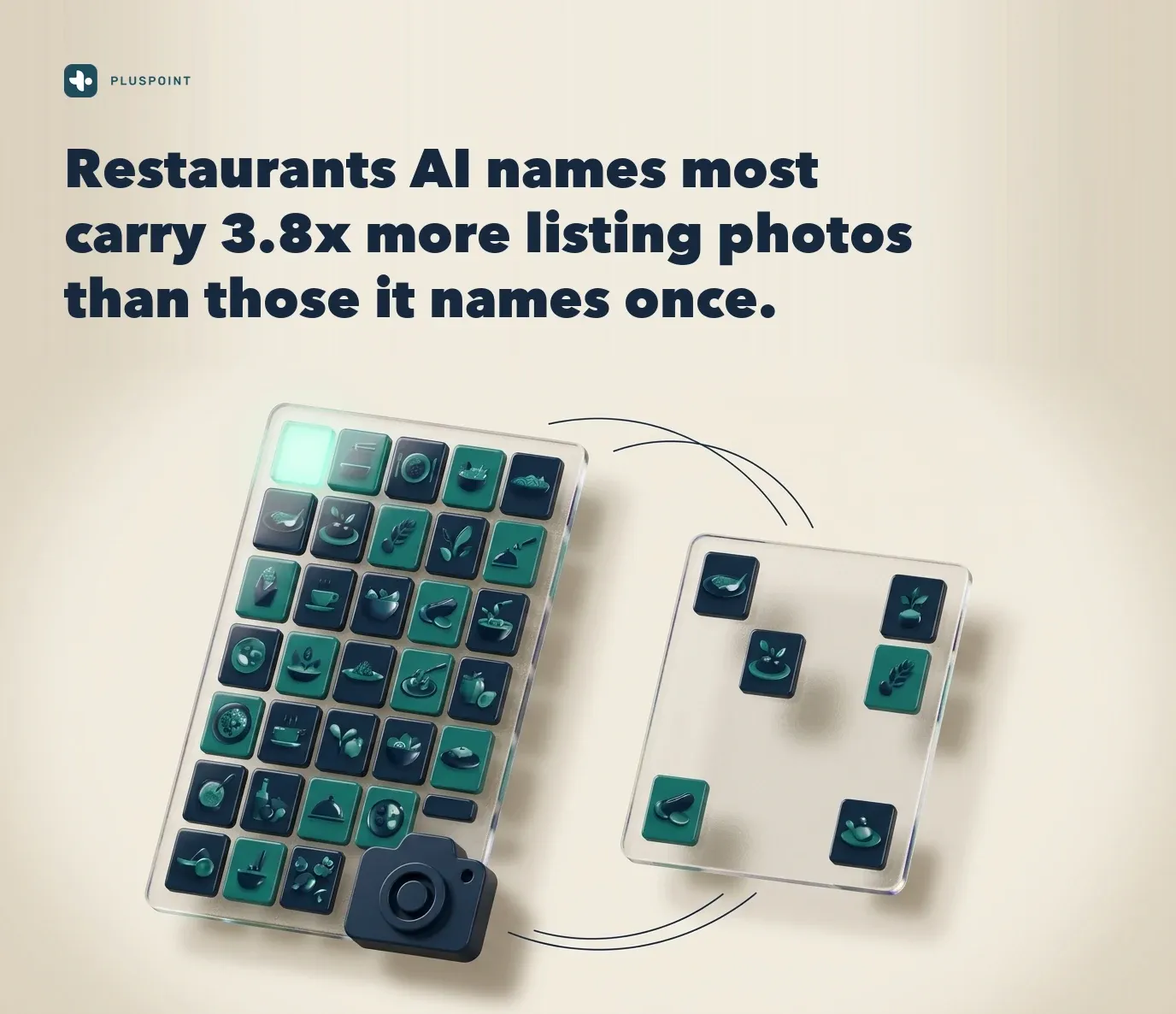
The star rating, the number operators check more often than their own pulse, did almost nothing: the two groups sat a tenth of a point apart. Almost nothing at the top of the scale, that is, because both groups were already in the mid-4s. The rating works like a dress code. It decides who gets through the door, and once inside, nobody checks it again. MyPlace reported the same shape in February 2026. Its recommended restaurants carried well over three times the reviews of the ones it skipped, and past about 4.4 stars the rating stopped separating anyone. Treat that as a second reading rather than confirmation, since MyPlace sells guest-engagement software and has an interest in review volume mattering. Two measurements pointing the same way is still worth something. It is not proof.
The cleanest split in the whole comparison was review depth. Among the most-named restaurants, 11% sat under a thousand reviews. Among those named once, 47% did. So depth is a floor to clear rather than a score to maximise, and above that floor sits the 4.5-star economy, where restaurant groups actually compete.
If a location has a claimed, complete, well-rated profile and still never gets named, the profile is not the problem. Nothing in the listing fields separated the two groups. What separated them was how much other people had written and photographed.
Where do AI restaurant recommendations come from?
Across the 551 answers, 1,113 distinct domains were cited. The concentration at the top is the actionable part.
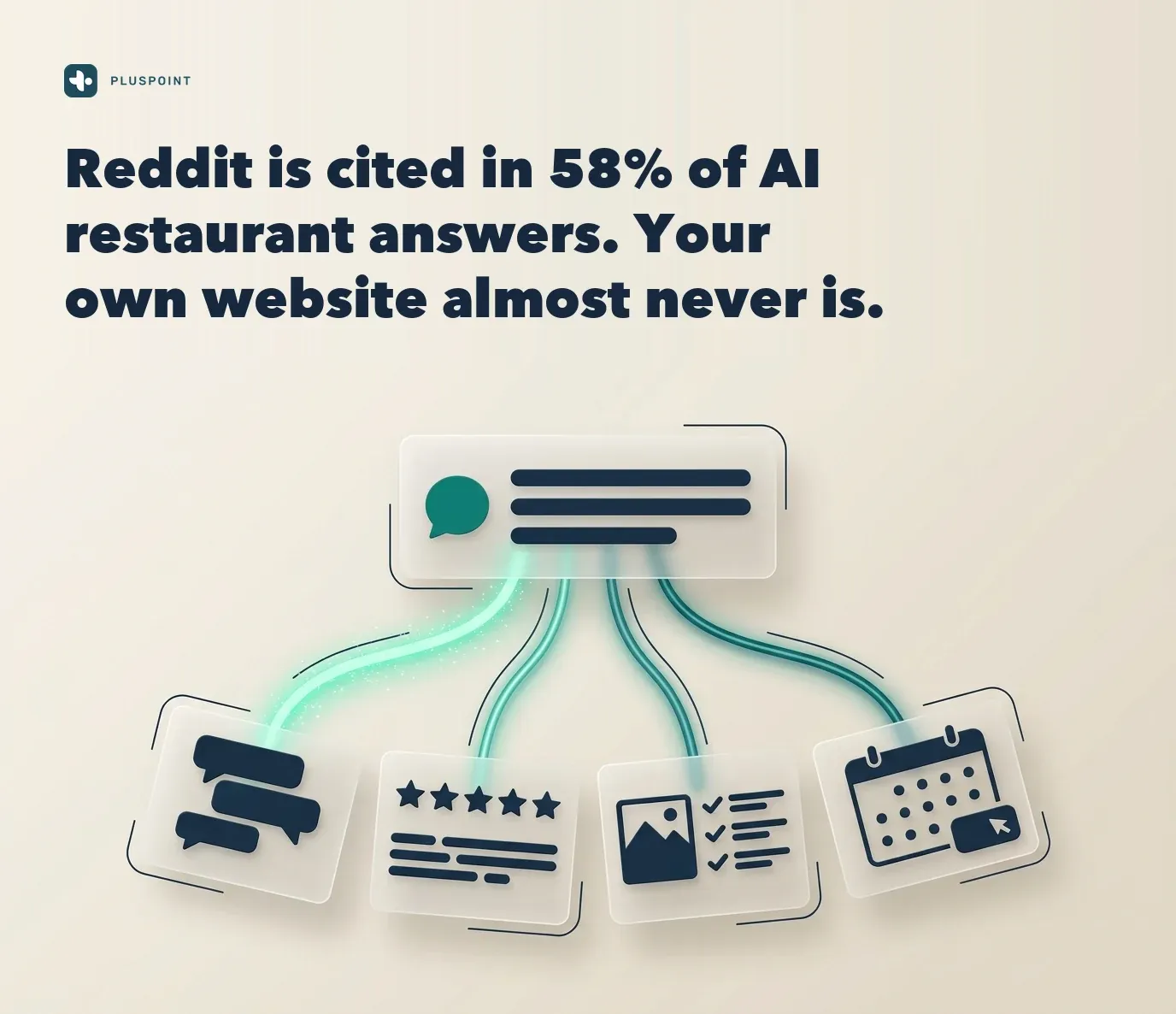
Each engine has its own reading habit, strong enough to plan around. Gemini cited Reddit in three quarters of its answers. Perplexity read Tripadvisor in 86% of its answers, with The Infatuation as its favourite critic. ChatGPT spread itself thinner, quoting city editorial and pulling operational detail from platform feeds behind the scenes.
That last detail deserves a pause. When ChatGPT named a restaurant, it stapled structured business data to the name, and three times out of four that data came from Yelp, with OpenTable and Resy trailing. So the editorial list decides who gets mentioned, while booking and review platforms decide what the answer knows: hours, menu, whether a reservation link appears at all.
Almost none of it is the restaurant’s own website. A location page can be the best in its market and still go unquoted, a beautifully set table in a room the AI engines rarely enter, because the answer is being assembled from a Reddit thread about deep dish and a Time Out list from July.
When AI recommends chains, and the one question where it never does
Multi-unit brands did show up, but not evenly, and the pattern is sharp enough to plan around. Across all 4,312 names, recognizable chains accounted for 2.1%. Split by question, that average hides the real story.
Not one chain location appeared in 490 names across the client-dinner question, in any city, from any engine. The engines treat a chain as an answer to a logistics problem, feeding children or eating cheaply or finding something open late, and never as an answer to an occasion. For a group operating a premium concept inside a larger portfolio, that is the constraint to argue with.
The cheap end also produced the study’s oddest results. Grocery delis and a warehouse club food court turned up as recommendations, always on the cheap-eats or late-night questions, never anywhere else. Seven times out of 4,312 names, an engine’s answer to “where should I eat” was, in effect, a supermarket.
When AI recommends a restaurant that no longer exists
Profiling the 72 restaurants surfaced something the answer text would never reveal. Two were recommended for Dallas, where the branch in question had already closed: Pizzeria Testa, whose Greenville Avenue restaurant shut in 2025, and Baker’s Ribs, whose recommended address no longer appears on its own locations page. Both brands still trade in the metro, from somewhere else. The listings outlived the dining rooms, and the engines kept seating people in them.
Both also came from the group named exactly once, which is a mild reassurance: the engines’ confident, repeated picks held up. It locates the failure precisely, too. The tail of an AI answer, the fourth and fifth names, is where the accuracy goes, and a diner has no way of knowing they are reading the tail.
Nothing, about a competitor’s dead listing. Quite a lot about your own: a closed location, a stale branch record or a duplicate listing can be the thing an engine hands to a diner. Sweep every platform for them, not just Google. Keeping profile data consistent at scale is unglamorous, and it is the layer these systems read most literally.
Across forty locations, that is an operations problem wearing a checklist’s clothes. Pluspoint is a reputation and location marketing platform for multi-location brands, holding listings, reviews, guest messages and social posts for every location in one place. The overlap with this study is not a marketing coincidence. Those are the same records an engine reads when it decides who to name.
ChatGPT is already selling ads inside restaurant recommendations
141 of the 189 ChatGPT answers carried a sponsored placement beside the organic recommendations. Three in four. Gemini and Perplexity showed none at all.
The advertisers were a strange crowd. DoorDash led with 39 placements, and Domino’s at least concerns dinner. Then it gets stranger: Hilton, hotel booking sites, a tour marketplace, a limousine service, accounting software, a company selling luggage and linen shirts. What accounting software is doing next to a dinner recommendation is anyone’s guess. Several answers carried two or three ads at once.
The ads were labelled, and nothing about them is hidden. What matters is the direction of travel. Search took about a decade to go from clean results to a page where the top of the screen is bought. AI answers are running the compressed version, and the answer is one slot wide. The organic recommendation is worth building now, while it is still most of the answer.
The more specific the question, the shorter the list
Ask the plainest question and you get the longest list: “best restaurants in [city]” returned about ten names. Every more specific question returned six to eight.
This runs against the usual advice about chasing long-tail phrases. In classic search a specific query is easier to win, because fewer pages target it. In an AI answer a specific query is harder to appear in, because the list is shorter and the engine wants evidence that this restaurant fits the constraint. Sometimes it finds none. Nobody gets recommended for a family dinner because their category field says “restaurant”. They get recommended because a review mentions that the staff brought crayons without being asked.
The money, awkwardly, sits in the specific questions. A client dinner is a table of six on a Thursday booked by somebody who will not shop around, and that is exactly the question where the engine hands back four names instead of twelve. Four names. One of them can be yours.
How to get your restaurant recommended by AI: four steps
Strip away the twelve cities and the three engines, and the study says one thing. AI recommends the restaurants other people have already written about, photographed and argued over, filtered through whichever platforms each engine happens to trust. The profile fields you control turned out to be the entry fee, and the order beyond the door is set by evidence other people leave behind: reviews, photos, threads, lists.
It is a brutal funnel. Thousands of restaurants trade in each of these markets, a few dozen made the answers, and nearly half of everyone named was named exactly once, never to return. Nobody outbids their way onto that shortlist. The seats go to the handful of places the web keeps bringing up on its own. There is no quick fix in that, which is also what makes a seat defensible once the patient, unglamorous work is done.
The restaurant AI visibility playbook, on one card
A complete profile got both groups to the door at 97%. These four steps are where the most-named restaurants pulled away.
-
2 of 72 profiled recommendations pointed at a branch that had already closed.
The move Fix the record. Correct every listing on every platform, and hunt dead branches and duplicates first.
-
3.8× photo gap between the most-named restaurants and those named once.
The move Grow the evidence. Ask for a photo with every review request, and get each location past a thousand reviews.
-
58% of answers cited Reddit. Tripadvisor and city best-of lists fed most of the rest.
The move Work the pages you do not own. Treat Tripadvisor, booking platforms and city editors as channels.
-
46.7% agreement when the same engine was asked the same question twice.
The move Track the rate. Run the eight questions monthly per engine, and score appearances, not screenshots.
From 551 recorded answers across ChatGPT, Gemini and Perplexity in twelve US cities, 30 July to 3 August 2026.
Four steps, in order.
1. Get every record straight, including the dead ones
Every location needs a claimed, correct listing on Google, Tripadvisor, Yelp and whichever reservation platform the market uses. Not because those sites send traffic, increasingly they don’t, but because they are what the engines quote. A location missing from Tripadvisor is close to invisible to Perplexity, which read it in six answers out of seven.
Correctness has a sharper edge than most audits assume. This study caught engines recommending closed branches, so a stale record is worse than a gap: it is a wrong answer handed to a diner with your name on it. Sweep for dead locations, moved addresses and duplicate listings first, on every platform, not just Google. Doing that by hand, platform by platform, is where a checklist turns into a system: Pluspoint keeps one listing record per location and pushes changes out, so a corrected address lands everywhere instead of on one dashboard. Then hold the honest view of what all this buys. It removes the reasons to exclude you. It does not supply a reason to pick you.
2. Grow the evidence pile, photos first
Review volume matters up to a floor, and that floor looks like about a thousand. Past it the count stops separating anyone, and the star rating stops working for you somewhere around 4.5. Photos matter more than the industry currently acts as if they do; that was the widest gap in the whole comparison. So bolt a photo ask onto every review request you already send, and give people something worth photographing, because a dish that photographs well is marketing that runs itself.
The words matter as much as the count. An engine claiming a place is “great for families” needs a sentence somewhere that says so, which means reviews naming the dish, the occasion and the room are the raw material for every recommendation. Ask guests about the visit, not just for stars.
3. Work the pages you do not own
Each engine’s reading habit is a channel. Perplexity treats Tripadvisor as scripture. Gemini lives on Reddit. ChatGPT quotes city editorial and pulls its operational facts from Yelp and the booking platforms, so a stale menu there becomes a stale answer. Pitch the local Time Out, Eater and Infatuation editors the way you would pitch press, because their lists decide who gets mentioned at all.
Reddit deserves its own sentence of caution. You cannot buy a thread, and the fastest way to get named in one for the wrong reasons is to be caught planting praise. Reddit can smell a press release through the screen. Show up as the owner, answer questions, fix what people complain about, and let the regulars argue on your behalf. The same logic that governs ranking higher in ChatGPT runs the whole stack: the engine believes the web, so change the web.
4. Track the rate, not the screenshot
Run a fixed question set per market, per engine, on a schedule, and record how often each location gets named. Twice per question, minimum, because single answers are coin flips. Track the rate across months, the same discipline that made rank tracking useful twenty years ago. And log which sources each answer cites, because that list tells you where next month’s effort goes.
Here is the question set from this study. Swap in a city and run it.
best restaurants in [your city]
best pizza in [your city]
where should I take a client for dinner in [your city]?
best family friendly restaurants in [your city]
best brunch in [your city]
I’m visiting [your city] this weekend, where should I eat?
best cheap eats in [your city]
best late night food in [your city]
The same four steps, broken into pieces a team can actually tick off:
The AI visibility checklist for restaurant groups
Twelve moves from the study, in working order. Ticks are saved in this browser, so the list survives until the next ops meeting.
Only have one week? Do the three starred items. They sit on the biggest gaps the study measured.
1 · Fix the record The entry fee. Removes the reasons to exclude you.
2 · Grow the evidence What actually separated the winners.
3 · Work the pages you do not own AI visibility is decided mostly off your website.
4 · Measure like a rank tracker One screenshot proves nothing in either direction.
0 of 12 done
Running the questions monthly, per market, is the measuring half. The other half is having something to change when the numbers come back: listings that stay accurate on every platform, review and photo requests that actually go out, and a record of what guests said. That is the work Pluspoint handles for multi-location brands, and the restaurant guest-experience comparison covers how the tooling differs for anyone weighing options.
Frequently asked questions
What is AI visibility for a restaurant?
AI visibility is how often an AI engine names a restaurant when someone asks where to eat, measured as a rate across repeated questions rather than as a yes or no. The rate matters because the answers are unstable: asking the same engine the same question twice produced lists that matched only 46.7% of the time across 269 repeat pairs. A restaurant appearing in six answers out of ten and one appearing in one out of ten look identical if you only check once.
How do ChatGPT, Gemini and Perplexity choose which restaurants to recommend?
They search the web at the moment the question is asked, then summarise what comes back. Across 551 recorded answers, the sources they read were overwhelmingly third-party: Reddit threads, Tripadvisor pages, and city best-of lists from Time Out, Eater and The Infatuation. A restaurant's own website was rarely the thing being quoted. AI visibility is decided mostly off the restaurant's website, on pages other people control.
Why does AI give a different restaurant list each time?
Because there is no stored ranking. Each question triggers a fresh search, and small differences in which pages come back change the answer. Asking the same engine the same question twice produced lists that matched 46.7% of the time on average, across 269 repeat pairs.
Do ChatGPT, Gemini and Perplexity recommend the same restaurants?
Almost never. Counting each city-and-question matchup where all three engines answered, they surfaced 2,158 names between them and agreed on 103: 4.8%, or fewer than one name in twenty. ChatGPT and Gemini agreed on about a fifth of names; ChatGPT and Perplexity on roughly a tenth. Being recommended by one engine says very little about the other two.
What do the restaurants AI recommends most have in common?
Not a completed profile. Comparing the 36 most-named restaurants against 34 named exactly once, both groups had claimed listings at 97% and filled in nearly every attribute. The separation was in accumulated evidence: a median 3,979 photos against 1,044, and 2,559 reviews against 1,178. Star ratings were effectively identical at 4.6 and 4.5.
How many reviews does a restaurant need to be recommended by AI?
There is no published threshold, and depth behaves more like a floor than a ranking factor. Among the most-named restaurants, 11% sat under 1,000 Google reviews. Among those named exactly once, 47% did. A February 2026 study by MyPlace found a similar pattern, with recommended restaurants averaging 3,424 reviews against 955.
Are there ads in AI restaurant recommendations?
In ChatGPT, in three answers out of four. Of 189 recorded ChatGPT answers, 141 carried at least one sponsored placement, most often DoorDash, Hilton or Domino's. Gemini and Perplexity answers carried none. Many of the ads had nothing to do with dining.
How can a restaurant group track its own AI visibility?
Run a fixed set of questions per market, per engine, on a schedule, and record which locations get named. Ask each question at least twice, because single answers are unstable. Track the appearance rate over months rather than a single result, and log which sources the engine cited, because those pages are where the work actually needs to happen.
How the study was run
Twelve cities, chosen on measured AI prompt volume rather than population: New York, Chicago, Houston, Las Vegas, Nashville, Charlotte, Seattle, Los Angeles, Dallas, Miami, Boston and Atlanta. San Francisco was the next candidate and was excluded by the same rule.
The eight questions are listed in full near the top. Three engines (ChatGPT, Gemini and Perplexity), each with web search active, reached through DataForSEO’s AI endpoints between 30 July and 3 August 2026. Every question was asked twice to measure repeatability.
That plan called for 576 answers and produced 551. By engine: ChatGPT 189, Perplexity 192, Gemini 170. Gemini’s shortfall sits in Boston and Atlanta, where the endpoint intermittently refused the web-search parameter. Collecting those without it would have mixed ungrounded, memory-only answers into grounded data, so those cells are absent rather than wrong. Fourteen failed calls were discarded rather than counted as empty answers, because counting a failure as “the AI named nobody” would invent a finding. Every cross-engine comparison is computed only on cells where all three engines answered, so the uneven counts cannot skew it.
For each answer we recorded the restaurants named and their order, every source domain cited, whether the answer carried an ad, and the full response text. Names were normalized within each city so that “Pequod’s” and “Pequod’s Pizza” count once, while Nobu Houston and Nobu Las Vegas stay separate. That leaves 4,312 name slots across 1,917 distinct restaurants. Places mentioned as context rather than offered as somewhere to eat were excluded.
For the winner comparison, the three most-named restaurants in each city were profiled against three named exactly once in the same city, using Google listing data read on 4 August 2026. Two could not be resolved to any listing and were excluded from every figure. Two more looked closed at first and were found trading on a second check, so a missing listing was never read as a closed restaurant. Three fields collected during profiling were discarded as unusable: Google’s price level does not track price, its structured menu count measures ingestion rather than menu size, and its review-topic count is capped at ten.
What this study does not show
The most obvious gap is the menu. Restaurants have an unusually rich editorial layer, and no other industry inherits it. A follow-up on who decides which local businesses AI names repeated the method for dental, veterinary, home services and four more, and the gatekeeper changed every time.
It measures API responses, not the logged-in consumer app. A real diner brings location, chat history and a personalized profile, all of which shift the answer.
It is a snapshot of one week, and these systems change monthly. It measures whether a restaurant gets named, not whether anybody then booked; attribution from an AI answer to a table remains largely unsolved.
The winner comparison rests on 70 restaurants. That supports a direction and a median, not a significance test, and nothing above should be read as one. It also shows correlation only: restaurants with more photos get named more often, and this study cannot say whether the photos caused it or whether both follow from being popular. The honest reading is that being written about, photographed and reviewed at volume is what the engines can see, whatever produced it.
Those limits are worth stating plainly, because the useful findings survive all of them. The answer is unstable. The engines disagree with each other. What they read is mostly not yours. And the profile fields most restaurant marketing focuses on turned out to be the one thing that separated nobody from anybody.