How Local Businesses Can Rank Higher in ChatGPT Recommendations (2026)
A customer asks ChatGPT to recommend a business like yours, and it answers with four names. Your website barely affects that list. Pages other people publish decide it, and you can check whether you are on it in an afternoon.

A customer asks ChatGPT where to go and gets a handful of names back. No second page, no map pack, no ten blue links. Either your business is one of the names, or you just lost a customer without ever knowing they existed.
Almost nothing that decided that list came from you. Pluspoint took apart 309 ChatGPT answers in August 2026, 210 for customers choosing where to go and 99 for owners asking how to get found. The pages doing the deciding were consistently ones no business owner can edit. Most standard advice tells you to tidy up what you own. That is the wrong end of the problem.
TL;DR: What decides whether an assistant names you
- The answer arrives on two trucks. The sentence naming businesses comes from third-party articles, roundups and forum threads. The business card beside it, with the address and hours, comes from a licensed data feed. Different suppliers, different work.
- Your own website is roughly 4% of the evidence. When an AI answer shows its sources, only about 4% of those links point at the business’s own website. Microsoft’s advertising division measured that across millions of links. You cannot write your way in from your own blog.
- Ranking well is not the same as being cited. On Google’s AI Overviews, the share of citations going to pages that also rank in the top ten has fallen to 38%. The search behind the answer reaches past the first page, and past the first hundred.
- You can buy the box, not the answer. ChatGPT now carries ads. They are labeled, separated from the answer, and barred from running near health topics, so a whole category of local business cannot buy its way in at all.
- Check twice or do not bother. Identical questions produced identical sources 8 times in 100. One screenshot is not a measurement.
How does ChatGPT decide which local businesses to recommend?
It runs a search at the moment you ask, reads what comes back, and writes a short list from the businesses several sources agree on. There is no index of businesses ranked by stars, and OpenAI publishes no formula. Its documentation commits to only three specifics. ChatGPT works with outside search providers. It may pass your approximate location to partners that supply local business data. And nobody can guarantee any site a place in the results.
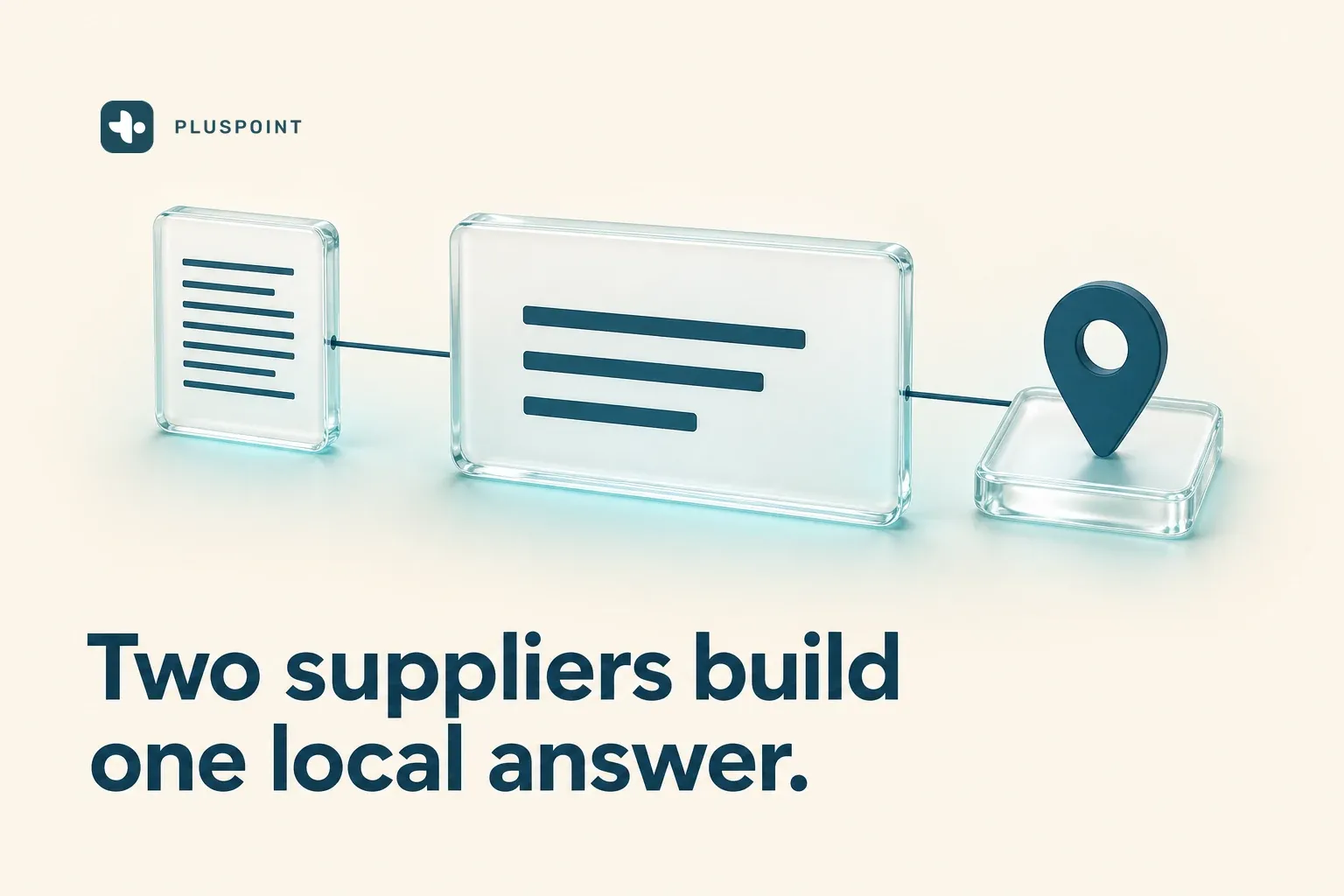
A local answer is not one object. It is two, built by different suppliers, and most businesses manage only one of them.
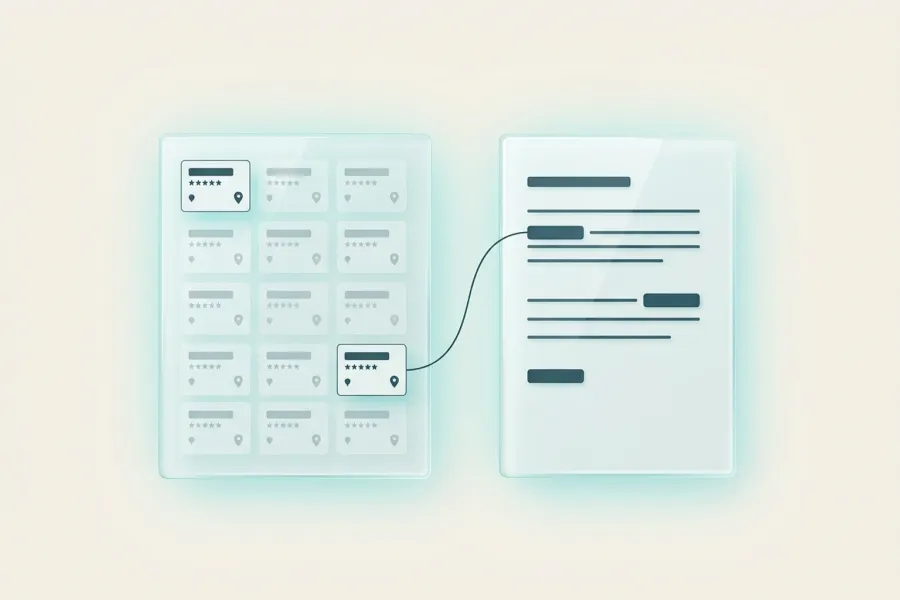
The sentence decides who gets named. We asked ChatGPT 110 customer dining questions across eleven US cities, twice each, and read the 210 answers that came back. City and national editorial supplied 48.9% of all cited domains, and community discussion supplied roughly one in ten more. Not one answer read a Google, Bing, Apple or Yelp page to decide its picks. The profiles you polish are not what it reads. Articles and forums about you are.
The card carries the address, the photos and the booking link. In a separate audit of the business cards themselves, 45 of 56 carried a Yelp URL tagged as an OpenAI data feed. Google, Apple and Bing appeared on none of them.
| The sentence that names you | The card beside it | |
|---|---|---|
| What it decides | Whether you appear at all | Whether the customer can act on it |
| Where it comes from | Editorial, roundups, directories, forum threads | A licensed business-data feed |
| Where listings show up | Never quoted, across 210 answers | Yelp feeds 45 of 56 cards |
| The work | Getting written about by other people | Keeping the source record current |
| Who owns it internally | Marketing, PR, partnerships | Operations and listings |
That split explains a failure owners keep describing and rarely diagnose. Rewriting your website moves neither half much. Listings improve the card but leave the sentence alone. The sentence moves when other people write about you, and the sentence decides whether the customer ever reaches the card.
Why is your own website only 4% of the answer?
Because a model treats your description of yourself as the least interesting evidence available. When an AI answer shows its sources, only about 4% of those links point at the business’s own website. That figure comes from Microsoft’s advertising division, which measured it across millions of links. Everything else sits on pages you do not control.
This is the hardest idea to sell internally. Every instinct in a marketing team says publish more, and publishing more of your own pages moves a number that was already small. It is shouting louder into your own voicemail.
What the website does still control is whether a model can tell what you are. An agency owner who ran 30 local searches across ten cities wrote up the pattern on Reddit in July 2026: “Businesses whose homepage says ‘quality solutions for all your needs’ basically don’t exist to these tools.” A commenter on the same thread had worked it out the slow way and put it better than any framework:
“A lot of my fellow Drum Circle leaders have a lot of vague, fluffy language on their websites. They list every singing possible event that could have a drum circle. I noticed that and tried to do the opposite… I made a page for each of the top five types of jobs that I get, and then explained exactly how it works for that type of event. And I’ve been getting a lot of people who found me on AI.”
One page per job, written the way a customer would describe the job. That is most of the website work, and it is closer to copywriting than to search engine optimization.
What actually gets a local business named
Six moves, in order. Each comes from an operator who ran it on real accounts and published what happened, and each matches what we measured. Budget an afternoon for the first two and an hour a month for the last.
| Move | Time | Done when | |
|---|---|---|---|
| 1 | Map who the assistants already name | An hour | You have the pages that produced those names |
| 2 | Pull the conversational queries out of Search Console | An hour | 20 to 50 real questions, in customer language |
| 3 | Ask the engine for its sources | 20 minutes | A named shortlist of listicles, review sites and threads |
| 4 | Make the page and the record specific | Ongoing | One page per job, one record everywhere |
| 5 | Ask for reviews that describe the job | Ongoing | Reviews that name the dish, the repair, the room |
| 6 | Track the mention rate | An hour a month | A trend per city, not a screenshot |
- 1 Find out who is winning, before you look at yourself
Map who the assistants already name in your market. It is rarely who you expect. You are hunting the pages that produced those names, not grading yourself.
An operator who optimizes local businesses for AI answers, mostly plumbers, painters and clinics, walked through their process on Reddit and puts this first, ahead of touching the website: “Before I touch their site I map who’s actually winning the AI answers in their market. It’s usually not who the client thinks.” Whoever keeps appearing is standing on a set of pages. Those pages are your target list.
- 2 Mine Search Console for the questions people already ask
This is the step almost everyone skips, and the one with the shortest path to results. Search Console already holds the exact language customers use, including long conversational strings that read like chat questions. Filter to queries over 30 characters and there they are.
The same operator calls it the most valuable move in the whole process: “GSC shows the real language people already use to find the business. I pull those queries and turn the high-intent ones into natural-language prompts. No guessing at keywords, it’s demand that’s already there, just rephrased the way someone would ask an AI.”
It checks out on our own data. This page’s Search Console shows queries like “how do i get chatgpt to recommend my business in specific cities?” sitting at position 2. Nobody researched that as a keyword. Somebody typed it as a question.
- 3 Ask the engine where it got the answer
Run a customer-voice question, then ask the assistant to show its sources. You get the exact pages standing between you and the recommendation. A vague ambition becomes a short outreach list.
Best [your category] in [your city]. After you answer, list every source you used, with the URL for each one.
A practitioner tracking mention rates across client accounts described the pattern on Reddit: “Ask the engine where it got its answer. For local it’s usually 2-3 listicles, the big review sites, and GBP [Google Business Profile]. Get on those pages and the mention rate creeps up over a few weeks.”
The sources behind one answer are usually a handful of pages, which makes the target list short enough to work through by hand. Two or three listicles is a pitch list rather than a content strategy. That shrinks the job from a year of publishing to an afternoon of polite email. Add the forum threads where your market already argues to the same list, since community pages supplied about one cited domain in ten in our own measurement. They also have long memories for anyone who turns up only to advertise.
- 4 Make the page and the record specific
Vagueness is what gets you skipped. A model matching a specific question against a page that promises quality solutions for every need has nothing to work with.
On the site, that means one page per job, named the way a customer actually names it, with a plain question-and-answer block underneath: what it costs, how long it takes, whether you handle the awkward case. Specificity beats authority more often than teams expect. In the same Reddit discussion, an agency tracking around 400 prompts across roughly 50 businesses reported that “company A that only installs water heaters is going to show up before company B that is a general plumber, even if company B has way more authority.”
In the record, it means the same name, address, phone, hours and category everywhere, menus and service lists included. A directory entry from 2019 can outvote your own homepage, and contradiction is what makes a model hedge. Doing that by hand across twenty directories and fifty locations is where the work quietly dies. That part Pluspoint automates: fix the record once, push it everywhere, and keep it from drifting back.
- 5 Ask for reviews that describe the job
Ask for the detail rather than the score. Models quote sentences, and an average gives them nothing to quote.
Another practitioner in that discussion watched the gap open up in front of them: “I watched a business with 2000 short reviews get completely skipped by ChatGPT while a competitor with 50 reviews kept getting recommended. The difference was that the competitor’s reviews mentioned actual details about the food, the atmosphere, specific dishes. AI reads the words, it doesn’t count the stars.”
The matching is that literal. Somebody asking for the best brunch gets matched against reviews that say brunch, and somebody asking for a kid-friendly dentist gets matched against the review describing a nervous six-year-old. Changing the ask is a one-line edit to whatever request already goes out, whether that is a review QR code at the counter or a follow-up message the next day. Across fifty locations it is one template, changed once. Keep the stream steady too, because a trickle of recent reviews outweighs a pile of old ones. Concentrate on Google, Yelp and Tripadvisor.
- 6 Track the mention rate, not the screenshot
Run a fixed set of questions monthly, twice each, once per city, and never with your business name in them. Naming yourself plants the answer you were trying to test.
Check whether you are in the answer, then read what it actually says about you. A confident recommendation carrying a phone number you disconnected two years ago is a wild goose chase with your name on it, and no report will ever tell you it happened.
This loop is what AI visibility means in practice for a local business: a mention rate you track, not a rank you hold.
The reason for two runs is not caution, it is arithmetic. “One ChatGPT screenshot means nothing. Ask the same thing 10 times and you get different lists most of the time. So all the before/after screenshot stuff is noise,” as one commenter in the same discussion put it, which matches what we measured: identical questions returned identical sources 8 times in 100.
Fix these before you start
Three failures make everything above pointless, and each takes under an hour.
| Check | Why it decides everything | Done looks like |
|---|---|---|
| Can AI crawlers fetch your pages? | OpenAI’s documentation ties inclusion to letting OAI-SearchBot through. Bot protection, a firewall rule or browser-only rendering leaves an assistant with a blank page. | Your location pages return readable HTML to a plain request |
| Does your record agree with itself? | Contradiction across sources is the most common reason a model declines to commit. Pluspoint’s free Listings Scanner surfaces the conflicts in a couple of minutes. | Name, address, phone, hours and category match everywhere |
| Is your markup honest? | LocalBusiness markup makes hours and services unambiguous, which is worth having. It will not get you quoted, though, because an assistant reads the words on the page. Marking up a vague page gives you a well-labeled vague page. | Structured data present, and the page underneath says something specific |
What the standard advice gets wrong
One caveat before the list. Everything here describes ChatGPT, and the engines diverge sharply on local questions. We later measured who decides which local businesses AI names across seven industries and found Gemini sends roughly 60% of its local citations to the business’s own website, almost the reverse of the pattern below.
Two beliefs do most of the damage, and both come from treating an assistant as a search engine wearing a different logo.
Does ChatGPT still run on Bing?
Partly, and it matters far less than the advice assumes. OpenAI names Bing as a search provider and also runs its own crawler and index, so by 2026 it draws on several sources. The belief survives on a real fact, Microsoft’s roughly 27% stake in OpenAI, quietly upgraded into an imaginary data pipeline.
Underneath sits a costlier mix-up. The web index and Bing Places, the free listing product, are separate systems, and the listing product publishes no public page for a business. No URL, nothing for a crawler to fetch. Claiming one so an assistant can read you is a billboard in a locked garage. Add your business to Bing Places anyway for the twenty-minute win: the dashboard imports your Google listing, and it feeds Maps, Windows Search, Edge and Copilot. Just do not expect it to reach ChatGPT. The Apple and Bing listing setup covers the rest.
Does ranking on Google get you cited?
Less reliably every quarter. Ahrefs found the share of Google AI Overview citations going to pages that also rank in the top ten has fallen to 38%, with the rest split between positions 11 to 100 and pages outside the top hundred altogether. An assistant splits one question into several searches and digs deeper on each, so it can pull a page in from nowhere near the first screen while the page that owns the first screen goes unmentioned.
Can you pay ChatGPT to recommend your business?
You can buy an ad. The answer itself is not for sale, and for a large share of local businesses the ad is not available either.
OpenAI began testing ads in ChatGPT in February 2026 and has since expanded the pilot well beyond the US. Its own account of how they work is specific. Ads appear only for logged-in adult users on the Free and Go tiers. OpenAI matches them to the topic of the conversation rather than to anything tracked across the web, and keeps them “always clearly labeled as sponsored and visually separated from the organic answer.” The company says outright that ads do not influence the answers.
One exclusion settles this for a whole slice of the market. OpenAI has said ads “are not eligible to appear near sensitive or regulated topics like health, mental health or politics.” A twelve-clinic dental group can buy an ad for almost anything except being a dental group.
For everyone else, trade reporting describes a self-serve portal with no minimum spend, and pay-per-result formats in development. Treat that as reporting, not documentation. Either way the point stands: the paid box and the organic answer are separate products, and your customers read the organic one first.
How do you check whether ChatGPT names your business?
Ask it, in a customer’s words, at least twice, and write down what came back. The checking is not the hard part. Almost nobody does it, so most owners learn about the problem from a customer, not a report.
Check whether an assistant names you
Pick the closest category, swap the bracketed words for your own city and neighborhood, then ask each question twice in a fresh chat. Never type your business name: naming it plants the answer. Tick a box each time you are named in the reply.
-
Where should I take a client for dinner in [city] this week?
-
Somewhere in [neighborhood] that can seat six on a Friday without a month of notice
-
Best coffee shop in [city] where I can actually work for two hours
-
I'm gluten free and in [city] for one night. Where do I eat?
-
Which places in [city] are open past 11pm on a Tuesday?
-
I need a dentist in [city] taking new patients. Who is good?
-
Which [city] clinic should I call about a chipped tooth today?
-
Best pediatric dentist near [neighborhood], my kid is nervous
-
Who does clear aligners in [city] and roughly what does it cost?
-
Is there a dental practice in [city] open on Saturdays?
-
Who should I call for a leaking water heater in [city] right now?
-
Best electrician in [city] for rewiring an old house
-
I need a plumber in [neighborhood] this weekend. Who actually turns up?
-
Which heating and cooling company in [city] is honest about pricing?
-
Who installs heat pumps in [city], and are they any good?
-
Where in [city] can I try [product] in person before buying?
-
Which [city] store has the widest selection of [product]?
-
Is there anywhere in [neighborhood] that repairs [product] instead of replacing it?
-
Best place in [city] to buy [product] as a gift, budget around [amount]
-
Which [city] stores selling [product] are open on Sunday?
-
Best gym in [neighborhood] for someone starting from zero
-
Where should I get my hair cut in [city] if I have been let down before?
-
Which studios in [city] run beginner classes in the evening?
-
Is there a salon in [city] that is genuinely good with curly hair?
-
Which gyms in [city] bill monthly with no contract?
-
Which accountant in [city] handles small companies with a few locations?
-
I need a real estate attorney in [city] for a house purchase. Who is recommended?
-
Best bookkeeper near [neighborhood] for a multi-location business
-
Who in [city] does employment law for small employers?
-
Which firms in [city] actually reply within a day?
0 of 10 asks named your business
Not named yet. Nothing here is broken, and nothing here is fixed either. Work the section above and re-run this in a month.
Two runs is not fussiness. We asked every question in our own study twice on the same day, and that produced 100 complete pairs. Only 8 of them drew on identical sources, and the two source lists overlapped by 38% on average. That is not a ranking you can climb. It is weather. You read weather by taking readings on a schedule.
An operator replying on Reddit in July 2026 named the part that costs money: “it’s not just whether you get named, it’s whether what it says about you is correct. The failure mode that quietly costs money is being recommended and then handed a phone number that’s been disconnected for two years, or hours from before you changed them. The customer never calls and you never find out — there’s no dashboard for it.”
Assistants also disagree with each other about the same business, so one engine is a poor proxy. Google’s conversational layer inside Maps runs on different signals again. Pluspoint’s Ask Maps readiness work covers that surface, and the restaurant study across three assistants shows how far apart their answers sit for the same query.
How fast can you rank in ChatGPT?
Days for the engine to find a new page, one to three months before it names you on most asks. Fresh pages surface fast because the search happens live. Naming is slower because it leans on pages other people publish.
The most useful public account comes from a practitioner who posted their numbers on Reddit in January 2026, after going from no mentions to positions five and six for a main term within a month. The work behind it was unglamorous: brand mentions with service keywords on partner blogs and social profiles, clear service-area details on the site, and a review push that brought in seventy reviews in a month. No single lever. Nothing money could have bought.
Where AI visibility gets oversold
Worth saying plainly, because the category has attracted a lot of confident nonsense.
Assistants are a discovery layer. They have not replaced the places people already check. A 2026 study reported by Search Engine Land found that only 54% of consumers now call AI search more helpful than traditional search. Twelve months earlier it was 82%. The same trend shows up in how people use it: they ask, then they go and verify somewhere else. Across Pluspoint’s 99 owner answers, ChatGPT named Google first 97% of the time, which is the assistant telling you where it thinks the ground truth lives.
There is a sharper objection, and it deserves a straight response. A commenter on Reddit argued in July 2026 that the whole effect is an attribution illusion: customers “asked it a question, got a generic answer, then googled the recommendation anyway and landed on you through Google. The AI didn’t actually route them to you, Google did.”
They are partly right and partly out of date. ChatGPT does search live rather than recalling a two-year-old index, so the answer is not a fossil. But the attribution problem is real and unsolved. Any vendor showing you a confident count of AI-sourced revenue is showing you a model, not a measurement.
The honest position is that this is cheap insurance with an uncertain payout curve. As consolation, consistent listings, specific service pages and reviews that describe the job all pay for themselves in ordinary search, whatever the assistants do next.
Confirm a crawler can actually read your location pages. Fix the platform whose data about you is oldest, which is rarely the one you check. Then run ten customer-voice questions twice, note who gets named instead of you, and go and get onto the pages that named them.
Method and limits
Two runs sit behind the figures above, both carried out on 10 August 2026 through ChatGPT with live web search.
The first put ten diner-voice question templates to eleven US cities, twice each. Of 220 calls, 10 failed, leaving 210 usable answers. A separate audit read the business cards attached to 56 of those answers. The second run asked 50 questions a real owner would ask about getting found locally, twice each, producing 99 usable answers. No question in either run named a platform, because naming one plants the answer you were trying to test.
What this does not establish matters as much. One engine, one country, one day, so the source mix is a snapshot rather than a trend. Restaurants dominate the sample, and that skews which publications appear. And a platform’s absence from ChatGPT’s citations is not evidence that its listing is worthless: Apple and Google place data reaches people through maps, voice assistants and phone search, none of which this instrument can see. The raw question sets and results sit alongside the Apple Maps and Bing Places analysis.
Frequently asked questions
How do I get my business ranked on ChatGPT?
There is no ranking to climb. ChatGPT assembles a local answer from whatever it can retrieve at the moment you ask, so the work is making your business easy to confirm from the outside. In practice that means three things. Appear on the third-party pages an assistant is likely to pull, which for local questions means roundups, category directories and forum threads rather than your own blog. Keep your name, address, hours and services identical everywhere they appear, because contradiction is what makes a model hedge. And let AI crawlers reach your site, since an assistant cannot read a page hidden behind bot protection.
How fast can you rank on ChatGPT?
Faster than Google at finding you, slower than anyone promises at naming you. Because ChatGPT searches live at the moment of the question, it can pick up a new page within days. Reliable naming runs on a different clock. Operators who documented the work describe one to three months before a business goes from never appearing to appearing on most asks, and the bottleneck is almost always the third-party pages, not their own site.
Does ChatGPT recommend different businesses in different cities?
Yes, and the difference is bigger than most multi-location teams expect. The assistant assembles each answer from whatever it retrieves for that question in that market, and the local roundups, directories and forum threads it finds differ from city to city. A group can be named consistently in one metro and absent in the next while running identical operations in both. Audit each market separately, with the same set of questions, rather than checking your strongest city and assuming the rest look the same.
Can I pay to appear in ChatGPT recommendations?
You can buy an ad slot. You cannot buy the recommendation. OpenAI began testing ads in ChatGPT in February 2026 and has since expanded to Europe and several other markets, and its own statement is that ads are clearly labeled as sponsored, visually separated from the answer, and do not influence what ChatGPT says. Ads also appear only for logged-in adult users on the Free and Go tiers, and they are not eligible to run near health, mental health or political topics.
Does ChatGPT read my Google Business Profile?
Not as a page it reads to decide, on the evidence available. In 210 ChatGPT answers to customer dining questions, collected with live web search in August 2026, not one read a Google, Bing, Apple or Yelp page to choose its picks. That does not make the profile pointless. It feeds the wider agreement about your business that a model checks against, it supplies the maps and assistants people use elsewhere, and it is the record most third parties copy from. It is groundwork rather than the thing that gets quoted.
Why does ChatGPT recommend my competitor and not me?
Usually because the other business is easier to confirm, not because it is better. A model needs several independent sources agreeing on what you do and where before it will put your name in a short list. A business described the same way on its own site, two directories, a local roundup and a forum thread gives it that. A business whose homepage says it offers quality solutions for every need gives it nothing to match against a specific question.
How often should I check whether ChatGPT names my business?
Monthly, and always more than once per question. Identical questions returned an identical set of sources in only 8 of 100 pairs when the same instrument was run twice in August 2026, so a single screenshot tells you almost nothing in either direction. Run a fixed set of five to ten questions, twice each, on the same day each month, and read the trend rather than any one answer.
Do AI crawlers need to be allowed on my website?
Yes, and this is the failure that costs the least to fix. OpenAI's documentation is explicit that inclusion in ChatGPT search depends on allowing OAI-SearchBot to crawl the site, and that nobody can guarantee a site placement. Bot protection, an aggressive firewall rule or content that only renders in the browser can each leave an assistant with nothing readable. Check what a crawler actually receives before rewriting a single sentence of copy.