
Who Decides Which Local Businesses AI Names (2026 Data)
Your listing fills the card beside the answer. Something else decides whether the answer says your name. We measured seven industries to find out who owns that second layer, and it turned out to be a different owner in every one.

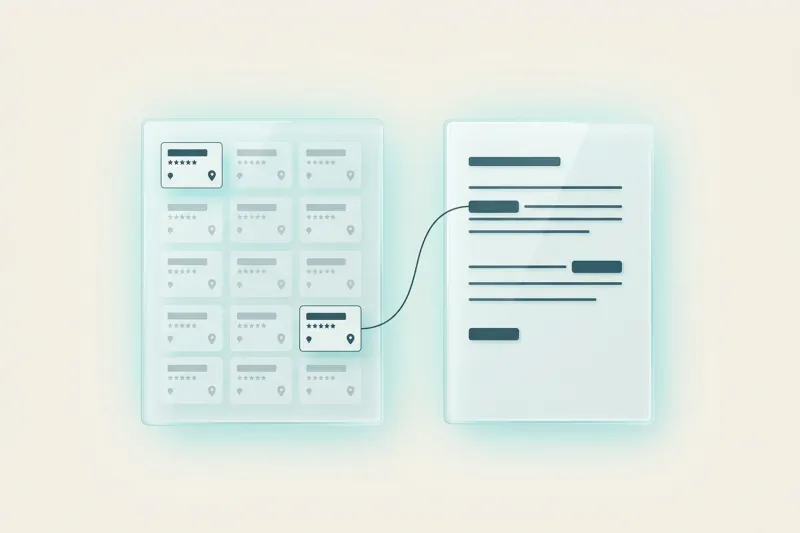
We asked ChatGPT for a dentist in Dallas. Its written answer named five practices and got every one of them right. The listing cards beside that answer mostly pointed at Detroit. A fine city. A day’s drive for a checkup.
Every local answer an assistant gives splits like this. The cards come from your listing data, and the recommendation comes from pages other people wrote. Think menu versus waiter. The menu lists everybody, the waiter names three, and nobody reads the whole menu anymore.
Nearly half of consumers already choose businesses this way. So we went and found out who the waiter listens to in seven industries. It turned out to be a different voice in every one.
TL;DR:
- Every local answer has two layers. A data feed fills the card. Pages other people wrote decide who gets named. Most teams manage the first and never think about the second.
- Being shown is not being recommended. Two thirds of the businesses in the listing panel never make it into the answer itself.
- Every industry has a different gatekeeper. A city magazine names dentists. Lifestyle guides name med spas. Auto repair has nobody at all, which is an opening.
- The engine matters more than the industry. Gemini leans on your own website. ChatGPT reads what other people say about you. They agree 8% of the time.
- Nothing here holds still. Reddit went from feeding two of every five ChatGPT local citations to none in under a month. Check twice or not at all.
What are the two layers of a local AI answer?
Ask an assistant for a dentist and you get two things that look like one thing. There is a panel of business cards carrying names, addresses, hours and star ratings, and beside it a paragraph of prose that quietly does all of the actual recommending. The card is assembled by a database. The recommendation is written by whoever happened to be interesting on the internet that day.
Different suppliers build those two halves. The card comes from a licensed business-data feed. Whatever pages the assistant retrieved while answering supply the prose, and the prose decides who gets named at all. We covered how that split works in how local businesses rank higher in ChatGPT recommendations, and the suppliers behind the card sit in the Apple Maps and Bing Places analysis.
“I just moved here and need a dentist. Who should I go to?”
- Practice A · 4.9 ★
- Practice B · 4.4 ★ never named
- Practice C · 234 reviews never named
- Practice D · 4.7 ★
- Practice E · 5.0 ★ never named
- Practice F · 949 reviews never named
- Practice A — long-established, strong patient reviews
- Practice D — a neighborhood favorite
- Practice X — highly regarded no card anywhere
In our seven-industry count, two of three businesses shown in the panel were never named, and one in five named businesses had no card at all.
Who supplies that second layer outside restaurants had never been mapped, so we went and looked.
Why a perfect listing cannot get you named
Because the sentence never reads the listing.
When we compared who got a card against who got named across seven industries, the two lists barely knew each other. Two of every three businesses shown in the panel were never mentioned in the answer, displayed like dishes the waiter walks straight past. And some of the answer’s warmest recommendations had no card anywhere, arriving instead from pages the panel has never heard of.
“I have managed to get them 1,200+ Google reviews at 4.8 stars, page 1 for every term that matters, and consistent citations across all major directories… Ran some tests and asked Chat to about my restaurant and nothing, it was not recommend at all. The place it keeps recommending has been open 2 years, weaker reviews, but from what I can tell they have a lot of food blog coverage and a few reddit threads about them.”
A reply in that thread put the diagnosis in one line: the business has strong structured data and thin unstructured coverage. In plainer words, a spotless CV and nobody who will vouch for you. Reviews, citations and rankings are all CV. The sentence is written from the references.
Who owns the naming layer in your industry?
We expected to find one gatekeeper and found seven, none of whom have heard of each other. Every industry ran its recommendations through a different kind of page, usually a kind that does not exist in the industry next door.
| Industry | Market tested | What the answer read to decide who to name |
|---|---|---|
| Dental | Dallas | A city magazine’s annual “Best Dentists” list, plus review-platform directory pages |
| Med spa | Miami | Two local lifestyle guides running “Best Med Spas in Miami 2026” roundups |
| Gym | Chicago | A local city guide, plus the city parks department’s own facilities page |
| Veterinary | Dallas | Pet-category directories publishing “top rated in Dallas” roundups |
| Home services | Atlanta | Two national service directories and a niche site that ranks firms by AI mentions |
| Auto repair | Phoenix | A vehicle-history site, and one shop’s own reviews page |
| Physical therapy | Chicago | Hospital health libraries and a clinical provider’s own location page |
Read down that column and the strategy writes itself differently in every row. For dental groups, one peer-voted magazine list carries real weight and comes with a nomination deadline. Med spas answer to the city lifestyle guides, which take pitches and refresh every year. In physical therapy the gatekeepers are hospitals, and you cannot charm a hospital, so being the clinic a health system already references is worth more than any campaign you could run.
Auto repair produced the strangest result: nobody owns its naming layer. No magazine, no award list, barely a roundup. With no one holding the microphone, the assistant reached for whatever credible page it could find, and its strongest endorsement leaned on a single shop’s own reviews page. An empty layer is an invitation, because the first credible page in the market gets read.
Nor is that emptiness a quirk of our sample, because veterinary has no consumer editorial layer either, and neither do optical, childcare or pharmacy. Dental and aesthetic medicine sit at the other end with peer-voted lists and physician registries that have run for decades.
The table says who the gatekeeper is. What to do about each one differs too, so here is the same map with the operational half attached.
A peer-nominated city magazine list
- What the answer read
- The city magazine’s annual “Best Dentists” list, plus review-platform directory pages. The practice named first held 18 reviews.
- Your first move
- Get on the peer-nomination ballot. Licensed local peers vote; public votes and payment are excluded.
- The calendar
- Nominations close around late April for late-summer publication. Miss the window and the door shuts for a year.
City lifestyle guides
- What the answer read
- Two local guides running “Best Med Spas in Miami 2026” roundups. A clinic with one review got named; one with 949 did not.
- Your first move
- Pitch the city guides that already run the roundup. They refresh yearly and take angles, not ads.
- The calendar
- Rolling, tied to each guide’s annual refresh. Find last year’s byline and write to that editor.
City guides and public directories
- What the answer read
- A local city guide’s “Best Gyms” page, plus the parks department’s own facilities directory.
- Your first move
- Get into the city guide’s roundup, and check the public-sector pages your city already publishes.
- The calendar
- Guide roundups refresh annually. Public directories update whenever you ask.
Pet-category directories
- What the answer read
- Pet-care directories publishing “top rated in Dallas” roundups. No consumer editorial layer exists in this vertical.
- Your first move
- Claim and complete the pet-care directories. Accreditation registries are the one earned badge that travels.
- The calendar
- None. Directory completeness is the whole game, and it compounds quietly.
National service directories
- What the answer read
- Two national service directories and a niche site that ranks firms by their AI mentions. No editorial layer.
- Your first move
- Complete the big service-directory profiles, then check whether a niche AI-rankings site covers your metro.
- The calendar
- None. The directories re-rank continuously on reviews and responsiveness.
Nobody, and that is the opening
- What the answer read
- A vehicle-history site, and one shop’s own reviews page, which earned the answer’s strongest endorsement.
- Your first move
- Publish the proof page yourself: reviews, certifications, specialties, in plain text. In an empty layer, your site is the layer.
- The calendar
- None. First credible page in the market tends to get read.
Health systems
- What the answer read
- Hospital health libraries and a clinical provider’s own location page. Institutions, not media.
- Your first move
- Be the provider a health system references. Structured clinical service pages beat any campaign here.
- The calendar
- None you control. Institutional references accrue with clinical relationships.
The engine matters more than the industry
Everything above describes ChatGPT. Run the same questions through Gemini and the ground moves under your feet.
Steady Demand ran the largest independent study of local AI citations to date and found Gemini sends nearly 60% of its local citations to the business’s own website. Directories, review sites and forums combined get less, which means the very behavior that barely registers on ChatGPT turns out to be Gemini’s main move.
One number in that table deserves a meeting rather than a footnote: the two engines cite the same sources for the same question 8% of the time. “Are we visible in AI” has the same problem as “are we famous in Europe.” It depends entirely on which country you land in, and the countries do not read each other’s newspapers. Fractl found the same fragmentation from the brand side, with most brands surfacing in exactly one of the three models it tested.
Neither position holds still. Ask the identical question twice and the sources overlap less than half the time. Ben Fisher of Steady Demand calls the wobble grounding drift. The old Google local pack repeats its top listing nine times in ten. Our own ChatGPT question pairs wobbled just the same way. Anybody who checked their visibility once and wrote the result down recorded the weather.
A naming layer can vanish in four days
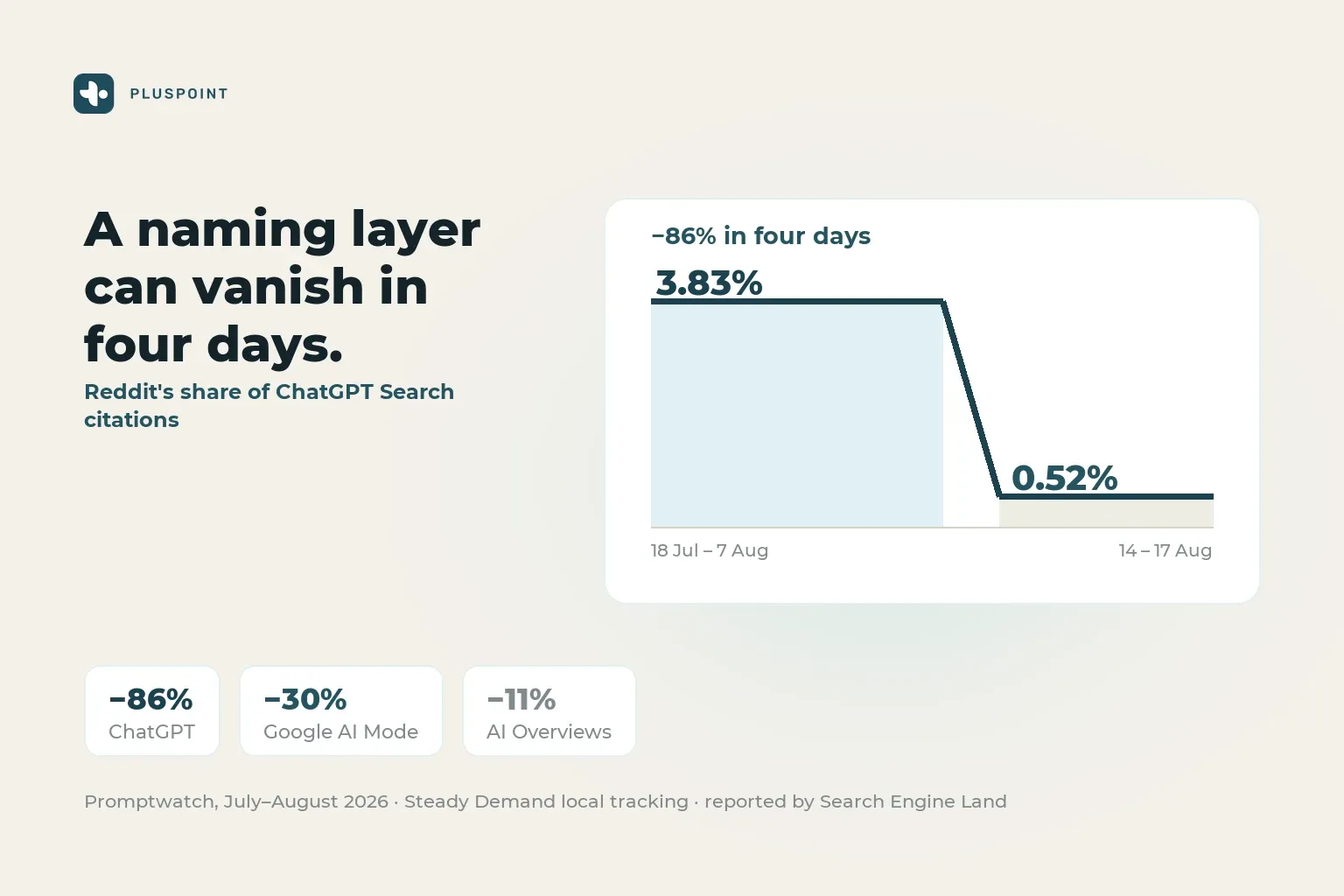
The clearest proof that the naming layer is rented ground arrived by accident, in the middle of August.
For weeks Reddit had been one of ChatGPT’s favorite local sources. It fed two of every five local citations. Then its share fell 86% in four days. No announcement. No changelog. Promptwatch caught it first and the trade press confirmed it. Google’s engines barely flinched over the same window, while ChatGPT simply changed its mind about an entire class of pages and changed it almost completely.
The reported mechanism is a change in how ChatGPT runs its follow-up searches. Search Engine Journal notes even that is only partly explained. Worth remembering before you build on it.
Our own data got caught in it too. The diner study had measured Reddit in roughly a fifth of ChatGPT answers, four days before the drop began. That figure was accurate on the day we took it and a museum piece two weeks later. Which is the real lesson, and it is bigger than Reddit: anything you build on one engine’s retrieval habits is a tenancy rather than an asset, and the rent can change without notice, without negotiation and without the landlord ever telling you why.
What changes when you run forty locations
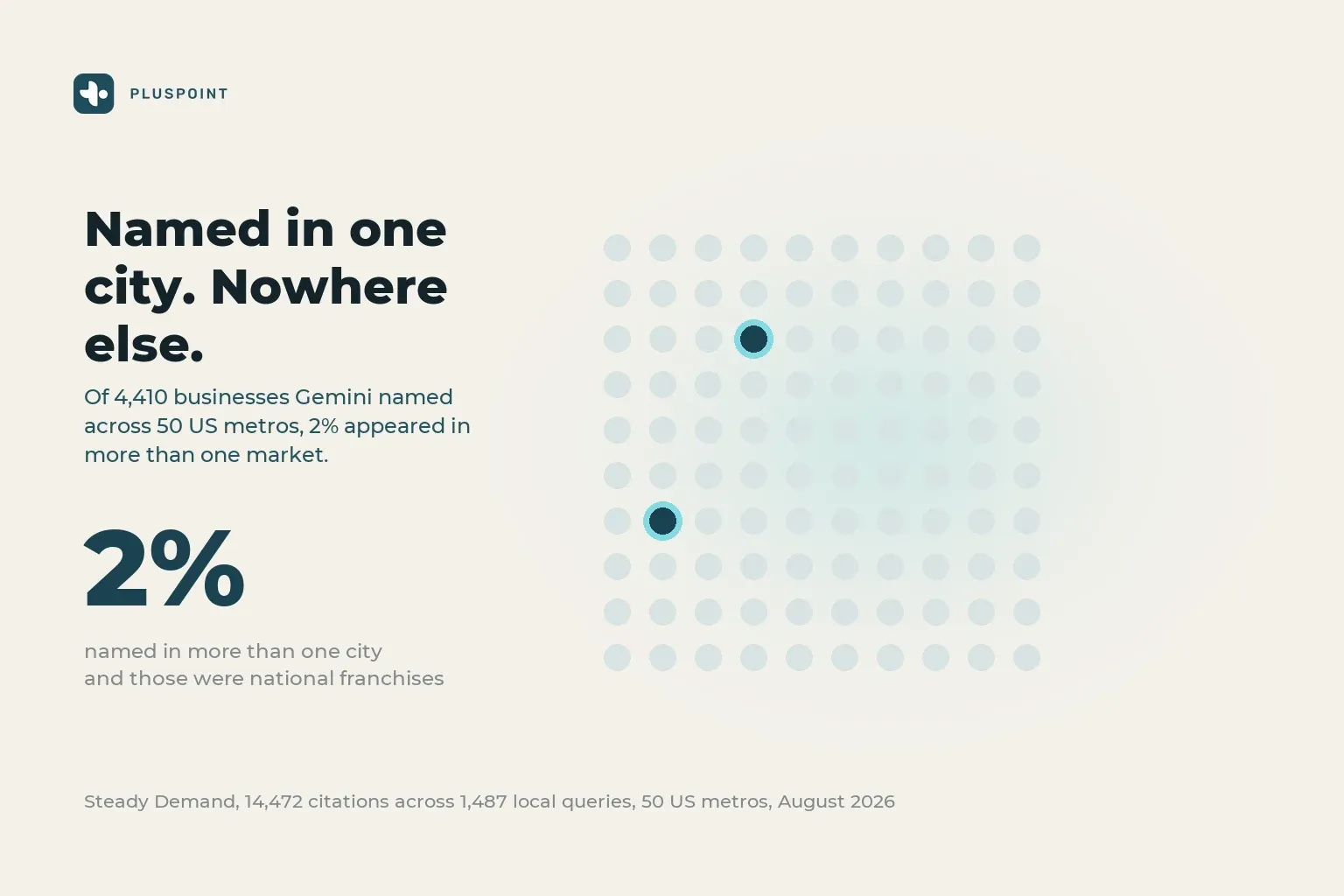
Every finding above multiplies, and multi-location teams feel the multiplication long before they can name it.
The naming layer is more stubbornly geographic than anyone plans for. Of the thousands of businesses Gemini named across fifty metros, 2% appeared in more than one city, and those few were national franchises. Everyone else existed in exactly one market and nowhere else at all.
A Dallas magazine names Dallas dentists and a Miami guide names Miami med spas. Neither cares what happens in Houston or Tampa. Those markets have their own gatekeepers with their own deadlines and their own idea of who matters. So forty locations is not one visibility problem. It is forty separate ones running in parallel, which makes the job whack-a-mole where every mole lives in a different city and reads a different magazine.
That is why single-location advice reads as useless to a regional operator. “Get featured in a local roundup” is a Tuesday afternoon for one restaurant. For a forty-location dental group it is forty relationships in thirty-one media markets, tracked by someone.
The practical consequence is that this becomes an operations problem rather than a campaign. Somebody has to hold a per-market record of who gets named and which pages produced the naming, and just as usefully a record of which markets have no naming layer worth chasing at all, because those are the cheap ones to enter. Pluspoint’s customers usually hit this the moment their listing data is finally clean everywhere and the recommendations still do not arrive. The listing work was real, and it finished the wrong half. Our guide to managing Google Business Profiles at scale covers that first half properly. This is the second one.
How do you tell which layer is failing you?
An afternoon of honest asking separates the two failure modes, and they need opposite budgets.
Write five questions a real customer would type about one location. Use their words and leave your brand out of it, because naming yourself plants the answer. Run each question twice on ChatGPT and twice on Gemini, because a single run measures nothing but noise and the two engines do not share opinions. For every answer note just two things: did your business appear in the card panel and did the written answer name you. A wrong card is a typo and typos are cheap to fix. Never being named is anonymity, and you cannot proofread your way out of anonymity.
Then ask the assistant one question more:
Which specific web pages did you use to decide which businesses to recommend in that answer? List the URLs and what each one contributed.
What comes back is your market’s actual gatekeeper list, which turns a vague ambition into a short outreach plan you could start working through on Monday. Run the same five questions on your weakest market before your strongest, then log what you found:
Which layer is failing you?
Answer for one location in one market, using a customer-voice question you ran twice.
Answer all three to get a diagnosis.
“It’s not just whether you get named, it’s whether what it says about you is correct. The failure mode that quietly costs money is being recommended and then handed a phone number that’s been disconnected for two years, or hours from before you changed them. The customer never calls and you never find out — there’s no dashboard for it.”
Four routes into the naming layer
Once you know which pages name businesses in your category and city, the work is getting onto them. Four routes exist, and they price very differently.

Earned local media. The city magazine list, the lifestyle guide roundup, the local newspaper’s annual awards. Slowest and cheapest and the most durable of the four. These pages rank for years and get re-cited every time somebody asks.
They also run on calendars, which is the part teams miss. D Magazine’s Best Dentists is peer-voted and free to enter. It closes around the end of April and publishes in late summer. Miss the window and you wait a year. Washingtonian surveys local practitioners, closes in May and publishes in November. Boston Magazine runs its list through a physician-led research process where doctors cannot pay to appear. Find the deadline before you find the angle.
Category directories and aggregators. The pet-care roundups, the service directories, the vehicle-history profiles. Usually a free profile plus a paid upgrade. These are the sensible shoes of AI visibility: nobody photographs them and everybody needs them. In two of the seven industries we tested they were the entire naming layer.
Forums and community threads. Earned only, and the clearest illustration of how fast this ground moves. Reddit remains Gemini’s second-favorite local source, ahead of the whole service-directory category put together, while on ChatGPT it fell to roughly nothing in August. Same source and same month with opposite outcomes on two engines. That is the whole argument against betting the plan on either one.
Paid placement. Where no independent roundup covers your category in a market, you can create a page rather than wait for one. PRNEWS.IO runs a marketplace of more than a hundred thousand outlets in 175 countries and lets you filter them by city. That filter is the point. The naming layer is local, so the placement needs to be too. Placements turn around in about two days and start at under six dollars.
Know what that route buys before you budget it. Muck Rack examined 25 million links the engines cited. Earned coverage supplied 84% of them. Paid and advertorial content supplied 0.3%. The same study found press releases surface far more often in trend answers than in best-of lists, which is a useful distinction rather than a discouraging one: distribution earns its keep on “what is happening in this category” questions, while the shortlist questions this article is about run on the earned side.
So use paid placement to establish presence in markets where the earned route has nothing to aim at yet. It gets you into the room. The toast, somebody else has to raise.
What the standard advice gets wrong
”Set up Bing Places, because ChatGPT runs on Bing”
Still the most repeated instruction in local AI advice, and it describes a doorbell wired to nothing. Bing Places publishes no public per-business page for a model to read. In more than two hundred recorded answers, not one cited Bing or Microsoft as a source.
Do not overcorrect, though. Bing’s web index is a separate thing from Bing Places, and it still matters for what an assistant can find. Claim the profile, then stop expecting it to do work it cannot do.
”You need 150 reviews before AI will recommend you”
This number circulates with no study attached, and the measurements run straight through it. In Miami the assistant named a clinic holding one review while a clinic with 949 sat in the panel unmentioned.
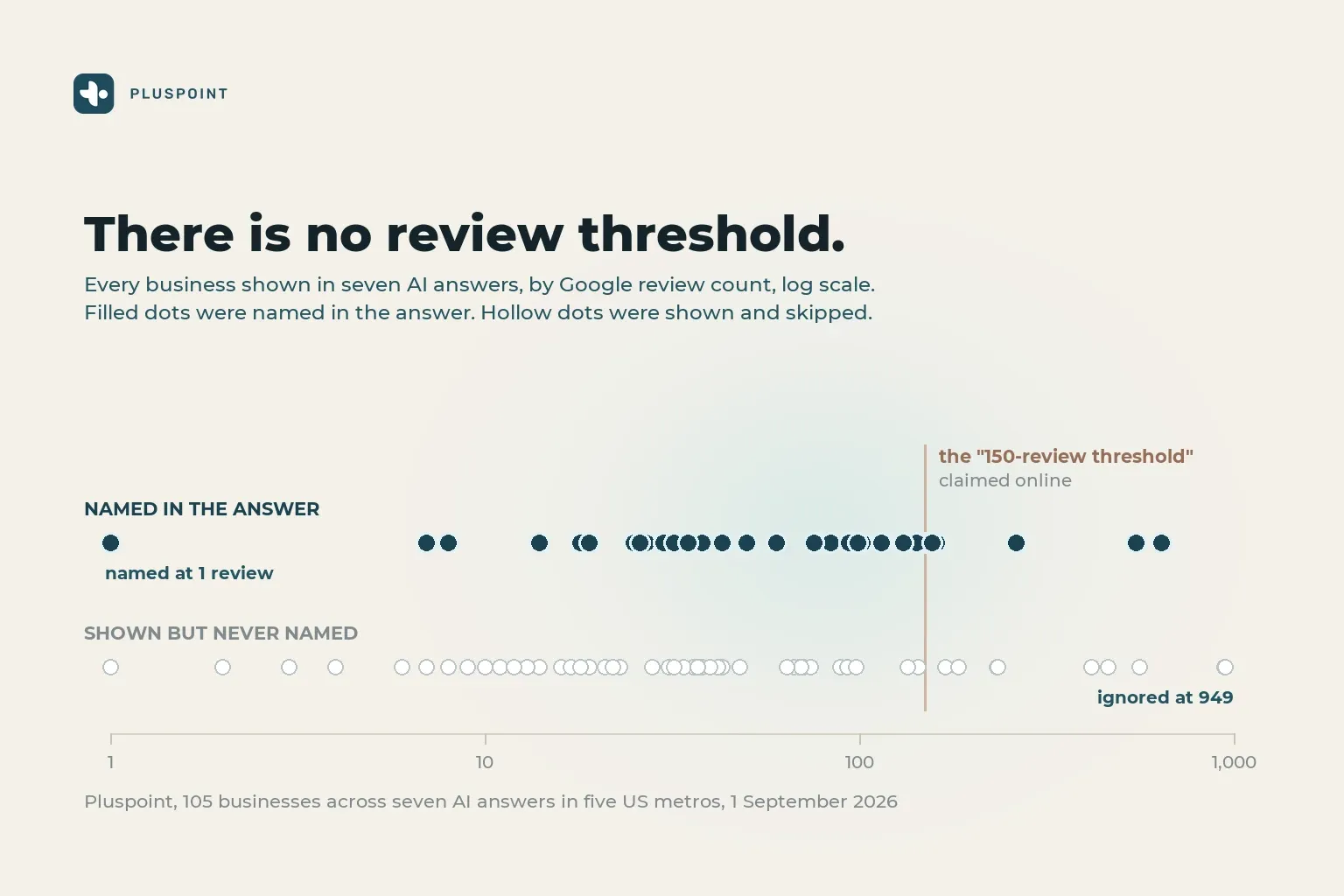
The bigger samples agree, and Gemini’s picks actually average slightly lower star ratings than the field around them. Reviews work like a fire code: below some minimum the room does not open, but nobody ever chose a restaurant for its sprinklers, and past the floor more of them stop buying you anything.
”Rank on Google and the AI will follow”
Partly true on Gemini, close to false on ChatGPT. An agency owner who ran 30 customer-voice searches across ten cities reported on Reddit that in about a third of them the assistant recommended a business sitting on page two of Google. Their conclusion matched ours: “Review count mattered way less than I expected. What mattered was being mentioned in multiple places.”
Rankings remain worth having. They are simply a different sport, and winning the 100 meters does not seed you at Wimbledon. That is why teams with excellent rankings keep getting blindsided. The same disconnect shows up in what customers are actually asking for, which we unpacked in what “near me” really asks for.
Method and limits
We asked seven customer questions in seven industries across five US metros on the first of September, with live web search on and no brand or platform named anywhere in the asking. The industry map shows which kind of page decided the naming in one market on one day, so read it as a map rather than a census. Load-bearing numbers come from larger samples: our own restaurant study and Steady Demand’s fifty-metro data. And everything here moves. Our own Reddit figure aged from accurate to historical inside two weeks, which is the finding as much as the caveat.
Frequently asked questions
What is the naming layer in AI search?
The naming layer is the set of pages an AI assistant reads to decide which businesses to name in a local recommendation. It sits apart from the listing data that fills the card beside the answer. In most industries it is roundups, award lists, category directories and forum threads written by other people.
How do I get my business named in AI recommendations?
Find the pages that already name businesses in your category and city, then get onto them. That usually means a city magazine list, a local guide roundup, a category directory or a forum thread. Publishing more on your own site moves ChatGPT very little, though it matters more on Gemini.
Why doesn't ChatGPT recommend my business when I rank number one on Google?
Because the two systems read different things. Google ranks pages. An assistant assembles a shortlist from what it retrieves at the moment of the question, and for local recommendations that retrieval skews toward editorial roundups and community discussion rather than your rankings or review count.
How long does it take to get named in AI answers?
Days for a new page to be retrievable, months for reliable naming. Assistants search live, so fresh coverage can surface almost immediately. Consistent naming depends on several independent sources agreeing about you, and earned lists often run on annual cycles, so plan in quarters.
Does my Google Business Profile affect AI recommendations?
It affects one half of the answer. Profile data keeps the card beside the answer accurate, and it carries more weight on Gemini than on ChatGPT. Across 210 ChatGPT answers we recorded, none cited a Google, Bing, Apple or Yelp page as the source for who to name.
How many reviews do I need before AI will recommend me?
There is no threshold, despite the numbers circulating. Across 105 businesses in our measurement, an assistant named a clinic holding one review while a clinic with 949 sat unnamed. Reviews work as a floor for credibility rather than as a dial you can turn.
Do ChatGPT and Gemini recommend the same businesses?
Rarely. Steady Demand ran 1,487 local queries through both and found they cited the same domains 8% of the time and recommended the same top business 4.2% of the time. Treat them as two separate positions, because a win on one says little about the other.
Can I pay to get my business named in an AI answer?
You can pay to create a page an engine can retrieve, not to be recommended. Muck Rack analyzed over 25 million links cited by ChatGPT, Claude and Gemini and found earned media supplied 84% of citations while paid and advertorial content supplied 0.3%.
Do I need to do this separately for every location?
Yes, and that is the hardest part of multi-location AI visibility. The gatekeepers are city-scoped. Of 4,410 businesses Gemini named across 50 metros, it named 2% in more than one city, and those were national franchises. Forty locations means forty separate naming layers.
How do I check whether AI names my business?
Ask a customer-voice question that never mentions your brand, because naming yourself plants the answer. Ask it twice, on more than one engine. Then ask the assistant to list its sources. Repeat per market, since the deciding pages are usually local rather than national.