How Real Estate Brokerages Get Recommended by ChatGPT: A Study of 500 Answers Across 50 US Cities
ChatGPT often names big brokerage brands as the best real estate companies, and rarely as the ones with the best reviews. Being named for reviews takes one office with about 100 reviews in each city.

Illustration with invented numbers: an office and its four agents have 40 Google reviews each, all under the bar of 100 reviews at 4.8, and the AI answer names another brokerage, not yours. ChatGPT quotes the office's profile, so the company counts as 40, not 200. Then each agent asks the next client for the office's review first: the office reaches 104 reviews, the agents keep their 40, and the answer names your brokerage too.
Read on to see how to clear the bar“One of my agents got referred through chatgpt,” someone who manages real estate agents wrote on Reddit. “They have no idea what causes it.”
An owner of a multi-office brokerage can end up in the same spot. A lead arrives from ChatGPT, and nobody knows why, a bit like winning a raffle you don’t remember entering. So we asked ChatGPT what buyers and sellers ask, in the 50 largest US cities, and checked the companies it named on Google Maps.
It turns out a well-known name is only half of it. The other half is reviews. A big brokerage often has plenty, but split between its offices and agents, and we never saw ChatGPT add them up. Not once. By that arithmetic, an office and its four agents with 40 reviews each make 40 + 40 + 40 + 40 + 40 = 40. It would fail third grade, and 40 is still the number a buyer sees.
In this article, you’ll see who ChatGPT recommends, where multi-office brokerages lose AI visibility, and what to do in each city. First, the short version.
TL;DR: How real estate brokerages get recommended by ChatGPT
- A strong brand is not enough to be named for reviews. Big brands took 43% of the names when buyers asked ChatGPT for the best real estate companies, and 5% when they asked who has the best reviews.
- Being named for reviews takes one office with a strong profile in each city. Almost every company named for reviews was quoted with 100 or more at 4.8 stars. A big brokerage often has that many, but split between offices and agents, and we never saw ChatGPT add them up.
- Agents collect the praise, and the office is left with the complaints. We call it reputation cannibalization. At franchise companies, offices hold about half of the reviews and 91% of the one- and two-star ones.
- One check tells you almost nothing, so track a share. Ask for the best companies twice and 39% of the names change. Ask every month, and count how often your company comes up.
Who does ChatGPT name as the best real estate companies? Big brands, but rarely when buyers ask about reviews
It depends on what the buyer asks. Ask for the best real estate companies in a city, and ChatGPT leans on the big brands and backs them with sales rankings, but ask which brokerage has the best reviews, and it names independent brokerages and teams instead.
Both questions come from people who are about to choose a company: a seller comparing listing companies, or a buyer who has heard a bad story about an agent. Here is how the two answers look in one city, with invented company names:
Asked for the best companies
What are the best real estate companies in Denver?
-
Crestline Realty Franchise brand
No. 1 by sales volume
-
Meridian Homes Group National brand
Largest agent network in the metro
-
Harper & Lane Realty Independent
No. 3 by closed sides
-
Summit Home Team Team
5.0 stars, 640 reviews
Franchise and national brands: 43% of the names
Asked for the companies with the best reviews
Which real estate brokerage in Denver has the best reviews?
-
Bluebird Properties Independent
4.9 stars, 1,280 reviews
-
Summit Home Team Team
5.0 stars, 640 reviews
-
Alder & Finch Real Estate Independent
4.9 stars, 520 reviews
-
No franchise or national brand named here
Franchise and national brands: 5% of the names
The names are invented. The split is real, and we saw it in city after city. For a brokerage with several offices, it means the brand reaches one kind of buyer. The buyer who asks about reviews rarely hears its name. A company can have its logo on the stadium and still go unmentioned when someone asks who treats clients best.
Some companies do get named in both answers, and they are the ones to copy, shamelessly. Most of them have a single office, with about 250 Google reviews on its profile.
What to do: Find out which ChatGPT answer leaves you out
Ask ChatGPT both questions about every city where you have an office. Missing from the best companies? Report your sales to RealTrends and state them on your homepage. Missing from the reviews answer? Pick the office closest to the bar in that city, and have its agents ask every client for the office’s review first.
Illustration with invented data: a table marks, city by city, whether the company is named in each of the two answers.
Do Google reviews help a brokerage get recommended by ChatGPT? Yes, from about 100 reviews on one office’s profile
Yes, Google reviews help when the buyer asks about reviews. And there is a level to reach: about 100 reviews at 4.8 stars. On one profile. Almost every company ChatGPT named for its reviews was quoted above it, so let’s call it the bar.
A hundred reviews isn’t much for a company. A brokerage with dozens of agents can close that many sales in a season. The catch is that we never saw ChatGPT add up reviews from a company’s offices and agents. So the hundred need to sit on one profile. A brokerage can have several hundred reviews in total and still be below the bar at every office. It’s like collecting frequent-flyer miles on five different airlines: plenty of flying, no status anywhere.
Is a hundred reviews enough? It gets an office in the door. More is better. Among the 20 real estate profiles Google Maps shows first in each city, the ones with more reviews were named far more often:
With fewer than 50 reviews, almost never. With 200 or more, about half the time. So treat the bar as the entry ticket and keep going. The good seats cost more.
Stars count too: among profiles that had the reviews but not the 4.8 rating, ChatGPT named almost none. A pile of reviews at a lower rating is only a louder way of being average.
Getting to the bar takes one request at every closing. Pluspoint, a reputation platform for businesses with several locations, handles this for real estate offices.
What to do: Get one office in each city to 100 reviews at 4.8 stars
Start with the office closest to the bar. On closing day, have its agents text each client the office’s Google review link before their own, and reply to every review. Move on to the next office once this one is over the bar.
Illustration with invented data: an office's review count climbs from 64 to 100 and clears the bar.
Why do offices have fewer reviews and lower ratings than their agents? Reputation cannibalization by their own agents
Because of reputation cannibalization. A brokerage’s agents earn its reputation, and review by review they carry it to their own profiles. The office is left with the complaints.
It starts innocently. Google treats real estate agents as individual practitioners, so every agent can have a profile of their own, and a grateful client often leaves the review there. The agent gets the applause, and the office gets the paperwork. At franchise companies, about half of the Google reviews sit on agents’ profiles, while the independent brokerages that ChatGPT names keep most of theirs on the company’s own profile.
Illustration with real shares and invented reviews. Two profiles side by side. The office's profile is a complaints desk: its display reads now serving 2,837 one- and two-star reviews, the clerk looks worn out, and paperwork piles up; its median rating is 4.5. Next door, the agent's profile collects applause and five-star cards; its median rating is 5.0.
Praise goes to the agent. Complaints go to the office.
See how reviews split between an office and its agents. Each review you send lands by the odds we measured on 204 franchise companies' Google Maps profiles.
91%of one- and two-star reviews land on the office
98%of reviews on agents' profiles are five-star
Your simulationNo reviews yet
Your simulationNo reviews yet
Your turn: leave a review and see where it lands
The numbers are real. The desk and the review lines are not.
The stars split even more sharply than the count, and the office pays for it. Almost every review on an agent’s profile is five-star, while nine out of ten complaints land on the office. So most office profiles fall short of the 4.8 rating that the reviews answer shows.
Why does it happen? Two explanations fit. Agents ask the clients they know are happy. And it is easier to give one star to a company than to a person whose hand you shook.
Either way, the office ends up as the complaints desk, and the company’s own profile shows the worst of its reputation. The more of a company’s reviews sat on its agents, the lower its best office tended to be rated. It makes a strange shop window: the returns are on display, and the bestsellers are next door.
If nobody at head office can open half of those profiles, the guide to managing Google Business Profiles at scale covers who should hold the keys.
Fewer complaints is the other half of the fix. A buyer who waits a day for an answer is halfway to a one-star review. Pluspoint’s AI chatbot answers every office’s chats in seconds, even after closing.
What to do: Find the reviews you already have, and read the bad ones
List every profile that carries your name, with its review count and rating, and pick the office closest to the bar in each city. Then read that office’s one- and two-star reviews and fix what they repeat. That list is your training plan.
Illustration with invented data: two offices and two agents show their review counts against a bar of 100. The office closest to it lights up, its one- and two-star reviews come out, and they turn into a fix list: slow replies and paperwork errors.
Should reviews go to the agent’s Google Business Profile or the office’s? Both, with the office’s profile first
Keep both. Put the office first until it reaches about 100 reviews at 4.8 stars, because each profile does a different job.
An agent’s profile shows up when a buyer asks for an agent, and ChatGPT usually names the agent’s company beside it. The office’s profile is the one that counts when a buyer asks about reviews, because we never saw ChatGPT add the agents’ reviews to it. It pays twice, because offices with many reviews also rate higher: the franchise offices with 100 or more had a median rating of 4.9.
So the rule for every closing is short: the agent asks for the office’s review first, and for their own second. It also protects you when people move on. An agent who leaves can take their profile along, and quite possibly the good stapler. Every review on the office’s profile stays with the company, so the reputation your agents earn stays yours.
Illustration with invented numbers: three agents close deals. When reviews go to each agent's own profile, an agent who moves on takes her 64 reviews with her. When they go to the office's profile, the office keeps all 104 reviews.
Sometimes a team fills the gap. A team keeps all its reviews on one profile, and the count shows. The teams ChatGPT named for reviews were quoted with about ten times as many as their brand’s best office in the same city. So when buyers ask about reviews, your best team stands in for your company, like an understudy who ends up with the lead. You can accept that, or lift one office to the team’s level.
The good news: the reviews for that office mostly exist already. They live at the wrong address. If half of the reviews on agents’ profiles had gone to the office instead, three times as many franchise companies would have an office with a hundred. Old reviews can’t be moved, but you decide where the next ones go.
What to do: At every closing, ask for the office's review first
Have every agent send the client the office’s review link first and ask for their own second. Write it into the closing checklist, then send the same ask to past clients, all of them and with no reward. The office gets to the bar, and its reviews stay when an agent leaves.
Illustration with invented data: a closing sends its first review to the office profile and its second to the agent.
Does ChatGPT recommend the brand or the office? The brand, and at most one of its offices
When a buyer asks for the best companies, ChatGPT gives the company’s name and almost never says which office, so the buyer gets your name and has to find the nearest door alone. It’s like a friend who recommends “that Italian place downtown” and can’t remember the street.
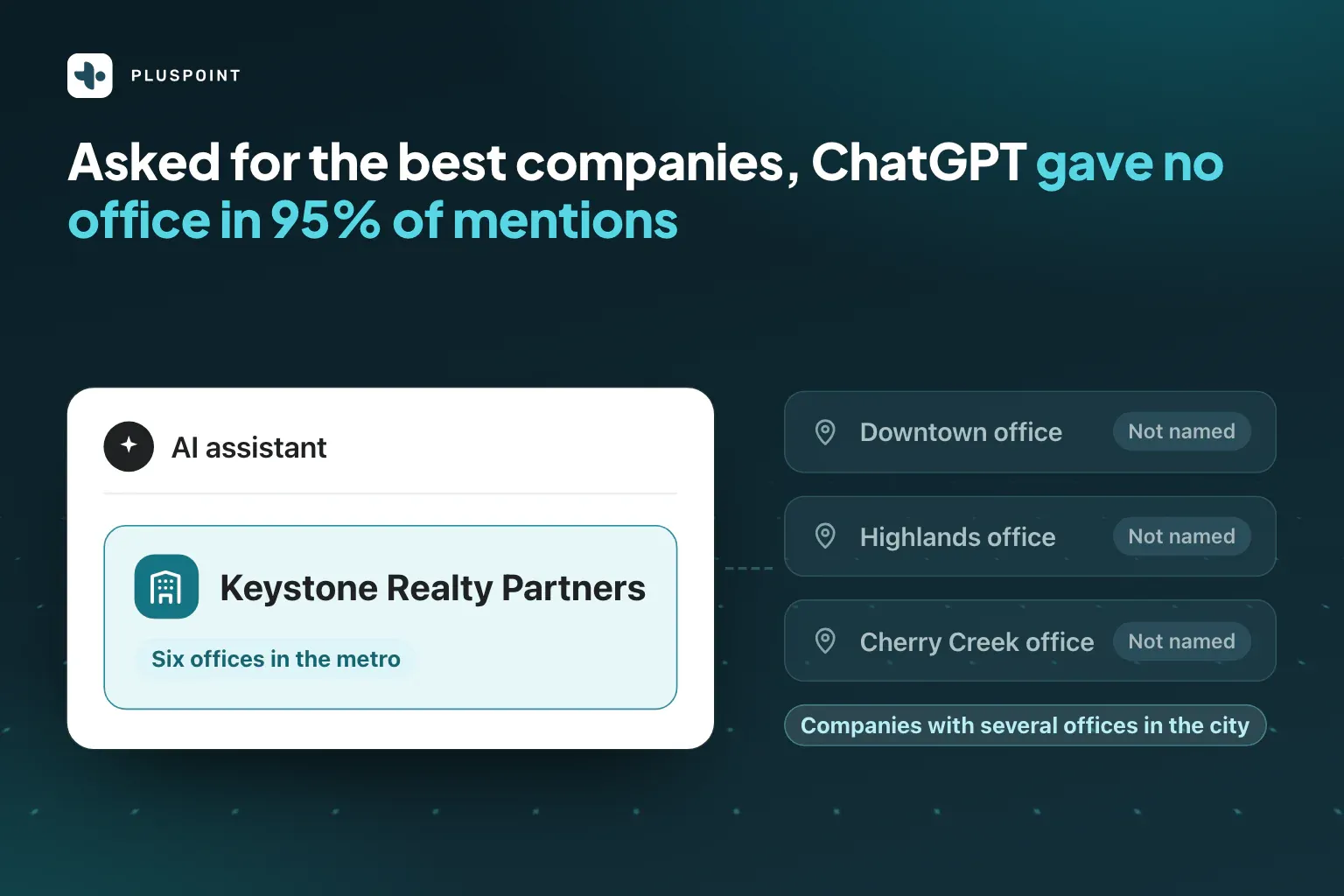
When it does name an office, it names only one, usually the office Google Maps ranks first in that city. ChatGPT can also use the buyer’s own location, and in about half of the answers it asked for a neighborhood or ZIP code. So a buyer across town may be sent to a different office. Any of your offices can end up as the front door.
That is why every office needs a correct listing. To see where one stands today, run it through the free listings audit, which checks an office across more than 200 directories and shows where the name, address or hours disagree.
What to do: Strengthen your top office on Google Maps, and keep every listing correct
Search Google Maps for your brand in each city and send the next reviews to the office that comes first. It is the one ChatGPT most often pointed to. A buyer nearby may be sent to the closest office, so keep each one’s name, address and hours the same in every directory.
Illustration with invented data: an office's name, address and hours are checked against four directories; the one with the wrong hours is corrected, and the listing ends the same everywhere.


Why did ChatGPT recommend my agent and not my company? It usually names your company too
Because the buyer asked for an agent. ChatGPT answered with people. That is still a win for the company, because it named the brokerage behind 83% of the agents and teams it recommended. An agent’s profile works like a yard sign. Their face, your logo.
The companies that came up most often in our answers appeared both ways: as a company, and through their agents and teams. That is most likely what happened to the manager on Reddit: ChatGPT named an agent, and the brokerage’s name came along. The mystery has a boring answer, which is the best kind. The sites it cited most for agents included Zillow, FastExpert and HomeLight.
What to do: Put your brokerage's name on every agent's profile
A recommended agent usually brings your name along, if their profiles say where they work. On Zillow, FastExpert and HomeLight, put your exact company name in the brokerage field: “Jane Miller, Sold Before Lunch Realty”. On Google, the profile name stays the agent’s own, as Google’s rules ask, so name the brokerage in the description and link the profile to the agent’s page on your site.
Illustration with invented data: an agent's sign gains the brokerage's name, and the answer names both.
Where does ChatGPT look before naming a brokerage? Sales rankings, homepages, review sites and listings
For the best companies, ChatGPT looks at sales rankings and at the company’s own homepage. In 54% of those answers it cited a RealTrends ranking of the city’s top real estate companies by sales, and when it cited a brokerage’s own website, the page was usually the homepage.
Both are within your reach. This year the national list of the largest real estate brokerages took 500 closed sides or $350 million in volume. Your homepage only has to be readable by OpenAI’s search crawler, OAI-SearchBot, which reads the text and skips the drone footage. Modesty is wasted here. ChatGPT can’t cite a number you never published.
It cited these kinds of sites:
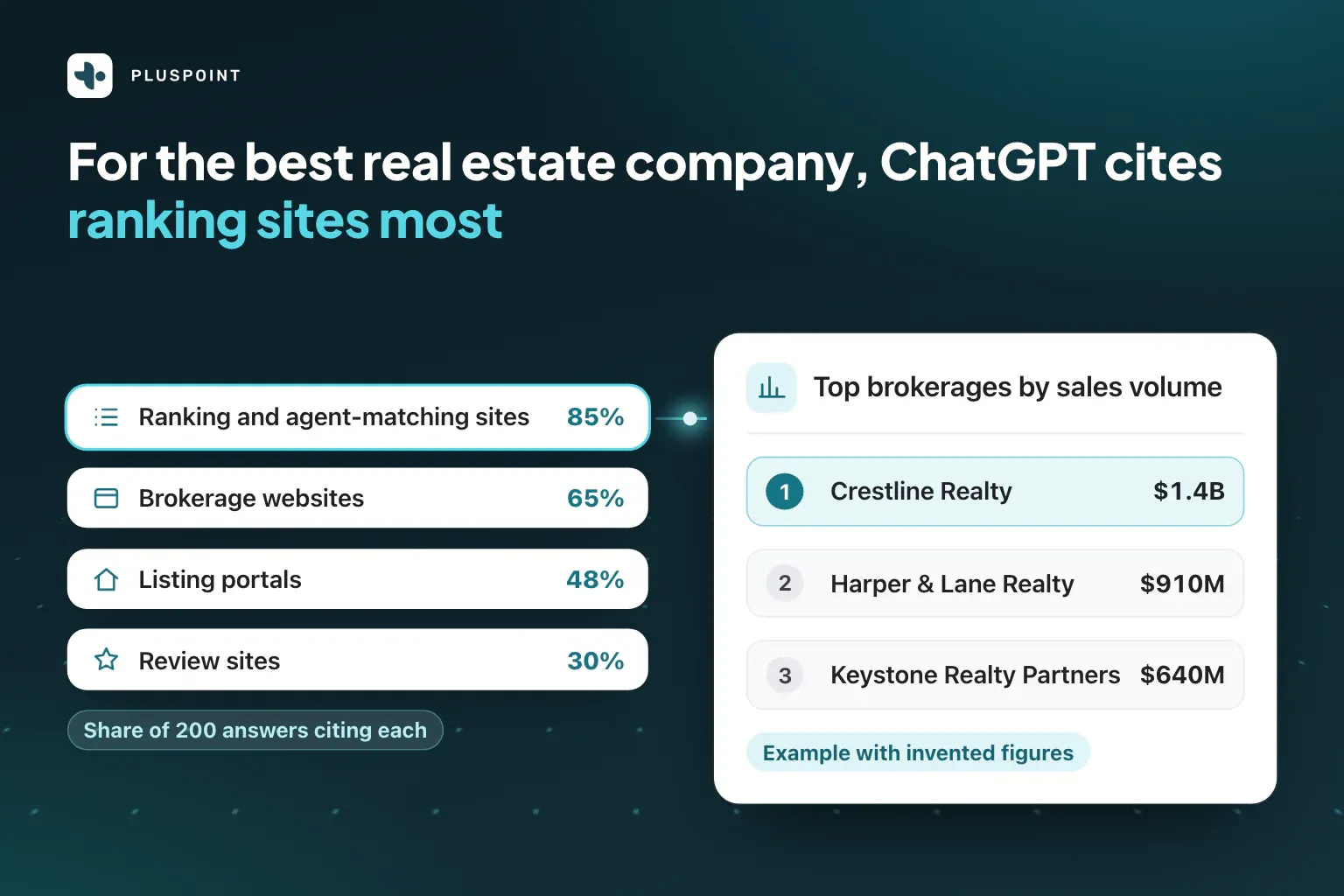
For reviews it goes elsewhere: review directories and Zillow. Sales rankings barely appear. When it said where a review count came from, the source was most often Google.
It reads listings too. In about half of the best-company answers, ChatGPT showed business cards with each company’s address, phone number, rating and review count. A wrong phone number there is a lead that calls someone else. Pluspoint keeps each office’s listing correct on Google and across the directories, so the card shows the right door and the right number.
What to do: Publish your sales numbers where ChatGPT can cite them
Report last year’s sales to RealTrends Verified, which takes submissions from January to early March, and ask your local business journal to list you. State your sales, offices and agents on your homepage as text.
Illustration with invented data: a homepage states sales, offices and agents, and city rank as text.
Why does ChatGPT give a different answer every time? It runs a new search each time
Each answer runs its own web search, and the results move. We asked for the best companies twice. Same city, same question. The second time, 39% of the names had changed.
So one answer is close to a coin toss, and checking once is like looking out of the window and calling it the climate. Restaurants show a similar churn in the restaurant AI visibility study.
One thing did hold steady, and it favors bigger companies: the more offices a company had in a city, the more often ChatGPT named it both times.
Reviews made no such difference: companies with more of them were no more likely to come back. For once in this study, being big helps.
That changes what to measure. “Did ChatGPT name us?” has no stable answer. “How often does it name us?” does.
What to do: Count how often ChatGPT names you each month
Ask the same three questions about every city once a month, twice each. Write down the share of answers that mention your company, a team or an agent of yours. When ChatGPT cites a page you are not on, get listed there.
Illustration with invented data: the share of answers that mention the company rises from 17% to 50% over three months.
What does ChatGPT say about brokerages in your city? Each city gets a different set of companies
Across four best-company answers, ChatGPT named about 14 different companies in a city, and only two of them every time. Two regulars and a dozen passers-by. A brand that is a regular in one city can be a stranger in the next, so look at your own market first. Pick your city to see what kinds of companies ChatGPT named there, which pages it cited, how their Google reviews compare with a typical local listing, and which companies it named most, with what it quoted about them.
What ChatGPT said about real estate companies in your city
Who it named, by kind of company
Who it named when asked for the best companies
1,460 names in 200 answers
Who it named when asked for the companies with the best reviews
468 names in 100 answers
| Best companies | Best reviews | |
|---|---|---|
| Franchise brands | 32% | 4% |
| National brands | 11% | 1% |
| Independent brokerages | 34% | 55% |
| Teams | 14% | 36% |
| Other | 9% | 4% |
Pages it cited
- realtrends.com cited in 68% of answers
- zillow.com cited in 44% of answers
- compass.com cited in 27% of answers
- Sales ranking of brokerages cited
- in 36 of 50 cities
- Business journal list cited
- in 12 of 50 cities
Google reviews of the companies it named
Median number of Google reviewsAsked a second time
61% of 656 names came back
Companies ChatGPT named most
Use them as references: open their Google profiles and websites and compare them with yours.Brands named in the most cities
| Brand | Best companies | Best reviews |
|---|---|---|
| Keller Williams 44 of 50 cities sales figure in 35% of mentions | 115 of 200 | 4 of 100 |
| Compass 29 of 50 cities sales figure in 15% of mentions | 91 of 200 | 2 of 100 |
| Coldwell Banker 28 of 50 cities sales figure in 21% of mentions | 65 of 200 | 0 of 100 |
| RE/MAX 28 of 50 cities sales figure in 38% of mentions | 65 of 200 | 4 of 100 |
| Sotheby's International Realty 26 of 50 cities sales figure in 35% of mentions | 63 of 200 | 1 of 100 |
| Berkshire Hathaway HomeServices 20 of 50 cities sales figure in 27% of mentions | 45 of 200 | 1 of 100 |
| eXp Realty 17 of 50 cities sales figure in 8% of mentions | 21 of 200 | 0 of 100 |
| Redfin 9 of 50 cities sales figure in 7% of mentions | 14 of 200 | 0 of 100 |
| Better Homes and Gardens Real Estate 7 of 50 cities sales figure in 16% of mentions | 19 of 200 | 1 of 100 |
| Engel & Völkers 6 of 50 cities sales figure in 20% of mentions | 9 of 200 | 1 of 100 |
Named in both answers in the same city
- DASH Carolina Real Estate Raleigh, NC quoted at 5.0 from 3,318 reviews
- Kris Lindahl Real Estate Minneapolis, MN quoted at 4.9 from 2,400 reviews
- JBGoodwin REALTORS San Antonio, TX quoted at 5.0 from 1,990 reviews
- The Briley Team Omaha, NE quoted at 4.97 from 1,932 reviews
- Huntington & Ellis Las Vegas, NV quoted at 5.0 from 1,548 reviews
- Nelson Home Group Kansas City, MO quoted at 5.0 from 1,276 reviews
- Houston Properties Team Houston, TX quoted at 5.0 from 1,215 reviews
- Levi Rodgers Real Estate Group San Antonio, TX quoted at 4.9 from 1,180 reviews
- MoJo Real Estate Team Kansas City, MO quoted at 4.98 from 1,163 reviews
- Every Door Real Estate Seattle, WA quoted at 4.9 from 1,120 reviews
For the best companies
For the best reviews
Names as ChatGPT wrote them. The figures are the ones its answers quoted, not our own counts.
See all 50 cities as a table
| City | Franchise brands, share of names | Median Google reviews, named companies | Median Google reviews, Maps top 20 | Sales ranking cited |
|---|---|---|---|---|
| Albuquerque, NM | 36% | 84.5 | 6.5 | Yes |
| Arlington, TX | 29% | 73 | 8 | No |
| Atlanta, GA | 36% | 52.5 | 42.5 | Yes |
| Austin, TX | 35% | 79 (7 matched) | 11.5 | Yes |
| Bakersfield, CA | 22% | 47.5 | 13.5 | Yes |
| Baltimore, MD | 27% | 88 | 9.5 | Yes |
| Boston, MA | 38% | 22 (9 matched) | 35 | Yes |
| Charlotte, NC | 25% | 172 | 9 | Yes |
| Chicago, IL | 19% | 37 (8 matched) | 30.5 | Yes |
| Colorado Springs, CO | 21% | 155 | 29.5 | No |
| Columbus, OH | 34% | 86 | 23.5 | Yes |
| Dallas, TX | 37% | 58 | 59.5 | Yes |
| Denver, CO | 36% | 41.5 | 54.5 | Yes |
| Detroit, MI | 20% | 121 (9 matched) | 16 | No |
| El Paso, TX | 50% | 81 | 12 | Yes |
| Fort Worth, TX | 52% | 70 (8 matched) | 2 | Yes |
| Fresno, CA | 9% | 66 | 27 | No |
| Houston, TX | 4% | 250 (7 matched) | 31.5 | No |
| Indianapolis, IN | 43% | 265 | 8 | Yes |
| Jacksonville, FL | 42% | 51 | 32 | Yes |
| Kansas City, MO | 37% | 214 | 26.5 | Yes |
| Las Vegas, NV | 41% | 183 | 19 | Yes |
| Long Beach, CA | 14% | 81.5 | 3 | No |
| Los Angeles, CA | 31% | 27 (7 matched) | 21 | Yes |
| Louisville, KY | 40% | 85 | 26 | Yes |
| Memphis, TN | 26% | 16 | 15 | No |
| Mesa, AZ | 32% | 118 | 14.5 | No |
| Miami, FL | 30% | 21 | 25 | Yes |
| Milwaukee, WI | 38% | 34 | 3 | Yes |
| Minneapolis, MN | 46% | 42 (9 matched) | 20 | Yes |
| Nashville, TN | 40% | 75.5 | 12.5 | Yes |
| New York, NY | 23% | 30.5 (8 matched) | 13 | Yes |
| Oakland, CA | 9% | 23 (7 matched) | 1.5 | No |
| Oklahoma City, OK | 39% | 63.5 | 9 | Yes |
| Omaha, NE | 39% | 31.5 (8 matched) | 34.5 | Yes |
| Philadelphia, PA | 24% | 38 (7 matched) | 29 | Yes |
| Phoenix, AZ | 41% | 80 | 10.5 | Yes |
| Portland, OR | 33% | 60.5 | 13 | Yes |
| Raleigh, NC | 30% | 402.5 (8 matched) | 21 | Yes |
| Sacramento, CA | 47% | 54 | 17 | Yes |
| San Antonio, TX | 35% | 139 | 1 | Yes |
| San Diego, CA | 41% | 157 | 26 | No |
| San Francisco, CA | 16% | 15 (8 matched) | 50 | Yes |
| San Jose, CA | 29% | 54 | 24.5 | Yes |
| Seattle, WA | 43% | 73 | 3.5 | Yes |
| Tampa, FL | 26% | 139 | 22 | No |
| Tucson, AZ | 32% | 137.5 | 65.5 | No |
| Tulsa, OK | 32% | 96 | 8 | No |
| Virginia Beach, VA | 17% | 204 | 59 | No |
| Washington, DC | 24% | 97.5 | 27.5 | Yes |
Four answers per city on the best-company questions and two on the review question, so small numbers appear as counts. ChatGPT with web search, November 9 and 11, 2026. Google review counts are for the best-matching office in that city.
If a sales ranking was cited in your city, that is the page to be on. The review counts of the named companies show where your market sits, though for the reviews question the bar of 100 reviews at 4.8 stars still applies. Give the companies named for reviews in your city a close look, because they are the ones a buyer will compare you with.
What should a brokerage with several offices do first? Get one office in one city to 100 reviews
Start with one office in one city. Get it to a hundred reviews. A brokerage’s brand and its local reputation are two separate assets, and each needs its own job. The brand job is like filing taxes, company-wide and once a year, getting your sales into the rankings ChatGPT cites, while local reputation is more like mowing the lawn, because it never stays done.
So ask ChatGPT both questions about that city, choose the office closest to the bar, and make its review card. It takes a minute, here or on the Google review QR code generator page:
Hand that card to every client at closing, somewhere between the keys and the champagne, and count your share of answers again next month. The aim is modest. Get the office’s forty up to a hundred. Any local business can use the same approach, as the guide to ranking higher in ChatGPT recommendations shows.
When should a brokerage stop managing reviews by hand? When one person can’t keep up with every office
A brokerage with 50 offices has about 250 pages to keep reviewed, correct and answered: a Google profile for every office, plus its listings on sites like Apple Maps, Bing, Yelp and Facebook. That is more than one person can check in a morning, and it all comes back next week. Nobody became a broker to babysit listings.
Pluspoint is built for a company like that. It asks every client for a review when the deal closes, replies to what they write, and keeps each office’s listing correct. Its leaderboard ranks your offices by rating and reviews, so you see which one is closest to the bar. And through Pluspoint MCP, ChatGPT or Claude can check every office for you and say which one needs attention. Each office is one location, at $29 a location per month, with publishing to the directories as an add-on.
How did we run this ChatGPT real estate study? 500 answers across 50 US cities, and what they can’t show
Pluspoint ran this study on November 9 and 11, 2026, in the 50 largest US cities, using ChatGPT on the web with web search. Every question named the city, and the only location we set was the United States. We asked three questions about companies twice each, 300 answers in all: “What are the best real estate companies in [city]?”, “I’m selling my house in [city]. Which real estate company should I list with?” and “Which real estate brokerage in [city] has the best reviews?” The first two are the best-company questions. We added 200 answers about agents from the same cities, to “Who are the best real estate agents in [city]?” and “I’m buying a home in [city]. Which real estate agent should I hire?” We sorted every company named by type, looked up its listings on Google Maps and compared them with the top 20 Maps results for “real estate agency” in each city.
The limits. This is one assistant over a few days, asked the way a buyer who names the city would ask. A buyer who shares a precise location, or asks for companies nearby without naming a city, may see a different office or a different list. The Maps lookups stop at 20 results and count only profiles that carry the company’s name, so the agents’ share of reviews is a floor. On the reviews question, the counts and ratings are the ones ChatGPT quoted, and about half of them name no platform. The other review figures come from our Google Maps lookups. Three checks rest on a few dozen cases: the office ChatGPT pointed to, the review counts it quoted for companies with several offices, and the teams it named under a brand. The office it pointed to was usually the top one on Google Maps, the most-reviewed and the closest to downtown at once, so we can’t say which of the three decides it. Why complaints land on offices is beyond this data too, because it holds star counts and no review texts. All of it shows who ChatGPT names and what it quotes. It shows links, not causes, and nothing here proves that more reviews will get a company named.
Frequently asked questions
What is AI visibility for a real estate brokerage?
AI visibility is how often AI assistants such as ChatGPT name a company when people ask for a recommendation. For a brokerage it is best measured as a share: out of many asks about your city, in how many answers your company comes up, as a company or through its agents and teams.
How many Google reviews does a brokerage need to be recommended by ChatGPT?
About 100 reviews at 4.8 stars on a single profile, when buyers ask which brokerage has the best reviews. Of the companies ChatGPT named for the best reviews, 93% were quoted with 100 or more. The data shows a link, not a guarantee that 100 reviews gets a company named.
Should real estate agents have their own Google Business Profile?
Yes. Google's guidelines treat each public-facing agent as an individual practitioner with a profile under the agent's own name, and 64% of the agents' Google profiles we could match were profiles of that kind. Keep them, name the brokerage in each profile's description, and have agents ask for the office's review first.
Should a brokerage with multiple locations have a Google Business Profile for each office?
Yes. In the few cases where ChatGPT gave an address for a company with several offices, it named one office, usually the one Google Maps ranks first in that city. Build one office per city to 100 reviews at 4.8 stars, then move to the next, and keep every office's listing correct.
Does ChatGPT use a buyer's location when it recommends a real estate company?
It can. OpenAI says ChatGPT may use an approximate location from the IP address, and a precise one only when the user chooses to share it. Our questions named the city, and ChatGPT searched for that city. A buyer who shares a location, or asks for companies nearby, may be shown a different office.
Does ChatGPT recommend franchise brokerages or independent ones?
Both, for different questions. Franchise and national brands made up 43% of the names when buyers asked for the best real estate companies and 5% when they asked which brokerage has the best reviews. Independent brokerages and teams took 91% of the names on the reviews question.
Does ChatGPT add up the reviews of all my offices?
Not in what we saw. In the 47 cases we could check, the review count ChatGPT quoted for a company with several offices never matched the total of its offices. When the count matched a listing, it was one office's.
What is reputation cannibalization in real estate?
Reputation cannibalization is what happens when a brokerage's agents collect its good reviews on their own Google profiles and the office's profile is left with the complaints. In the franchise companies in this study, offices held about half of the reviews and 91% of the one- and two-star ones.
What is the most successful real estate brokerage, according to ChatGPT?
When asked for the best real estate companies in November 2026, ChatGPT backed its picks with sales rankings such as RealTrends, and the brand it named in the most cities was Keller Williams, in 44 of the 50 largest US cities.
How often should a brokerage check what ChatGPT says about it?
Every month, and more than once each time. When we asked for the best companies twice, 39% of the names changed. Ask the same three questions for each city, count the answers that mention your company, and watch that share over time.