Best Restaurant Reputation Management Software for Chains in 2026
Eight platforms compared on the one thing that actually separates them: which review sources each one can see and answer. Verified G2 data, three published price lists, honest weak spots, and what really happens on the delivery apps.


Eight o’clock, Tuesday night. A burrito from one of your locations is going cold in a stranger’s Honda, and the guest is already typing: two stars, Uber Eats. She will forget it by Thursday. The app will not. And the dashboard you pay four hundred a month for never sees it, because Uber Eats is not on its list.
Restaurant reputation management software is supposed to prevent this: every review, from every location, in one inbox. All eight platforms below do that for Google, and have since about 2019. The hard part is everything else. Buying on Google coverage alone is hiring a night watchman who only checks the lobby.
TL;DR: Choosing reputation software for a restaurant group
- Shortlist on review-source coverage, not the feature grid. Everyone handles Google. Your second and third sources are where they diverge.
- Restaurant-native tools name their delivery sources; enterprise platforms mostly do not. Birdeye, Pluspoint, Momos and Marqii all name DoorDash. Chatmeter, Reputation and Ovation name no delivery app. None of the eight can reply to one.
- Check the list, then check it for Yelp. Birdeye publishes 322 named sites, the longest list here. Yelp is not one of them.
- Read the G2 score and the sample size as one number. SOCi's 4.5 rests on 4,672 reviews. Chatmeter's on 120. Three restaurant-native tools have no G2 profile.
- Three platforms publish a price you can check tonight. Pluspoint from $29 per location, Reputation from $80, Marqii from $90. The other five quote after a demo, where discounts average 9 to 11%.
What actually separates these platforms
Feature grids in this category are close to useless, because everyone ticks everything. Review monitoring, AI replies, sentiment analysis, location dashboards, listings sync: all eight platforms below will claim the lot, roughly the way every dating profile claims hiking. So this list ranks on the questions where the answers genuinely differ:
- Which review sources it can read, named specifically rather than counted.
- Which sources it can reply to from inside the product, a much shorter list for every vendor here.
- What it costs, and whether you can find that out without a sales call.
- Independent evidence, meaning the G2 score and the number of reviews behind it.
- How it handles many locations: per-store dashboards, routing to the person who can actually fix store 41, corporate rollups.
The receipts behind every claim, source lists, reply rights, prices, come after the rankings. First, the eight.
The eight platforms, reviewed one by one
Ranked for a multi-unit restaurant group specifically, against the criteria above. A single-site operator would get a different order, and an enterprise chain with 900 franchised units would get a different one again.
Pluspoint publishes this blog and makes one of the eight below. Every number links to its source, most of them on other vendors’ own pages, so you never have to take our word for anything.
1. Ovation: best for catching problems before they become reviews
G2: no profile · Price: quote only · Reads: Google, Yelp, TripAdvisor, Facebook
Ovation is the narrowest product here, which is why it opens the list rather than tops it. The core is a two-question SMS survey sent after the visit, which the company claims a 97% completion rate on. The logic is timing: a guest who texts you about the cold burrito has not yet told Uber Eats. Around that sit AI recovery messages, templated offers and heat maps of where the recoverable complaints cluster.
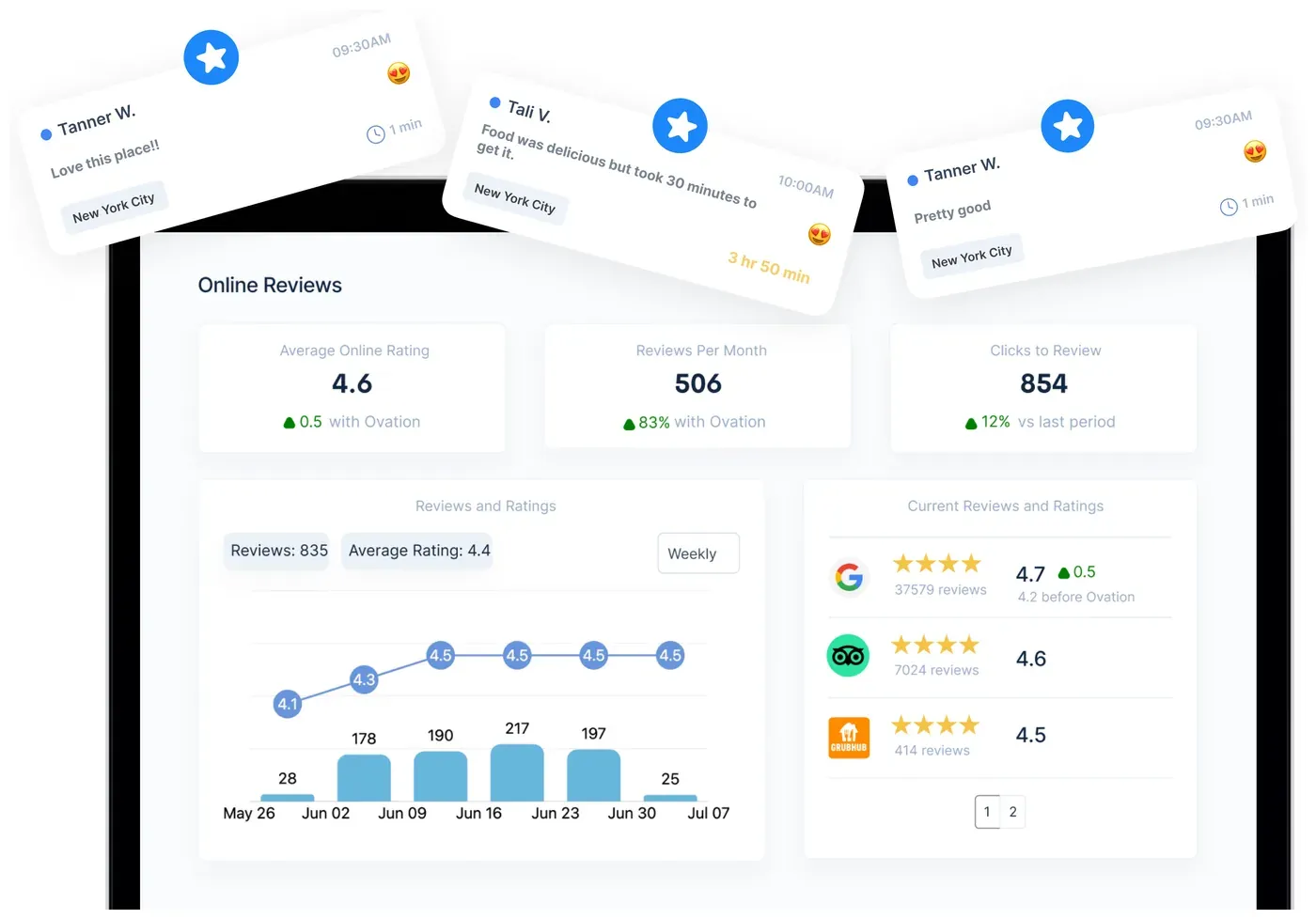
It connects to more than 50 POS, ordering and loyalty systems, which is the plumbing that makes the timing work. Dave’s Hot Chicken, MOOYAH, Friendly’s and Dog Haus run it across multiple units. A company-published case claims review volume up 87% and the rating up half a star, which is a vendor number and reads like one.
One number the deck will not volunteer: the Android app your store teams answer feedback on sits at 3.1 stars from 27 ratings, with reviews describing freezes and vanishing drafts. Tiny sample. Still, for a product built on the minutes after a visit, the app in the shift manager’s pocket is not a detail.
Where it falls short. Quote-only pricing, coverage limited to the classic four with no delivery app, and no G2 profile to check the pitch against. A delivery-heavy group needs a second tool; everyone else is buying on references.
Buy it if your problem is that bad reviews arrive as a surprise, and something else already handles the public side.
2. Pluspoint: best value for mid-market chains (10 to 100 locations)
G2: 4.9 across 70 reviews · Price: $29 per location per month, published · Replies post back: Google, iFood
Pluspoint publishes what it reads, which in this category is rarer than it should be, and the restaurant-relevant list is the widest here. The delivery row shows why it sits this high:
| Delivery app | Pluspoint | Birdeye | Momos | Marqii | SOCi |
|---|---|---|---|---|---|
| DoorDash | Reads | Reads | Reads | Reads | Not documented |
| Grubhub | Reads | Reads | Reads | Reads | Reads |
| Uber Eats | Reads | Reads | Reads | Reads | Reads |
| Deliveroo | Reads | Reads | Not documented | Not documented | Not documented |
| TheFork | Reads | Not documented | Not documented | Not documented | Not documented |
| iFood | Reads and replies | Not documented | Not documented | Not documented | Not documented |
| Grab, FoodPanda | Not documented | Not documented | Reads | Not documented | Not documented |
Chatmeter, Reputation and Ovation document no delivery app at all.
It reads all three US delivery apps, which only three others here manage, and does it at the lowest published price on the page. The sources beyond the border, TheFork, Deliveroo, iFood, come along in the same subscription: ignorable until the day an expansion deal makes them the most useful line on this table.
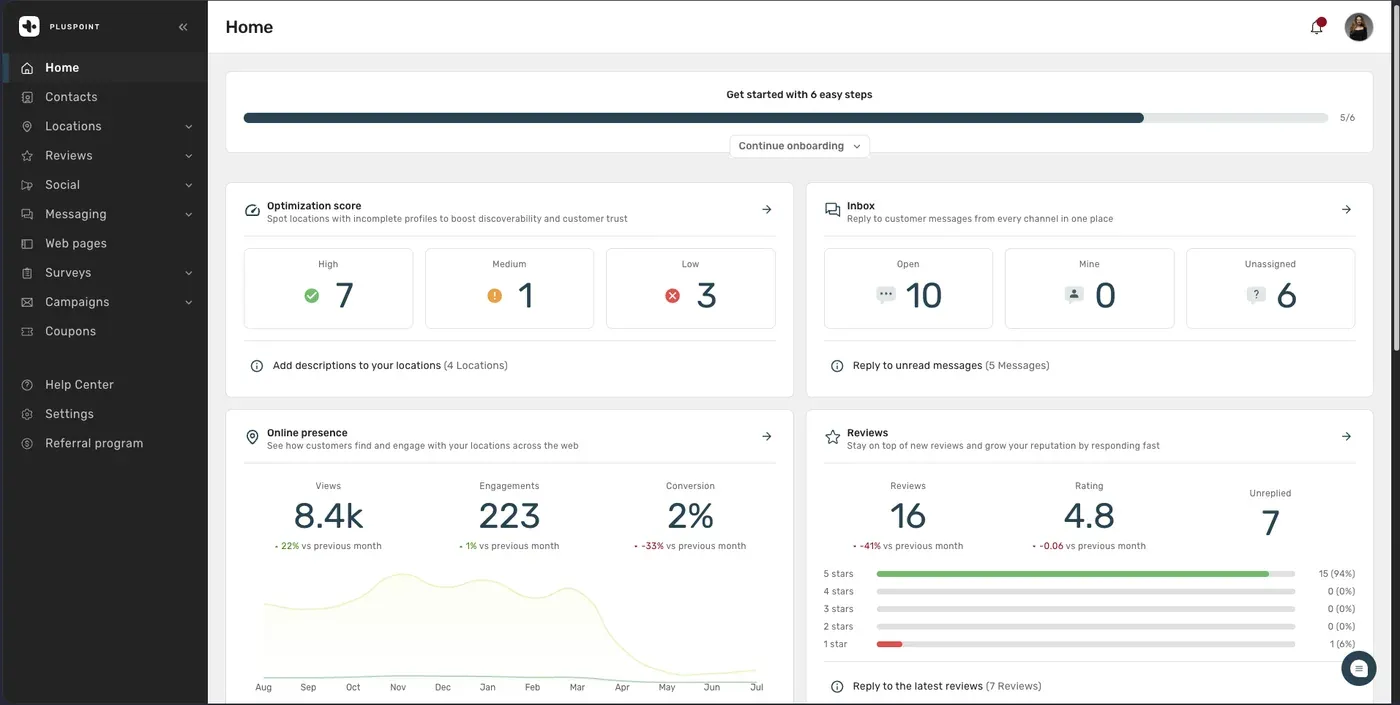
The independent evidence is strong: 4.9 on G2, the highest score on the list. Its price is published, so a fifteen-store chain can model the invoice tonight rather than next Thursday after a call. Pluspoint, a reputation and customer engagement platform for multi-location brands, also packs in the listings sync, a seven-channel inbox including WhatsApp, and the surveys and campaigns a mid-market chain usually buys as separate products.
Where it falls short. Polish rather than structure. Reporting could go a level deeper, the mobile app trails the desktop by a feature or two, and automatic reply posting covers Google and iFood, with ready-made drafts doing the work everywhere else.
Buy it if you run ten to a hundred locations and want the delivery apps covered without an enterprise invoice. At $29 a location it is the most affordable platform on this page, the best coverage per dollar here, and the only one you can price without talking to anybody.
3. SOCi: best for large US franchise networks
G2: 4.5 across 4,672 reviews · Price: quote only · Replies post back: Google, Yelp, Facebook
SOCi is what franchising looks like as software: corporate sets the guardrails, hundreds of franchisees do the driving, and the permission model keeps everyone in their lane. Grubhub and Uber Eats ratings pull in alongside Google, Apple Maps, Yelp and Facebook, it syncs with Olo and Punchh, and much of the automation now ships under its Genius agent line. With 4,672 G2 reviews, it also has the biggest pile of independent evidence on this page.
That evidence is not uniformly kind. Ease of use is what reviewers praise most; posts that fail to publish is what they complain about most. And its pile of one- and two-star reviews runs about three times Birdeye’s, on a similar-sized base. One reviewer this spring was blunt about rollout:
“The onboarding process was difficult for my teams; there was too much information at once.”
Mid-market reviewer, G2, April 2026
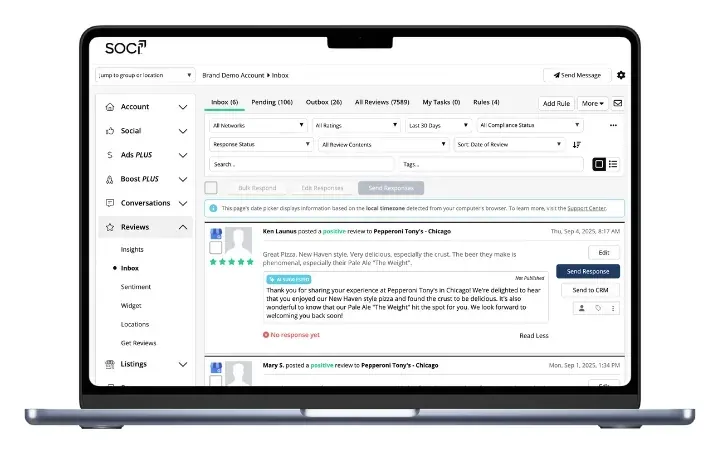
Where it falls short. No published pricing, and it is sized for large networks, which makes it heavy for a group of twelve. Delivery coverage is monitoring rather than management. Expect roughly a month to implement, and budget real training time.
Buy it if you run a franchise network where corporate control and local execution have to coexist, with the headcount to match.
4. Birdeye: best for breadth of general review sites
G2: 4.7 across 4,205 reviews · Price: quote only · Replies post back: not published
Birdeye is the default answer in this category, and the defaults hold up: the review-source breadth is real, the AI response tooling is mature, it lists 113 integrations, and its 4.7 across 4,205 G2 reviews is the strongest score-and-sample combination here. In the August spot check further down, ChatGPT named Birdeye first in all three answers, which matters if you care what your board reads before the meeting.
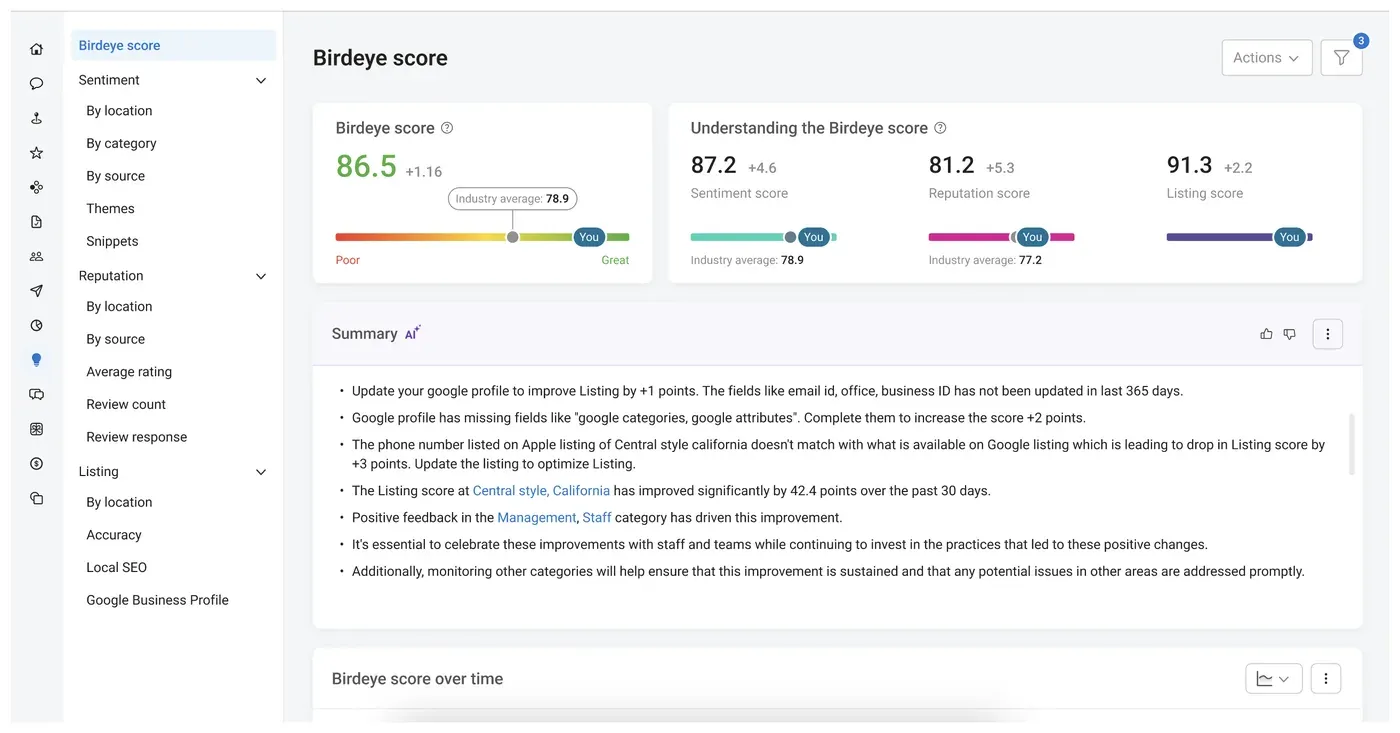
One G2 pattern tells the whole category’s story. Review management is the thing Birdeye reviewers praise most often, and the same feature sits high in their complaints too. One module, both columns: it delights the customers whose sources it covers and frustrates the ones whose sources it does not.
A hospitality reviewer drew that line himself, inside an otherwise warm three-star review:
“The review responder is helpful but limited in what platforms it responds to.”
Mid-market hospitality reviewer, G2, September 2023
The star spread has a tell of its own: unhappy Birdeye customers mostly skip two stars and go straight to one. When they fall out of love, they do not do it by halves.
Where it falls short. Cost is the recurring theme in operator discussion, which puts it at the top of this category’s range, a tenfold spread against the published end of this list. The breadth is real but uneven: the longest source list here, with no Yelp on it, a strange hole in the platform most often bought for coverage. And the list says nothing about which of those you can answer from inside the product. More than one operator describes paying for a full platform and using two features of it.
Buy it if your reviews spread across many general sites and you want the most-validated choice, with budget to match.
5. Momos: best for delivery-heavy US brands
G2: no profile · Price: quote only · Reads: Google, Yelp, TripAdvisor, DoorDash, Uber Eats, Grubhub, Grab, FoodPanda
Momos treats the delivery apps as the main dining room rather than the overflow seating, and in this crowd that alone is a personality. If most of your volume arrives through apps and your team thinks in store-level delivery ratings, a platform shaped like your business earns its shortlist slot.
It is also the only platform here reaching into Asia-Pacific, naming Grab and FoodPanda alongside the three US apps. That matters if your locations span Singapore or Jakarta as well as Texas. And it is a name the machines have started saying: Gemini’s August answer, covered below, put Momos first, ahead of every platform on this page that has a G2 profile.
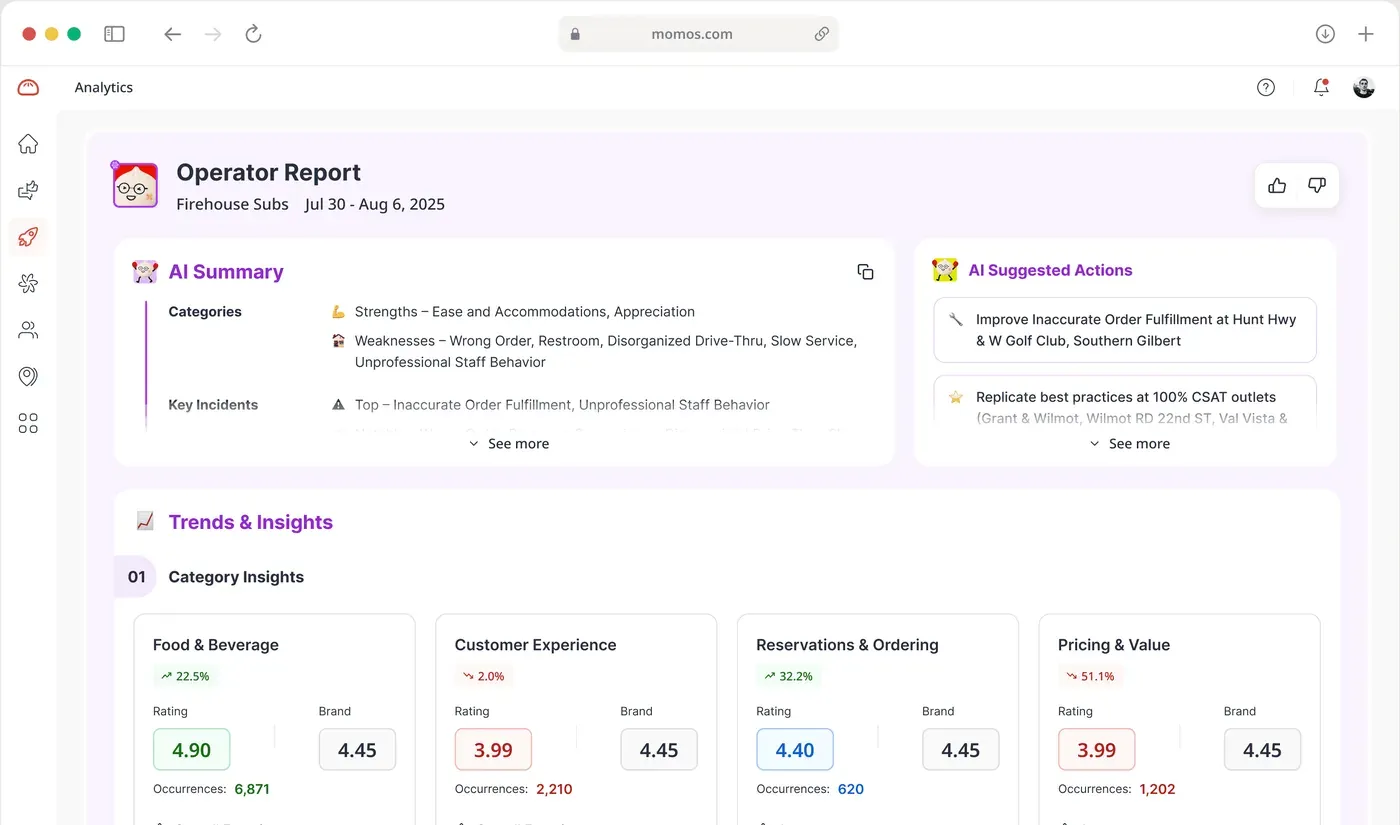
Where it falls short. No G2 profile, so independent verification is close to nonexistent, and no published pricing. Nothing European in the source list.
Buy it if delivery is the business rather than a channel, and your references check out.
6. Chatmeter: best for diagnosing why a location is slipping
G2: 4.5 across 120 reviews · Price: quote only · Reads: Google, Apple Maps, Bing, Yelp
Chatmeter’s strength is analysis rather than workflow: sentiment, theme extraction and location-versus-location benchmarking, the right tool when you know store 41 is sliding and cannot tell whether it is speed, staff or the parking. Know what you are buying into, though. Alchemer acquired Chatmeter in September 2025, the product’s own site now describes it as “fully integrated into Alchemer”, and the G2 listing has been renamed Alchemer Reputation Management. You may be evaluating a product mid-absorption.
The 4.5 comes from 120 reviews, an order of magnitude thinner than SOCi or Birdeye, and the praise clusters on support rather than product. Critics point at breadth, one calling the dashboard “a bit overwhelming with all the data available”. An enterprise customer described the multi-location reality:
“We’ve made consistent but slow progress on verifying our locations one at a time. Bulk verification would be ideal, but it doesn’t feel like we are moving forward with that.”
Enterprise reviewer, G2, July 2025
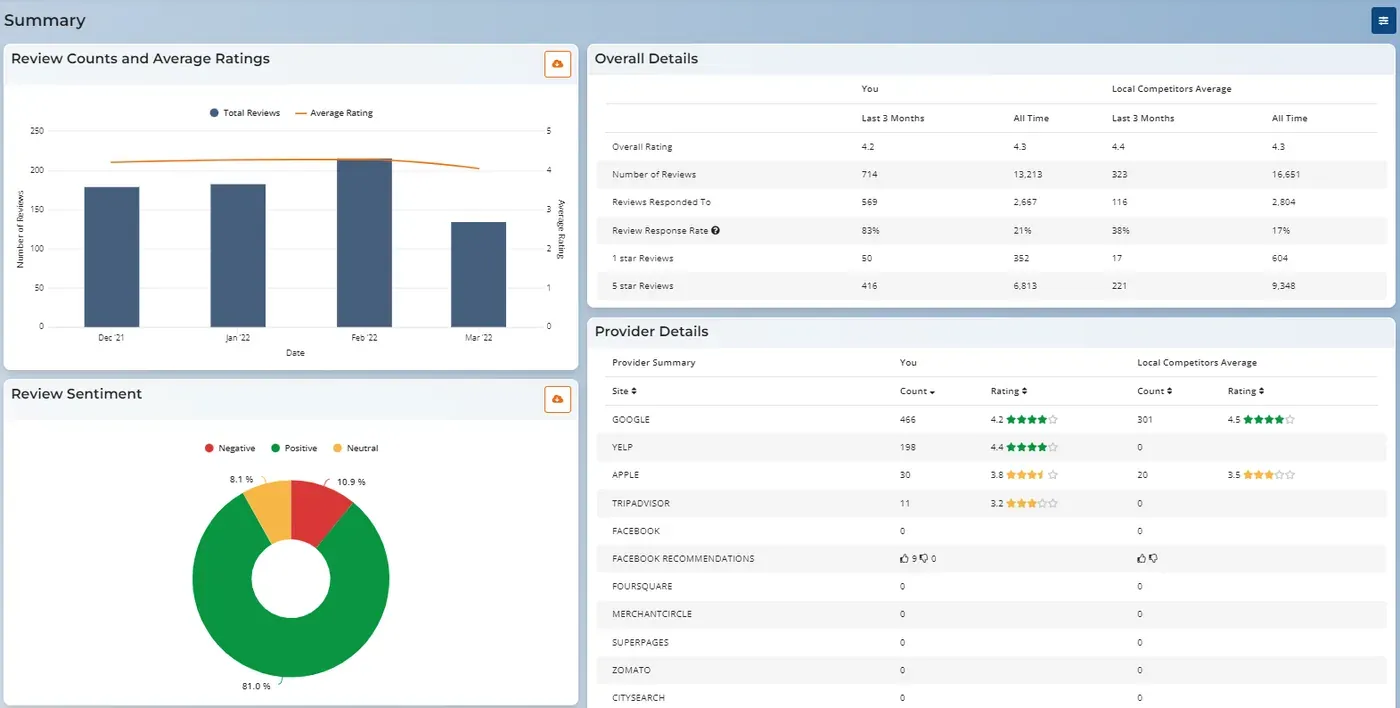
One at a time is a phrase to sit with, coming from inside a product sold on cross-location pattern-finding. G2’s reviewer averages add the bill: two months to implement and 17 to pay back, the slowest on this page.
Where it falls short. Quote-based pricing, and the four sources it names are all maps and search engines, with no delivery app among them. And depth is wasted on a group too small to have a pattern worth finding.
Buy it if you have enough locations to generate patterns and a person whose job is finding them.
7. Marqii: best for menu and listing accuracy
G2: no profile · Price: $90 per location per month, published · Reads: Yelp, Google, Facebook, DoorDash, Grubhub, Uber Eats, ezCater
Marqii solves an adjacent problem that quietly wrecks restaurant ratings: wrong hours and stale menus across dozens of listings, generating one-star reviews that are not about the food at all. Anyone who has watched a location collect angry reviews for two weeks because a holiday schedule never propagated knows the size of this problem.
It also publishes real prices, which almost nobody here does: $90 per location base, $145 with review management, $180 for the full suite. And it moved deeper into reviews this summer through a partnership with the loyalty platform Thanx, sending the post-purchase text that asks for the review in the first place.
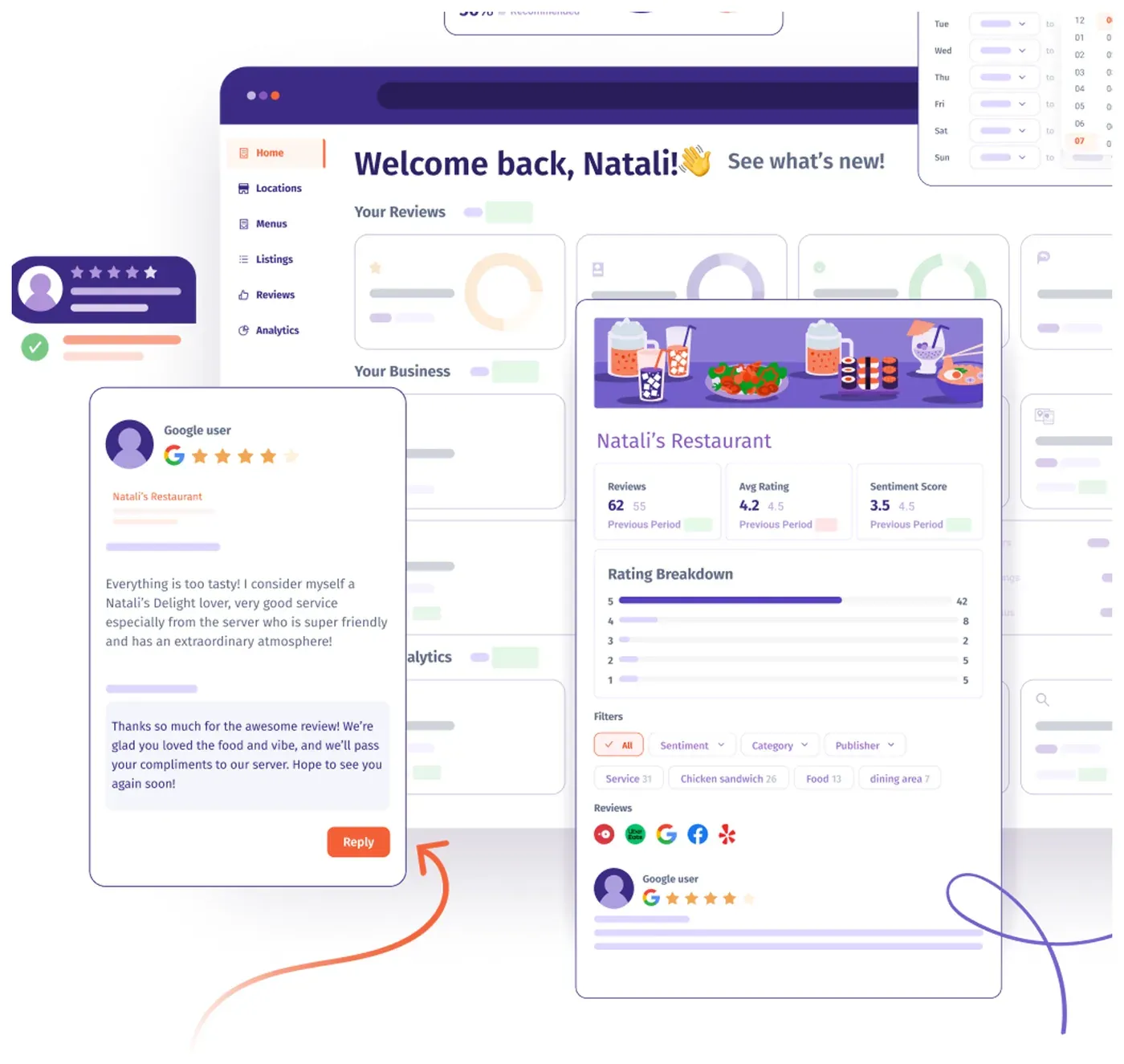
It is also refreshingly blunt about what it watches, spelling its review sources out on the pricing page itself, delivery apps included.
Where it falls short. Review management sits in the middle tier, so the honest comparison price is $145, not the $90 headline. Managed review responses cost extra again, from $100 a month for 50 reviews. Annual commitment, US-only sources, and essentially no G2 presence to check performance at scale.
Buy it if your ratings problem is really an operations-data problem, and reviews are the secondary purchase.
8. Reputation: best for enterprise CX programs
G2: 4.5 across 2,469 reviews · Price: $80 to $150 per location per month, published · Replies post back: not published
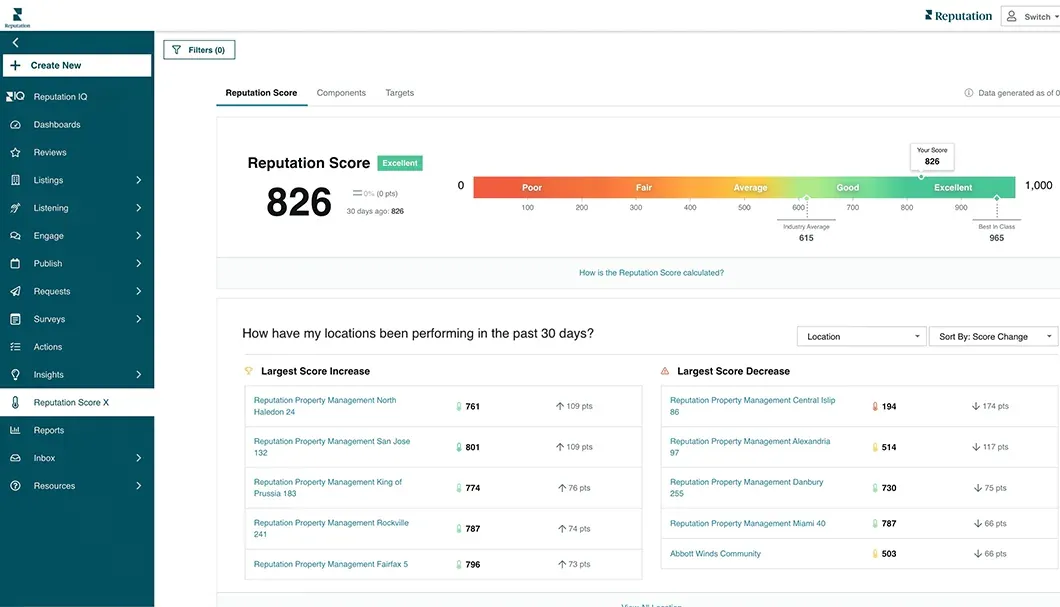
If your org chart has a box labeled VP of Customer Experience, Reputation was built for whoever sits in it: surveys, reporting and reputation rolled into one program, with 2,469 G2 reviews behind the 4.5. Unusually for the enterprise end, it publishes list prices: Rep Core at $80 per location covers reviews and listings, Pulse analytics takes it to $115, surveys to $150, and above 125 locations it goes custom. On sources it is quieter. The reviews page names Google, Facebook and Yelp, then trails off into “and more”, and no delivery app is named anywhere.
Where it falls short. Enterprise sizing and an enterprise sales cycle. G2’s reviewer average puts implementation at two months, tied with Chatmeter for the longest here and long enough to open a new location, with payback averaging 14 months. Its G2 profile shows 13 integrations, and its restaurant story lives on a general food-and-beverage page rather than anything chain-specific.
Buy it if reputation is one workstream inside a bigger CX program rather than the whole job.
Which review sources can each platform actually see?
More than they used to admit, though you have to know where to look. Birdeye keeps the longest list on its own site, 322 sources deep, delivery apps included, pool-supply shops included, with one hole you would never guess. Yelp. The most famous restaurant review site in America, missing from the longest source list in the category. Marqii prints its sources right on the pricing page, and Momos and Pluspoint publish theirs too.
The rest give you a few familiar names and an “and more”. That is not a no. It just means the demo call has to do the work the website should have done. Tick your sources below and see who puts what in writing.

Which platforms document your review sources?
Tick the sources your locations actually collect reviews on. The table shows what each platform states on its own public pages, checked in August 2026. A dash means the vendor does not publish that detail, which is not the same as saying the source is unsupported.
| Platform | Yelp | TripAdvisor | Apple Maps | DoorDash | Uber Eats | Grubhub | TheFork | Deliveroo | iFood | ||
|---|---|---|---|---|---|---|---|---|---|---|---|
| Pluspoint Names its sources, delivery apps included | Reads and replies | Reads only | Reads only | Reads only | Not documented publicly | Reads only | Reads only | Reads only | Reads only | Reads only | Reads and replies |
| Momos Names its sources, incl. Asia-Pacific | Reads only | Reads only | Not documented publicly | Reads only | Not documented publicly | Reads only | Reads only | Reads only | Not documented publicly | Not documented publicly | Not documented publicly |
| Marqii Lists sources on its pricing page | Reads only | Reads only | Reads only | Not documented publicly | Not documented publicly | Reads only | Reads only | Reads only | Not documented publicly | Not documented publicly | Not documented publicly |
| SOCi Names its sources on the restaurant page | Reads and replies | Reads and replies | Reads and replies | Not documented publicly | Reads only | Not documented publicly | Reads only | Reads only | Not documented publicly | Not documented publicly | Not documented publicly |
| Ovation Names four review platforms | Reads and replies | Reads only | Reads only | Reads only | Not documented publicly | Not documented publicly | Not documented publicly | Not documented publicly | Not documented publicly | Not documented publicly | Not documented publicly |
| Chatmeter Names maps and search only | Reads and replies | Reads only | Not documented publicly | Not documented publicly | Reads only | Not documented publicly | Not documented publicly | Not documented publicly | Not documented publicly | Not documented publicly | Not documented publicly |
| Birdeye Publishes 322 named sites. No Yelp | Reads and replies | Not documented publicly | Reads and replies | Reads only | Not documented publicly | Reads only | Reads only | Reads only | Not documented publicly | Reads only | Not documented publicly |
| Reputation Names Google, Facebook and Yelp only | Reads and replies | Reads only | Reads only | Not documented publicly | Not documented publicly | Not documented publicly | Not documented publicly | Not documented publicly | Not documented publicly | Not documented publicly | Not documented publicly |
● reads and replies ◐ reads only – not documented publicly
Can any platform reply to DoorDash, Uber Eats and Grubhub reviews?
Reading is the easy half. Answering depends on what each source lets outside software do, and the delivery apps let it do very little.
All three US delivery apps accept a merchant reply. Two of them publish it. None of the eight platforms here will post that reply for you.
| Delivery app | Can merchants reply? | Who sees it | Reply window |
|---|---|---|---|
| DoorDash | Yes, privately from the Merchant Portal | The guest only | 7 days |
| Uber Eats | Yes, publicly | The storefront, and the guest is notified | Not published |
| Grubhub | Yes, publicly | Anyone on your menu page, and the guest is emailed | 14 days |
So the reply exists. It is just being typed by someone on your team in a fourth browser tab, on a seven-day clock nobody put in a calendar. Birdeye illustrates the gap best: it reads DoorDash, and its own help pages then send you to the source to answer. A tool that reads what it cannot answer is a drive-thru speaker with the cord cut.
Plugging that cord in is the marketplace’s call, not the vendor’s, and at least one tool outside this list has managed it. Voosh publishes an API for posting DoorDash replies. So if a sales engineer tells you their platform answers DoorDash reviews, ask them to post one while you watch.

How much does restaurant reputation management software cost?
Five of the eight will not show you a price until you have sat through a demo, which in a restaurant would be a menu with no numbers on it and a waiter who wants to hear about your goals first. Reported figures for that end run several hundred dollars per location per month, and nearly every number in circulation traces back to a rival’s blog rather than an invoice.
The one figure from a paying customer with nothing to sell comes to about $470 a month for Podium, from an Australian owner on a twelve-month contract he says he never knowingly signed:
“Podium contacted us with 3 months trial and signed the contract without telling us that we are entering the 12 months contract without option to cancel the subscription.”
Small business owner, Reddit, June 2025. Converted from Australian dollars at August 2026 rates.
The other side of that argument, from an operator who thinks the premium is fair: it is “a convenience tax that pays for itself”.
Three platforms publish rates you can check tonight. Pluspoint lists $29 per location per month, with an $87 floor. Reputation runs $80 to $150 per location depending on tier, custom above 125 locations. Marqii starts at $90, $145 with review management included. The table says the rest plainly:
| Platform | Best for | G2 (reviews) | Published price | Reported price |
|---|---|---|---|---|
| Ovation | Catching feedback before it goes public | No G2 profile | Quote only | ~$150 to $300/location |
| Pluspoint | Mid-market chains, widest delivery coverage | 4.9 (70) | $29/location, $87 floor | |
| SOCi | Large US franchise networks | 4.5 (4,672) | Quote only | $23k to $62k/year |
| Birdeye | Breadth of general review sites | 4.7 (4,205) | Quote only | ~$300 to $400/month |
| Momos | Delivery-heavy and Asia-Pacific brands | No G2 profile | Quote only | None found |
| Chatmeter | Diagnosing why a location slips | 4.5 (120) | Quote only | None found |
| Marqii | Menu and listing accuracy | No G2 profile | $90 base, $145 with reviews | |
| Reputation | Enterprise CX programs | 4.5 (2,469) | $80 to $150/location |
Treat that last column gently. Reported prices come from operator threads, software directories and rival comparison pages, not from invoices, and several trace back to companies selling something cheaper. They are useful for sizing a budget and useless for arguing with a sales rep. G2 figures were read from each profile on 21 August 2026.
Buried further down each G2 profile is a panel most buyers never scroll to, averages assembled from reviewer reports, and it answers the question the quotes dodge: how long until this pays for itself.
| Platform | Time to implement | Payback period |
|---|---|---|
| Birdeye | 1 month | 9 months |
| SOCi | 1 month | 9 months |
| Reputation | 2 months | 14 months |
| Chatmeter | 2 months | 17 months |
The thinner profiles on this list do not have the panel, since it needs a review base to exist. Where it does exist, the same panel puts average negotiated discounts at 9 to 11% across the category’s big names. Whatever number the demo ends on, the sticker has air in it.
Why a delivery rating is worth more than it looks
Three in four delivery customers ordered through a third-party app in the past six months, per the National Restaurant Association. Those ratings then decide who sees you next.
Uber Eats grades stores monthly and gives the winners top billing plus a badge diners can filter by. DoorDash is coyer, though an operator on Reddit got the unvarnished version from their account manager:
“The locations that were flagged would have reduced visibility, leading to a drop in orders.”
Chain operator, Reddit, September 2025. The chain renegotiated its contract.
The anger does not stay inside the apps, either:
“We got a one star review on both google and yelp from the same woman who received her cupcakes from doordash in a state of disarray, with a pic and everything.”
Bakery owner, Reddit, February 2026
The reply that thread settled on is the one to memorize: “If I order something from Target and UPS breaks it, I’m going to blame Target.” DoorDash agrees, in its own walls, and rejects reviews that “focus primarily on delivery issues (such as delivery time or food temperature), which are outside a merchant’s control”. That courtesy stops at the app’s edge, though. On Google, it is still up.
What do ChatGPT and Gemini recommend for restaurant chains?
Increasingly the shortlist is not built by the buyer. It is built by whatever the AI assistant says when a regional manager asks it over coffee, so it is worth knowing what that answer currently is.
On 18 August 2026 we asked ChatGPT three versions of this question from a US English session, with web search enabled, and recorded every platform named and every source cited. It named Birdeye first all three times. Chatmeter and SOCi appeared in every answer; Reputation, Yext, ReviewTrackers, Podium and Bazaarvoice rotated through the lower slots. Nothing restaurant-native appeared in any of the three answers.
Gemini, asked the same question three days later, went the other way. It put Momos first, slotted Marqii fifth, and filled two of its five picks with restaurant-native tools. Then it listed its sources: four citations, at least two of which, a “Hospitality Review Benchmark Study” among them, do not appear to exist anywhere a search can reach. An engine recommending reputation software invented some reputation to cite. Which is the category in one sentence.
One more prompt is worth reporting, because an engine got it right. Asked which platforms can post a public reply to a DoorDash review, Gemini named nobody on this page. It pointed at DoorDash’s own merchant portal and at one delivery-first tool outside this comparison. The read-versus-reply distinction has reached the machines before it has reached most vendor marketing.
ChatGPT’s sources were vendor product pages and a single G2 category page, with no independent shortlist anywhere in the set. That shape is consistent with what shows up across the AI recommendations diners actually get. When no credible independent page exists, the assistant quotes marketing copy, because marketing copy is what is there.
Method and limits
Three ChatGPT prompts on 18 August 2026 and two Gemini prompts on 21 August, one country, web search on: the title question, a multi-location variant, a 2026-dated variant, and the DoorDash reply question, with every platform and cited URL recorded. Coverage claims elsewhere on this page come from each vendor’s own public pages, and G2 figures were read directly from each profile on 21 August 2026. Five answers across two engines is a spot check, not a study: it cannot say what the assistants answer on average, only which pages sat in the retrieval set those days.
Do star ratings actually move restaurant revenue?
The number every vendor deck quotes says yes: a one-star improvement lifts revenue 5 to 9%. Look it up before it prices your software. It comes from a Harvard Business School working paper built on Seattle Yelp data from 2003 to 2009, and it was never peer-reviewed.
For chain restaurants, the readers of this page, that paper reports an effect “statistically insignificant and close to zero”. The chain sample was small, so read it as could-not-detect rather than proven-zero. Either way, a figure measured on independent restaurants two decades ago is carrying more weight in sales decks than it can hold.
Better evidence exists, and it points somewhere more useful. A 2024 study in Cornell Hospitality Quarterly followed roughly 1,750 Belgian restaurants across a decade of TripAdvisor reviews matched to accounting records, and found the sentiment inside the reviews predicted profitability where the star average alone did not. Reviews written in the local language moved the needle more than reviews in English. The practical translation: the win is not nudging a 4.3 to a 4.5, it is knowing what guests are saying, in every language they say it in.
Stars still work as a gate, though. In BrightLocal’s 2026 consumer survey, 31% of consumers said they would only consider a business rated 4.5 or higher, nearly double the share a year earlier. Below the gate, the sentiment never gets read.
How to choose reputation software for your restaurant group
Pull last quarter’s reviews and count them by source. Not by memory, by export (about ten minutes, most of it waiting for the CSV). Nearly every group that does this finds the ranking is not what they assumed, usually because delivery volume grew faster than anyone updated their mental model.

Then follow whichever line matches:
- Your second source is Grubhub or Uber Eats. Four platforms read both: Pluspoint, Momos, Marqii and SOCi. Pick on the rest of the stack, not this row, and expect to read those ratings rather than reply to them.
- Your second source is DoorDash. Birdeye, Pluspoint, Momos and Marqii all read it. Pluspoint is the cheapest published route in at $29; Marqii is $145; Birdeye quotes.
- You run delivery in more than one country. Pluspoint is the only platform here documenting both the US apps and TheFork, Deliveroo and iFood.
- Your second source is TripAdvisor. Birdeye for breadth, and budget for it. If it is Yelp, check Birdeye’s list first, because Yelp is not on it.
- You are a franchise network with hundreds of units. SOCi, and plan a month for rollout.
- Ratings are sliding and nobody knows why. Chatmeter, if you have enough locations to make a pattern.
- Wrong hours and stale menus are generating the bad reviews. Marqii.
- Bad reviews keep arriving as a surprise. Ovation, and the two-question survey.
- You already run a formal CX program. Reputation, with published tiers from $80 and two months to implement.
One more thing before signing anything. Ask for the reply list, not the read list, and ask in writing. The distance between those two lists is the single most common source of buyer’s remorse in this category, and it is the one number no feature grid displays.
For a closer look at how the restaurant-native tools compare on features rather than sources, the Momos, Ovation, Marqii and Pluspoint comparison goes deeper on surveys, listings and messaging. And if the shortlist has narrowed to the household names, the Podium, Birdeye and Pluspoint comparison walks the fees and fit in detail.
Frequently asked questions
What is the best reputation management software for restaurant chains?
It depends on where your reviews actually land, because that is the one thing these platforms genuinely differ on. For delivery coverage and price, Pluspoint reads DoorDash, Grubhub and Uber Eats at a published $29 per location per month, and throws in European sources like TheFork and Deliveroo for chains that ever need them. Momos and Marqii also read the three US delivery apps, so on US-only coverage the three are close. For large US franchise networks, SOCi has the strongest corporate-and-franchisee permission model. For catching problems before they become public reviews, Ovation's two-question SMS survey is the most focused tool of the group. Shortlist on source coverage first, then compare features.
How much does restaurant reputation management software cost?
Three of the eight publish prices. Pluspoint lists $29 per location per month with an $87 floor. Reputation lists $80 per location for its core tier, $115 with analytics and $150 with surveys, going custom above 125 locations. Marqii lists $90 base, $145 with review management and $180 for the full suite, on annual contracts. Ovation, SOCi, Birdeye, Chatmeter and Momos quote on request; reported figures for that end of the list run several hundred dollars per location per month, and G2's reviewer-reported average discount of 9 to 11% suggests treating any first quote as an opening bid.
Do reputation platforms manage DoorDash, Grubhub and Uber Eats reviews?
Four of the eight document reading all three: Birdeye, Pluspoint, Momos and Marqii. SOCi documents Grubhub and Uber Eats. Chatmeter, Reputation and Ovation name no delivery source at all. Replying is the real gap: none of the eight documents posting replies back to a US delivery app. The apps themselves all accept merchant replies in their own portals, publicly on Grubhub (within 14 days) and Uber Eats, privately on DoorDash (within 7 days). Until a platform closes that loop, someone on your team answers delivery reviews in each marketplace portal.
Is Google enough, or do restaurant groups need the other review sites?
Google is the largest single source and every platform on this list handles it well, which is exactly why it is a poor basis for choosing between them. The differences show up on the second and third sources. A group doing serious delivery volume, a tourist-facing group living on TripAdvisor, and a European group taking bookings through TheFork each have a different second source, and that source is where the platforms diverge sharply.
How many locations do you need before this software is worth buying?
Operators discussing this publicly tend to put the line around the point where one person can no longer keep up by opening each site directly, usually somewhere between three and ten locations. Below that the tools are frequently described as overkill. Above it the argument shifts from features to time: multi-unit operators report staying with platforms mainly because a single inbox saves switching between tabs, not because of any individual feature.
How reliable are G2 scores for this category?
Treat the score and the sample size as one number, not two. SOCi's 4.5 rests on 4,672 reviews and Birdeye's 4.7 on 4,205, so both are stable. Chatmeter's 4.5 comes from 120 reviews and Pluspoint's 4.9 from 70, which are directionally useful but far thinner. Three restaurant-native tools on this list, Ovation, Momos and Marqii, have effectively no G2 presence, so their absence from the rankings is a gap in independent evidence rather than a verdict on the product. One more wrinkle: G2 bought Capterra, GetApp and Software Advice in early 2026, so agreement across those four sites no longer counts as an independent cross-check.