Podium vs. Birdeye vs. Pluspoint: Features, Fees and Fit in 2026
Podium pulled its public prices and Birdeye never had any. One of the three has no listings or social posting at all. What each platform actually does in 2026, what it costs, and which kind of operator each one suits.

Comparing these three platforms takes an evening you won’t get back. Podium’s pricing page describes plans but no longer shows a dollar figure. Birdeye wants your phone number before it will say a number at all. And most of the write-ups ranking for this exact search were written by one of the vendors, which is worth remembering, because this one was too: Pluspoint is the platform this blog belongs to.
So, ground rules. Every claim below comes from the three vendors’ own pricing pages, help centres and product documentation, checked in July 2026. Where Pluspoint loses a row, the row says so. There are a few.
The short version for skimmers: Podium is a texting and phone business that happens to collect reviews, quoted by sales, with no listings tool and no social posting. Birdeye covers the most ground of the three, 200+ review sites and nine social networks, also priced only after a sales call. Pluspoint sits between them on features and is the only one that publishes its pricing, starting at $29 per location. The choice carries more weight than it looks, too. 97% of consumers read reviews of a local business before visiting, per Capital One Shopping’s July 2026 roundup, and whichever platform you pick ends up running that first impression.
Which platform fits which business
Fit decides this faster than any feature table.
Podium suits a single site or a small footprint where speed to lead is the bottleneck. A dealership missing texts at 7pm loses that sale to whoever answered first, and Podium is built almost entirely around closing that gap, down to a phone system and an AI receptionist that picks up when nobody else can. Seats are unlimited on every tier, which matters when twenty people share one counter. There are industry editions for dealerships, home services and clinics. No listings tool, though, and nothing that posts to social.
Birdeye suits big brands with a procurement process and the patience for one. Its pitch is breadth: more review sites monitored and more social networks than the other two, priced by location band after a sales call. Whether that breadth earns the quote depends on how much of it you’d actually switch on, and buyers in this category consistently report using a fraction of what they signed for.
Pluspoint suits multi-location operators who want the whole core stack with a bill they can check tonight. Reviews, listings, social posting, a WhatsApp inbox, surveys and campaigns on one published rate: $29 a location, self-serve to 30 locations. The honest gap is Yelp replies, which only Birdeye posts. Everything else a multi-location brand touches weekly is here, without a meeting on the calendar.
What Podium actually costs in 2026
One disambiguation first, because this search is a mess: Podium the customer-communication platform, not the lectern you stand behind.
Podium quotes through sales now. The pricing page still lays out plans, but the dollar figures are gone, replaced by “talk to our sales team for details”. What survives, on third-party breakdowns and in buyers’ memories, are the last prices Podium listed publicly:
| Plan | Last listed price | What was included |
|---|---|---|
| Core | $399/month | 5 phone numbers, 250 bulk-message credits |
| Pro | $599/month | 15 numbers, 500 credits, labelled “Best Value” |
| Signature | Custom | Advanced multi-location management |
Treat those as your anchor for the negotiation rather than a checkout price. They were per-month figures, not per-location, with unlimited team members on every tier.
The add-ons are where the bill grows, and Podium’s help centre documents them. Phone seats run $30 per user for the first four and $25 from the fifth. Podium Phones carries a $500 network optimisation fee per location, US locations pay a $5 monthly 10DLC fee, and every extra number is another $5. The AI Employee add-on has no published price at all.
Contract length isn’t published anywhere. Ask.
There’s a running Pluspoint vs Podium breakdown with the feature-by-feature detail.
What Birdeye actually costs in 2026
Birdeye has never published prices. Its pricing page is a configurator: choose a location band, from 1-3 up to 1000+, hand over a mobile number, wait for contact. Pricing, it says, is “built around outcomes, not seat counts.”
Figures do circulate. Blog roundups quote $299 to $449 a month, and buyers comparing bills on Reddit and review sites describe single locations around $300 to $400, with the per-location rate dropping sharply on multi-location deals. None of it appears on any Birdeye page, so treat it as a sanity check for your quote rather than a rate card.
The configurator bands, 1-3 up to 1000+, point the same direction: more locations, lower per-location rate. And paying by product mix means two brands with identical footprints can land a long way apart.
The Pluspoint vs Birdeye page has the fuller matchup if that’s the one you care about.
If you get a Birdeye quote, ask three things in writing: the contract term, what happens to the price at renewal, and which specific products are inside the number. The third matters most. “One platform, one contract” means the line items are invisible from the outside, and you can’t compare a quote you can’t itemise.
What Pluspoint costs
Pluspoint is the disclosure case, so the numbers here come with extra care: every one of them sits on the pricing page, and none of them needs a call to obtain.
$29 per location per month. Three things to know before comparing that number to anything:
- Three locations minimum. The real floor is $87 a month, not $29.
- Three users included. Extra seats are $19.
- Google and Facebook listings sync at no extra cost. Syndication to 100+ further directories is a $39 per location add-on.
Annual billing charges ten months for twelve. Self-serve runs to 30 locations, and past that a human gets involved, at the same published rate.
Pluspoint isn’t the cheapest tool in the category. It’s the only one of the three that publishes pricing at all, which means it’s also the only one where you can work out the exact monthly bill before anyone calls you back.
What would your locations cost?
Numbers on a page blur together, so here’s the same arithmetic as a control you can drag.
Estimate
Podium
≈ $399+/mo
Quotes through sales; the last listed tiers were Core $399 and Pro $599 a month, flat rather than per location, and volume gets negotiated. Phone seats and the $5 10DLC fee come on top; Podium Phones adds a one-time $1,500 network fee at 3 locations.
Estimate
Birdeye
≈ $760–1,030/mo
Modelled from figures buyers report publicly, with volume discounts built in. Birdeye publishes no prices, so your quote will differ, in either direction.
Published rate
Pluspoint
$87/mo
$29 × 3 locations (the three-location minimum). Annual billing charges 10 months for 12.
Same rate on the pricing page. Cancel in-app.
Podium and Birdeye figures are estimates from public sources, not vendor rate cards. Pluspoint's is the published rate.
For a three-location business today, that reads: a sales quote from Podium anchored by its last listed $399 tier, a Birdeye estimate in the high hundreds based on what buyers report publicly, and a published $87 on Pluspoint. At ten locations, Podium’s one-time phone setup alone reaches $5,000 if you take its phone system, and Pluspoint lands at $290.
Listings management
Listings are the make-or-break row for multi-location brands: can the platform push your hours, addresses and categories to the directories customers actually search, across every location, from one screen?
Podium has no listings product. Its Google Business Profile connection pulls reviews in and pushes replies back, and that’s the entire relationship. No hours, no categories, no addresses, no other directories. For a single site this is survivable. Across forty locations, it means directory accuracy lives in a spreadsheet.
Birdeye
Birdeye Listings covers over 100 sites by its own current count, with 60+ editable fields per location and automated detection of listings that drift out of sync.
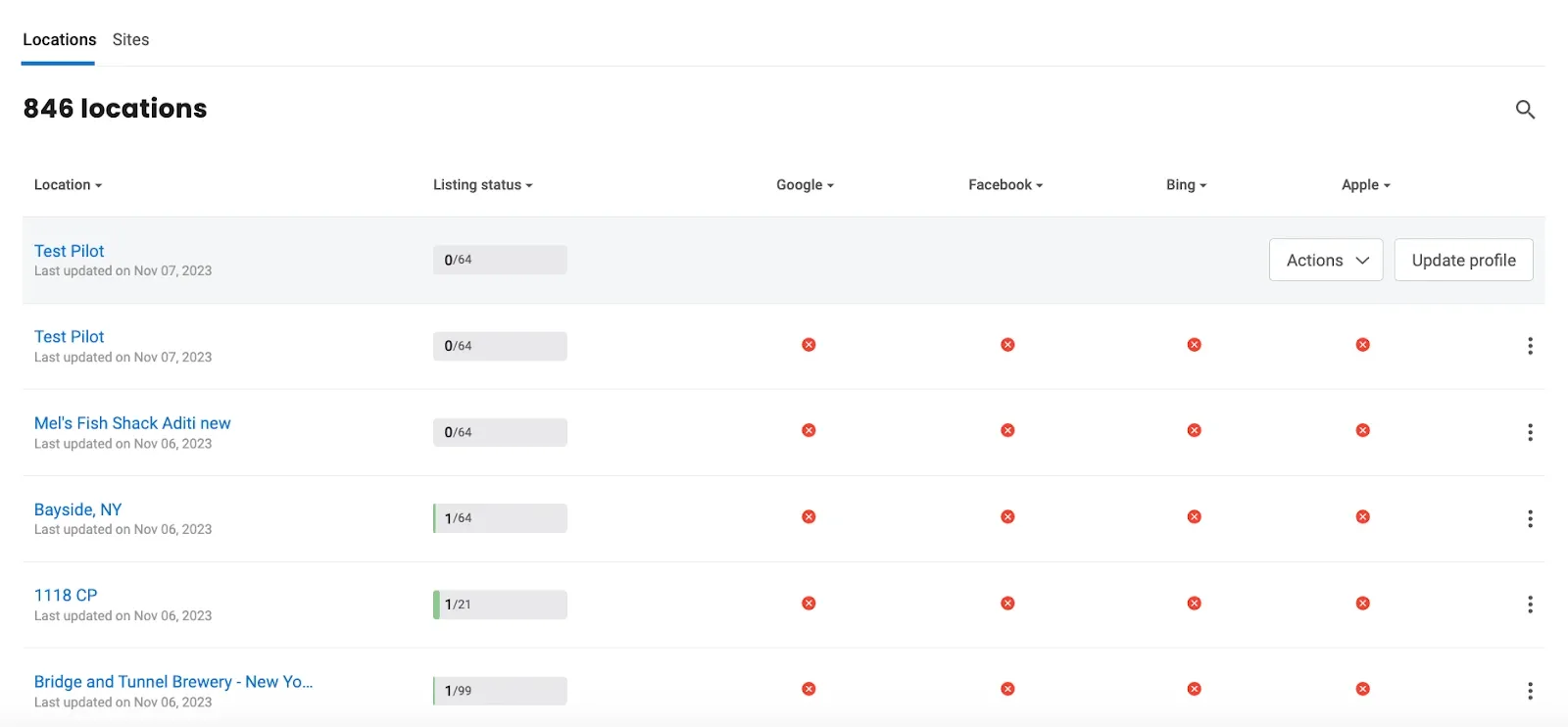
Treat the headline directory count sceptically whoever’s quoting it, Pluspoint included. Most of the sites padding out a “100+ directories” claim lost the bulk of their traffic years ago, and the handful still sending anyone through your door is short enough to name.
Pluspoint
Pluspoint covers 100+ directories: Google and Facebook, then Apple, Bing, Foursquare and the long tail behind them. Each location carries its own hours, categories, addresses and photos.
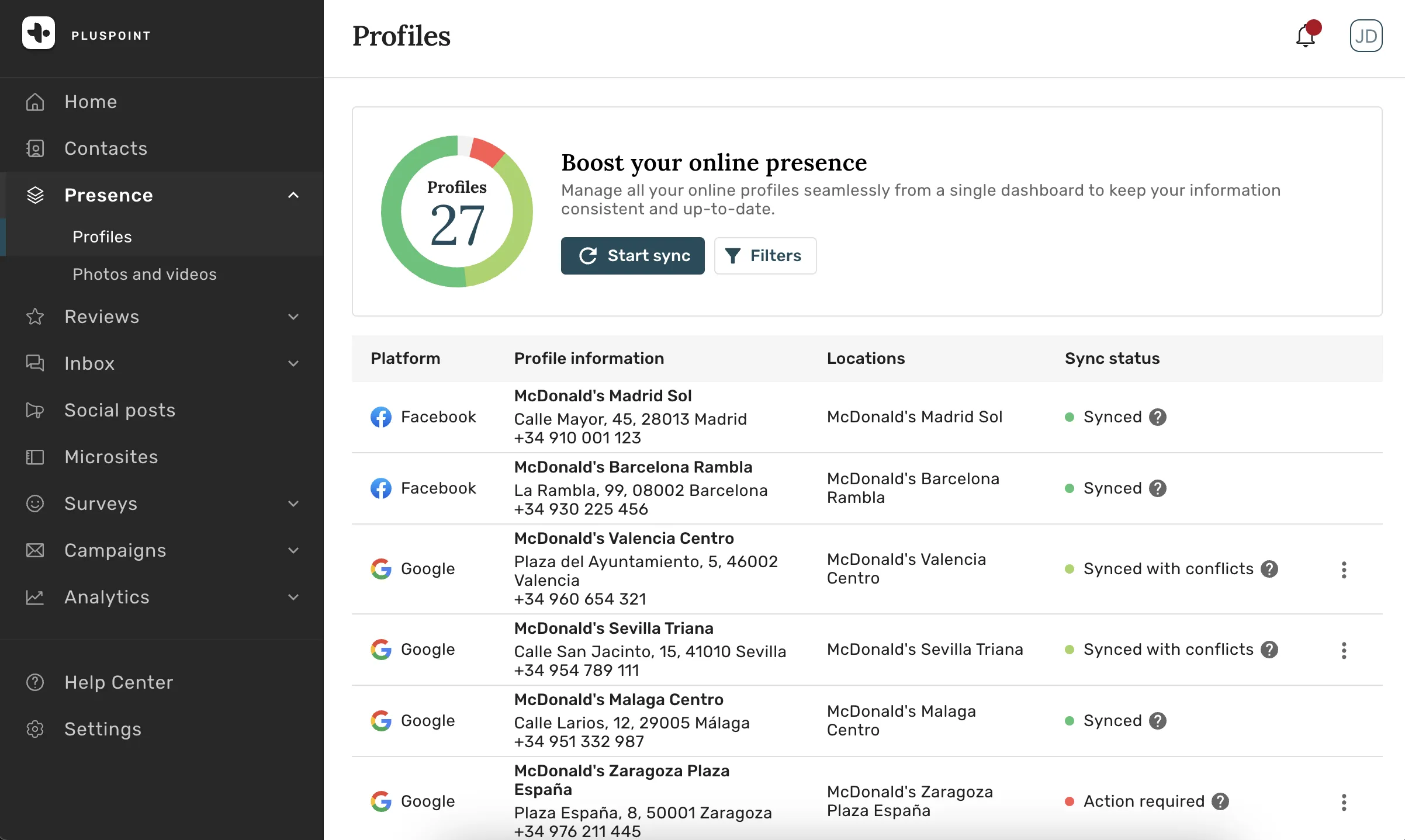
Bulk updates across locations work the way you’d hope, which is the whole point when a brand changes holiday hours across sixty sites in one afternoon.
Review management
All three collect reviews. The differences show up in where you can reply, and they’re larger than any marketing page admits.
Podium
Podium monitors a long list of sites, 24 of them named on its own help pages, from Angie’s List and Carfax to Healthgrades and Zillow.
Replies are the constraint. Asked directly whether you can respond to reviews from integrated sites inside Podium, its own documentation says no and links you out to the review site instead. Google and Facebook are the only two you can reply to in-product.
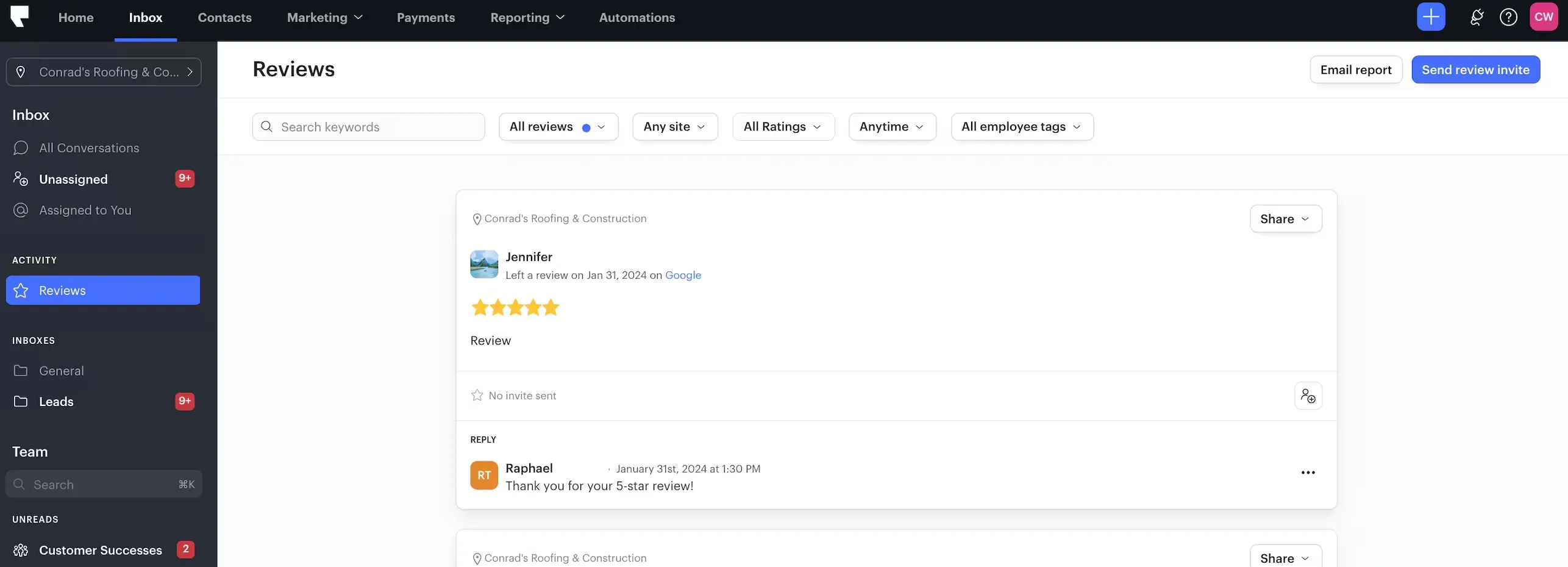
Yelp is absent entirely, not even monitored. Podium explains why on its own site: Yelp and Trustpilot don’t permit third-party integrations.
Birdeye
Birdeye monitors 200+ review sites by its own count. Google and Facebook replies happen natively; for other sources, it copies your reply to the clipboard and redirects you to the site to paste it.
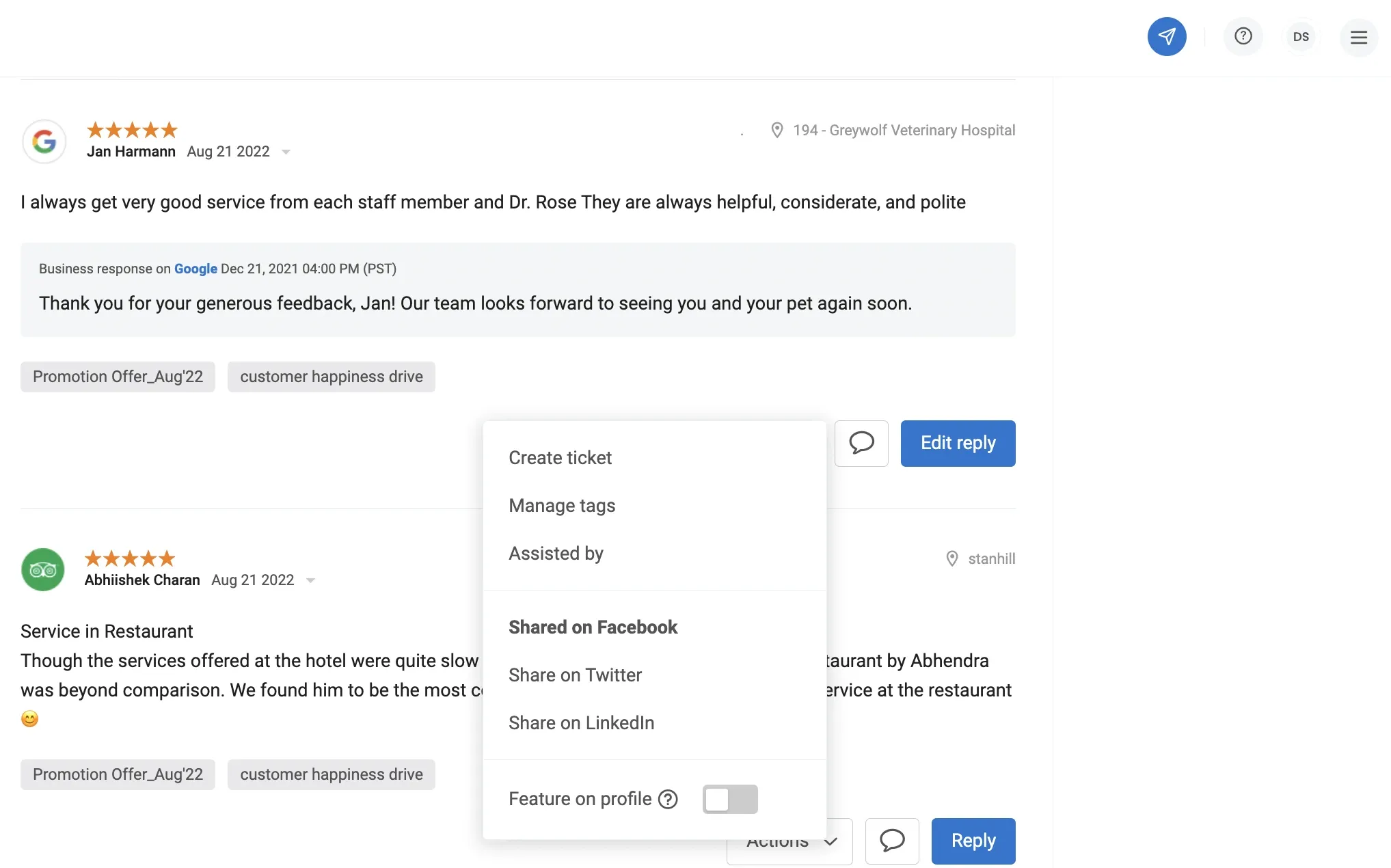
Then there’s Yelp, where Birdeye stands alone among the three. Connect your own Yelp account and you can reply from the dashboard. The limits matter: no bulk replies, no emojis, and no asking customers for a Yelp review at all, since Yelp forbids soliciting them. For a Yelp-heavy restaurant group, that alone can settle it.
Pluspoint
Every major review site a local business lives on is covered. Pluspoint syncs 14 platforms natively, picked by vertical rather than padded for a bigger number: Google, Facebook, Yelp, Trustpilot and TripAdvisor for everyone; Booking.com, Hotels.com and Expedia for hotels; TheFork, Deliveroo and iFood for restaurants; Healthgrades, Zocdoc and RateMDs for clinics. Reviews from anywhere else flow in through the public API, and surveys and QR collection feed first-party feedback alongside.
Replies post back to Google and iFood; on other platforms the reply is stored against the review rather than published. A business that lives on Yelp responses will want Birdeye for that particular job.
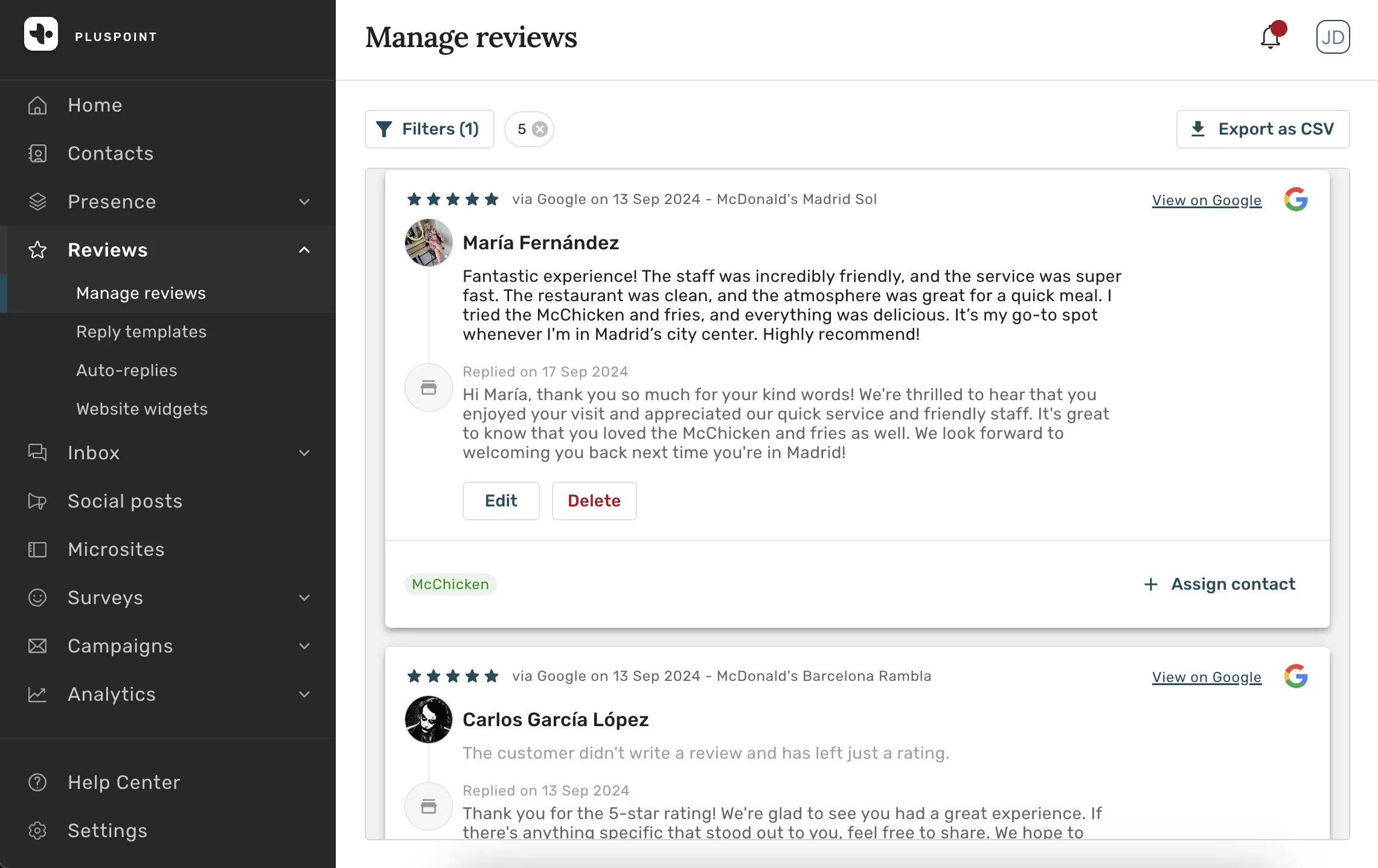
Around the reviews themselves, Pluspoint adds AI translation and reply drafting, sentiment sorting into promoters, neutrals and detractors, and author matching so a review connects to a contact record.
Whichever platform you pick, routing unhappy customers to a private form while sending happy ones to Google is against Google’s review policies, and since October 2024 the FTC’s rule on fake reviews has carried civil penalties of up to $53,088 per violation. The FTC sent its first warning letters under the rule in December 2025. Private service recovery before a review is fine. Filtering who gets asked is not, and no vendor’s feature set makes it legal.
Social posting
Social posting is where the three differ most: nine networks, six, or none at all.
Podium
Podium can’t publish to any social network, including Google Business Profile posts. The Facebook, Instagram and Google entries in its plans are inbound messaging channels feeding the Inbox, not publishing tools. No composer, no scheduler, no post button anywhere.
Birdeye
Birdeye publishes to Facebook, Instagram, Google Business Profile, LinkedIn, X, TikTok, YouTube, Threads and Apple, with bulk scheduling from a spreadsheet, approval workflows and cross-network analytics.
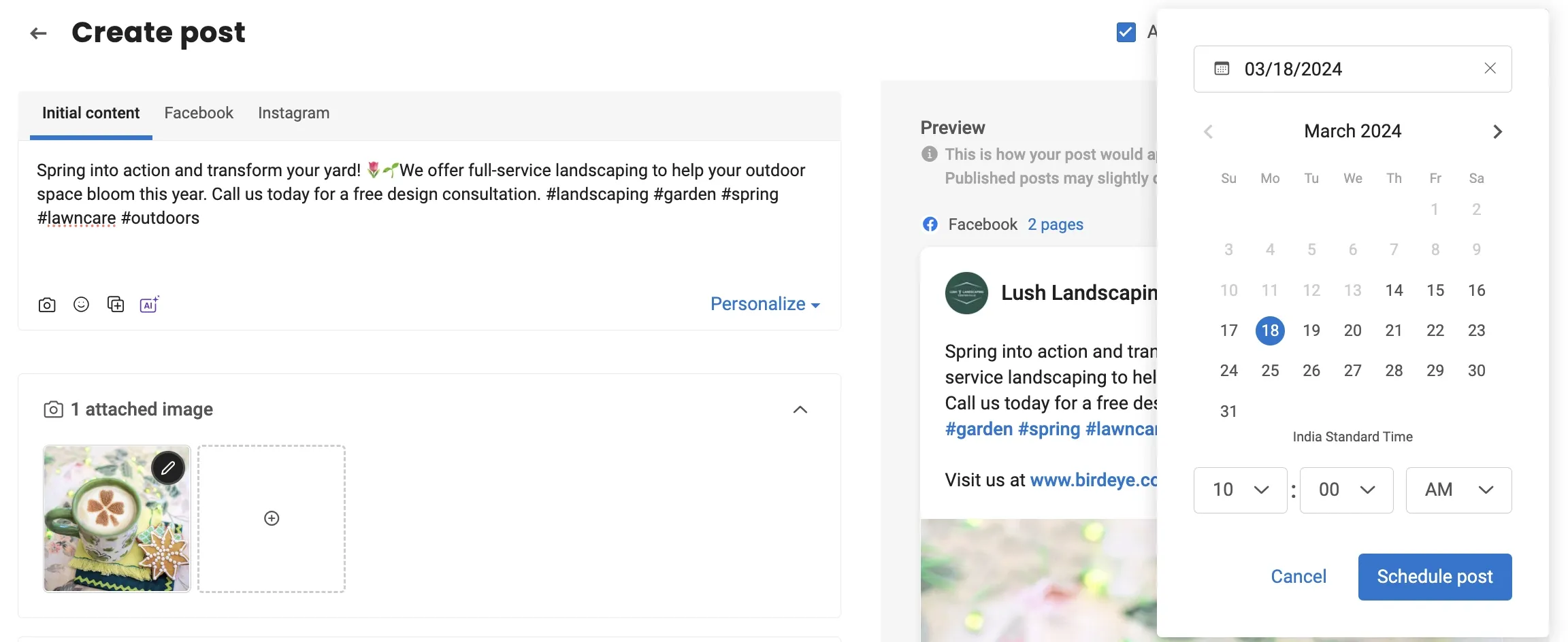
Nine networks beats Pluspoint’s six, plainly. One nuance worth reading twice: the separate “share your best reviews as a post” feature reaches four of the nine, not all of them.
Pluspoint
Six networks: Google Business, Facebook, Instagram, TikTok, X and LinkedIn.
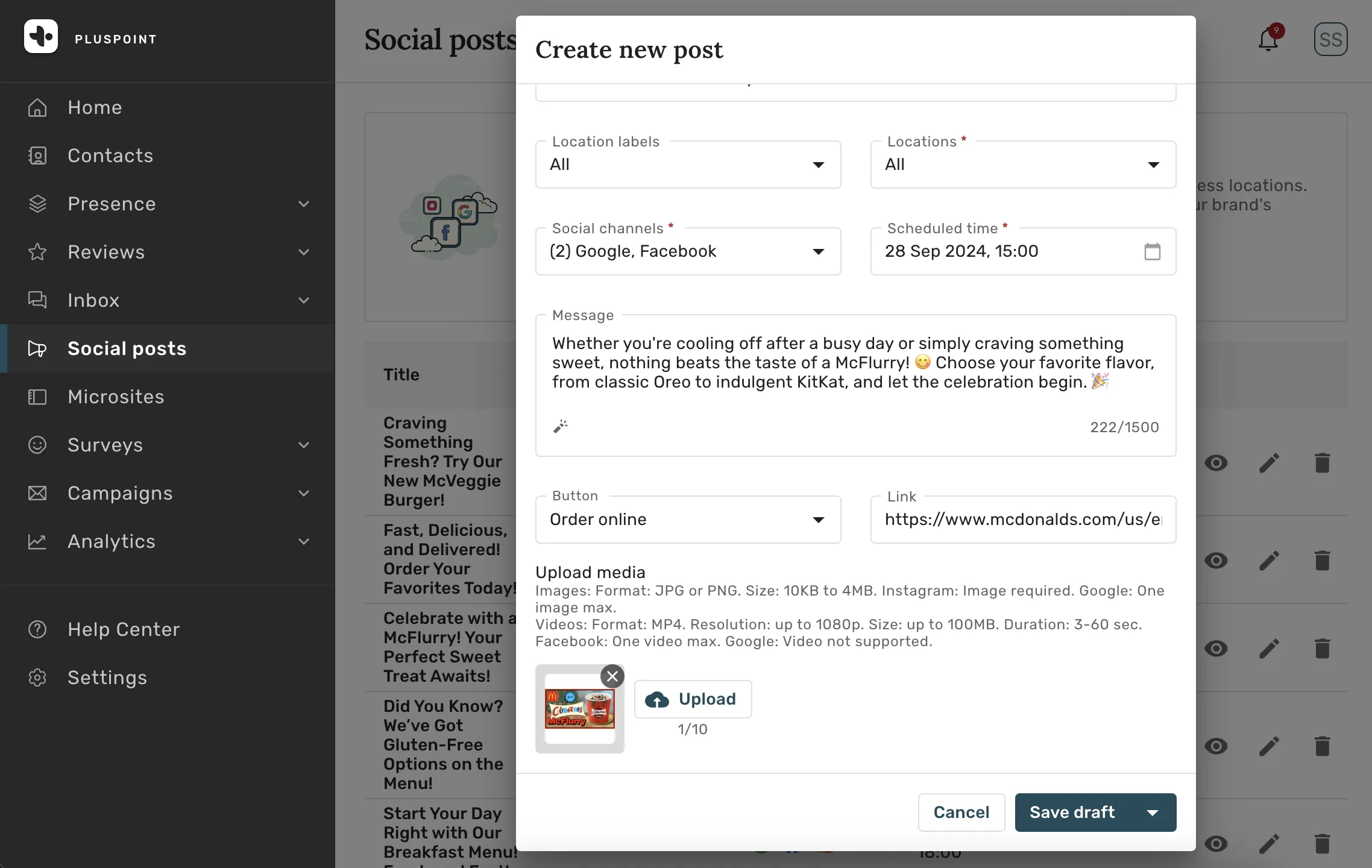
Posts can target location groups or single sites, captions are AI-drafted per brand voice and translatable, and carousels take up to ten images or videos. No YouTube, Threads or Apple.
Omnichannel inbox
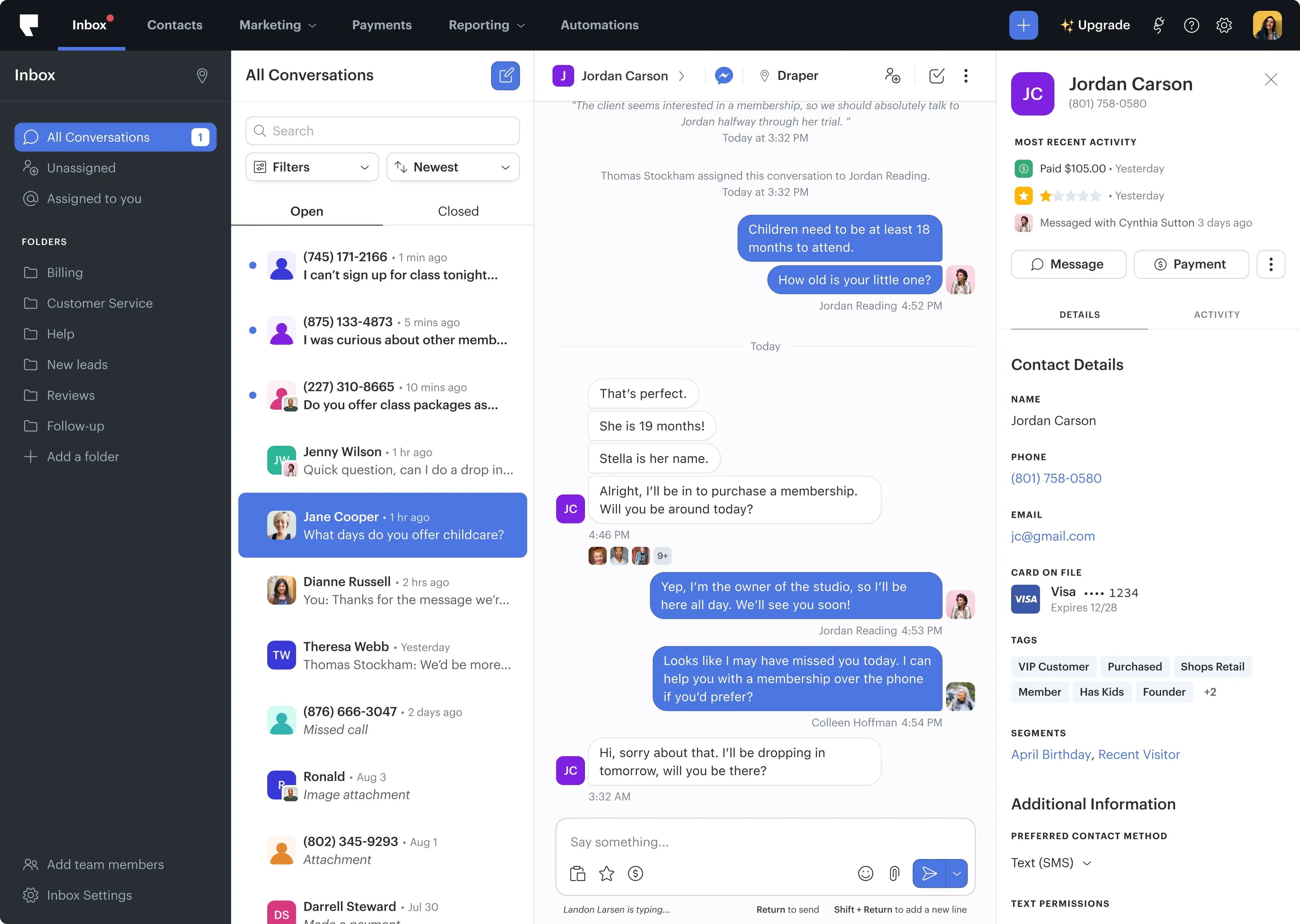
All three sell a unified inbox, one thread view for every conversation. What differs is which channels can reach it.
Podium
Two-way SMS, webchat, Facebook Messenger, Instagram, Google Business Messaging, email and Apple Business Chat, with a real phone system behind it.
No WhatsApp. Podium’s API documentation enumerates its channels and WhatsApp isn’t among them, which rules Podium out for most businesses in Brazil, Spain, India or the Middle East before the conversation starts.
Birdeye
Webchat, SMS, email, voicemail, Google, Instagram, Facebook Messenger, plus an AI chatbot.
And WhatsApp, documented in detail: connect a WhatsApp Business Account, use your templates from the dashboard, migrate a number in from another provider.
Pluspoint
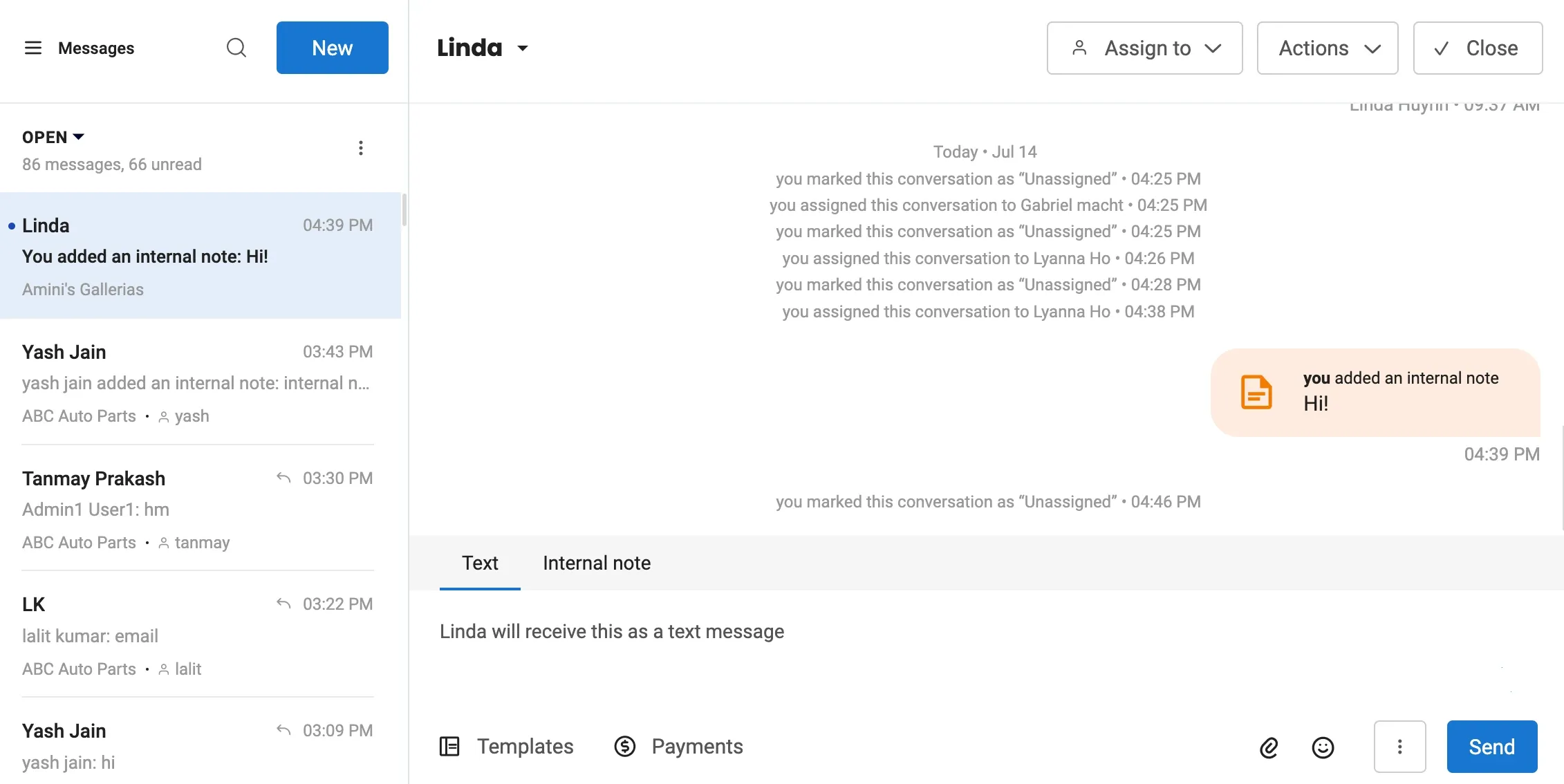
Six channels: SMS, WhatsApp on the official Business API, email, live chat, Facebook Messenger and Instagram DM.
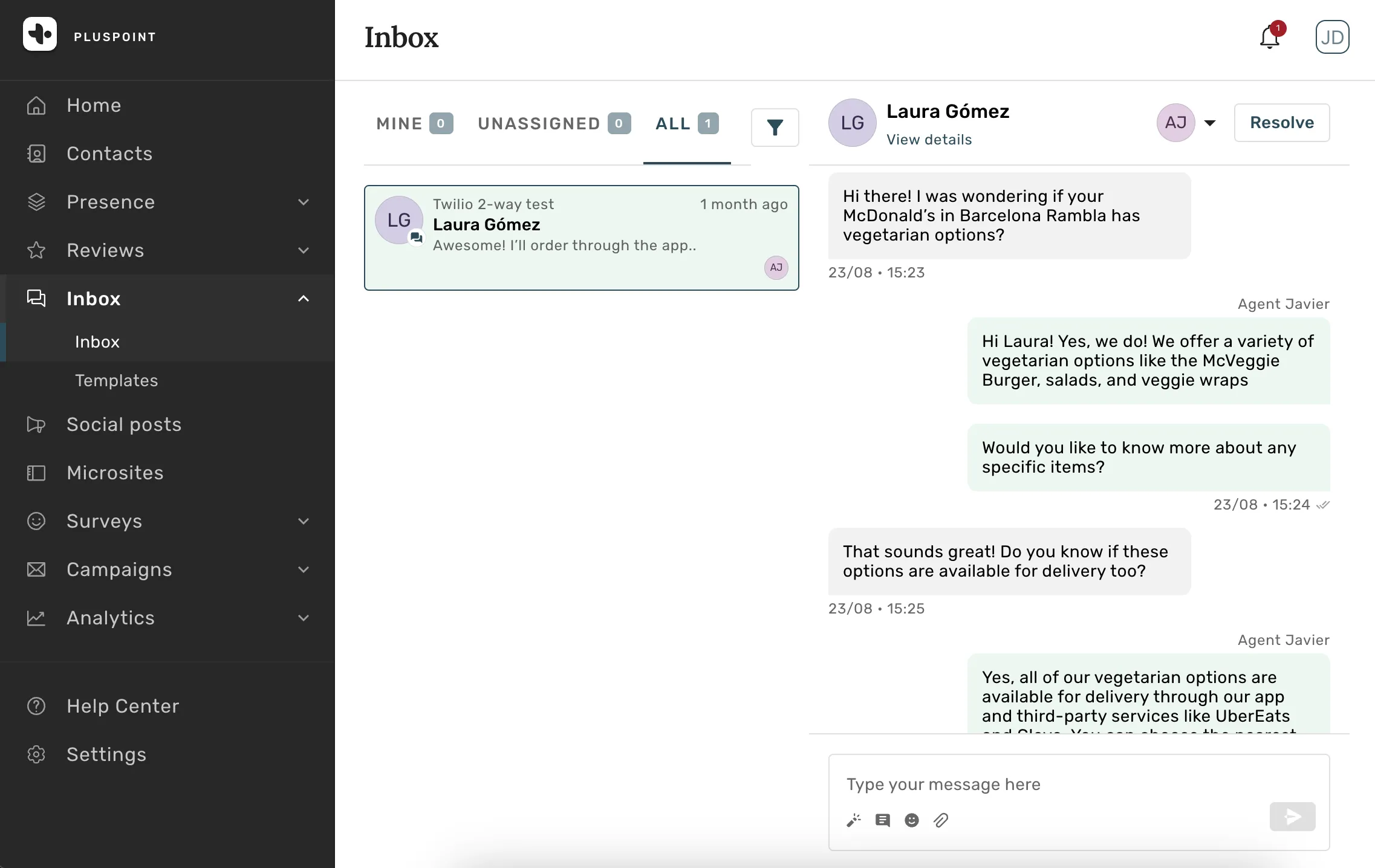
Agent-level analytics track response time and volume per queue. No X, TikTok or LinkedIn DMs, and Google Business Messages is gone, since Google retired it for everyone.
Surveys and feedback
Podium runs surveys over SMS, which suits a business already texting everybody and limits you to one channel’s response patterns. Birdeye adds sentiment scoring on open-text answers and automated send schedules.
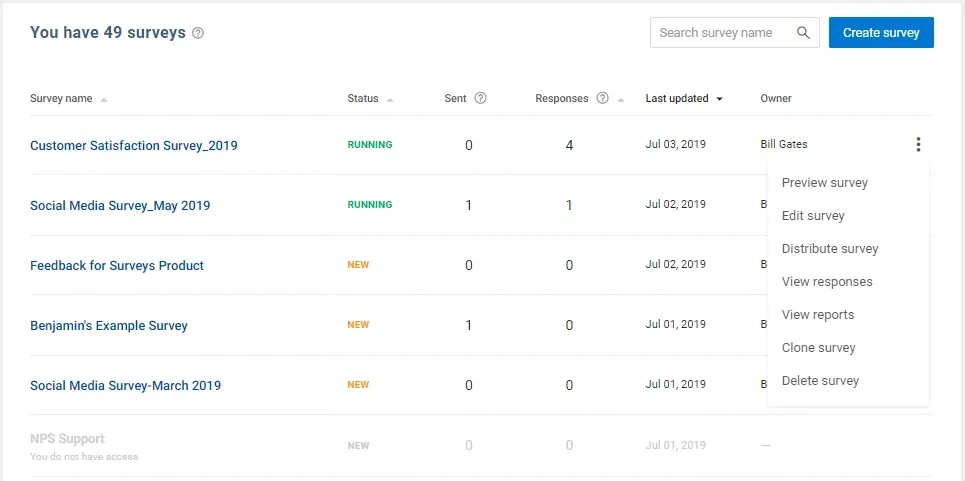
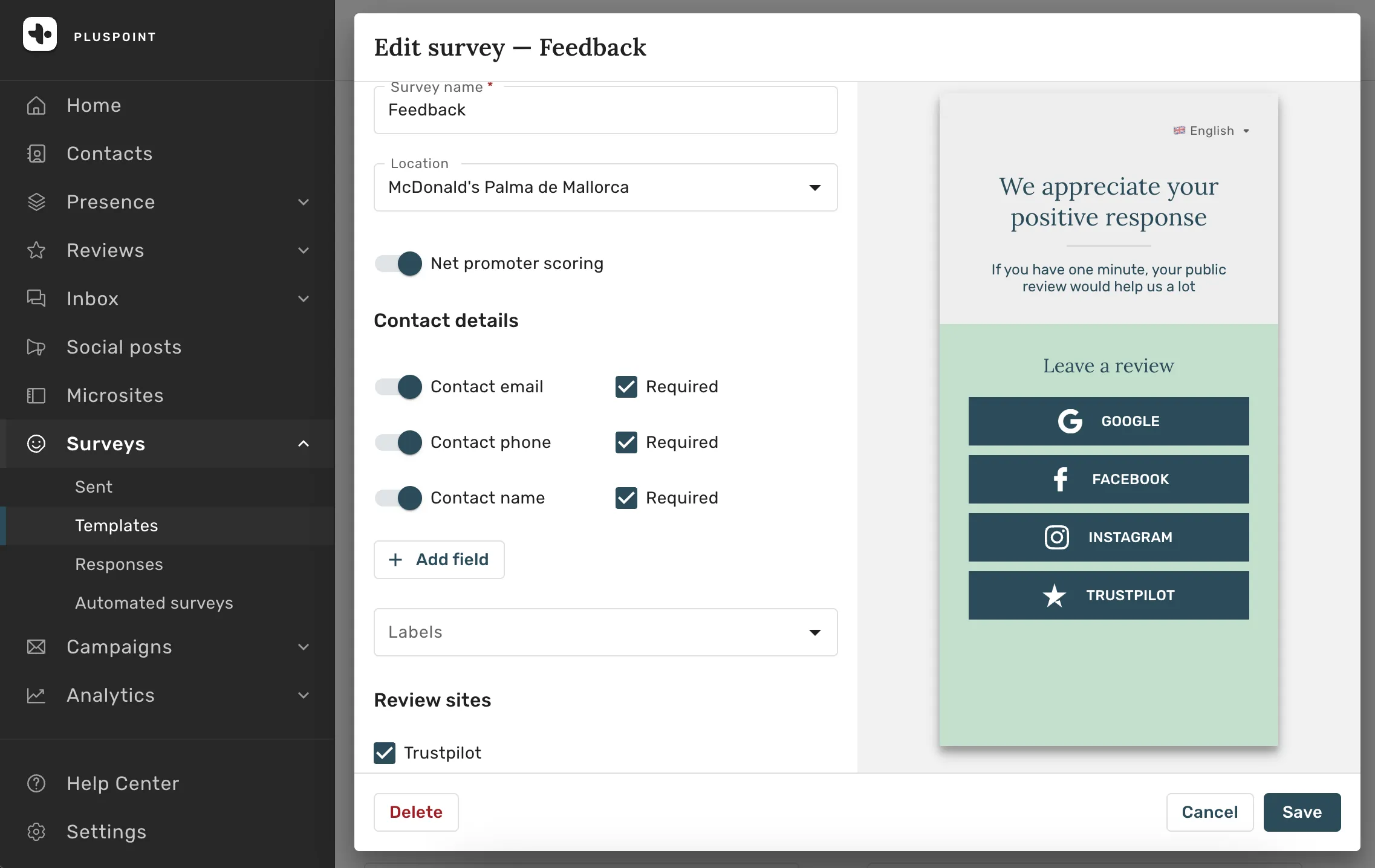
Pluspoint collects through QR codes, SMS, WhatsApp and post-purchase email, with NPS scoring and per-location analytics.
If you’d rather catch feedback at the counter than by text, a review QR code collects it at the moment the experience happened, which is when people actually feel like answering.
Campaigns
All three send bulk campaigns to customer lists; the differences are the channels and the metering.
Podium’s bulk messaging is SMS-first and fast to launch, metered in credits: 250 a month on Core, 500 on Pro.
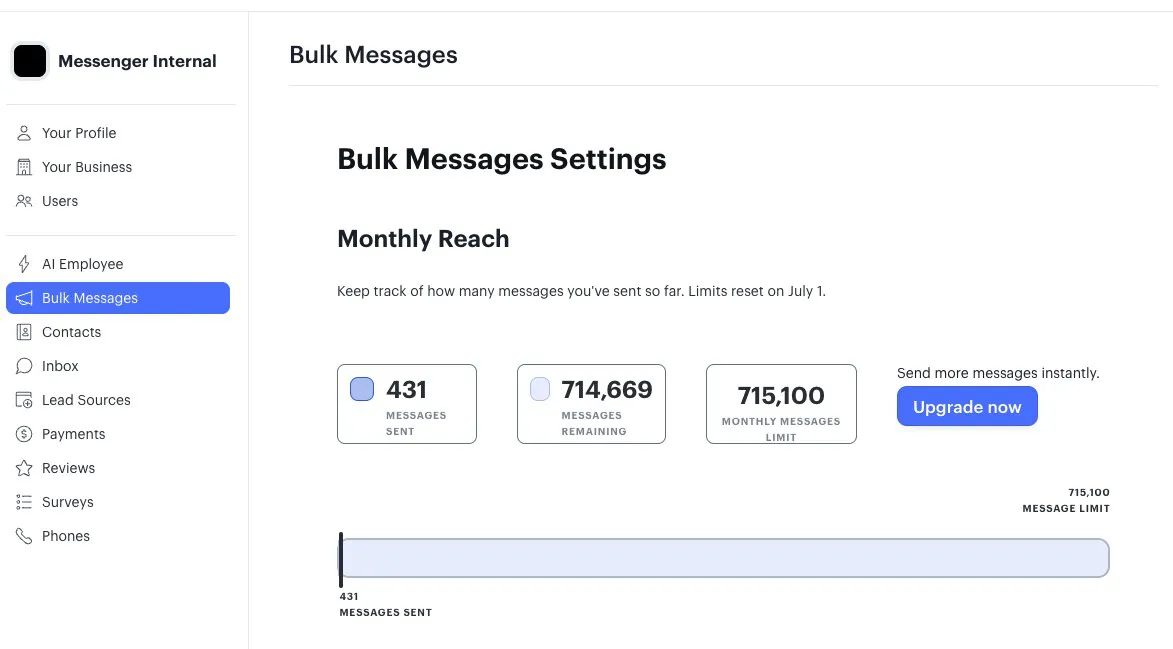
Birdeye handles mass texting and email with two-way conversation.
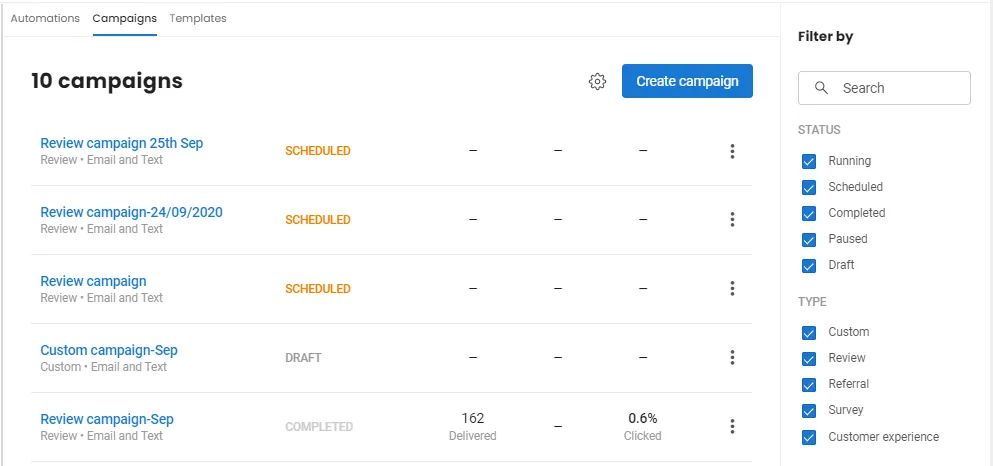
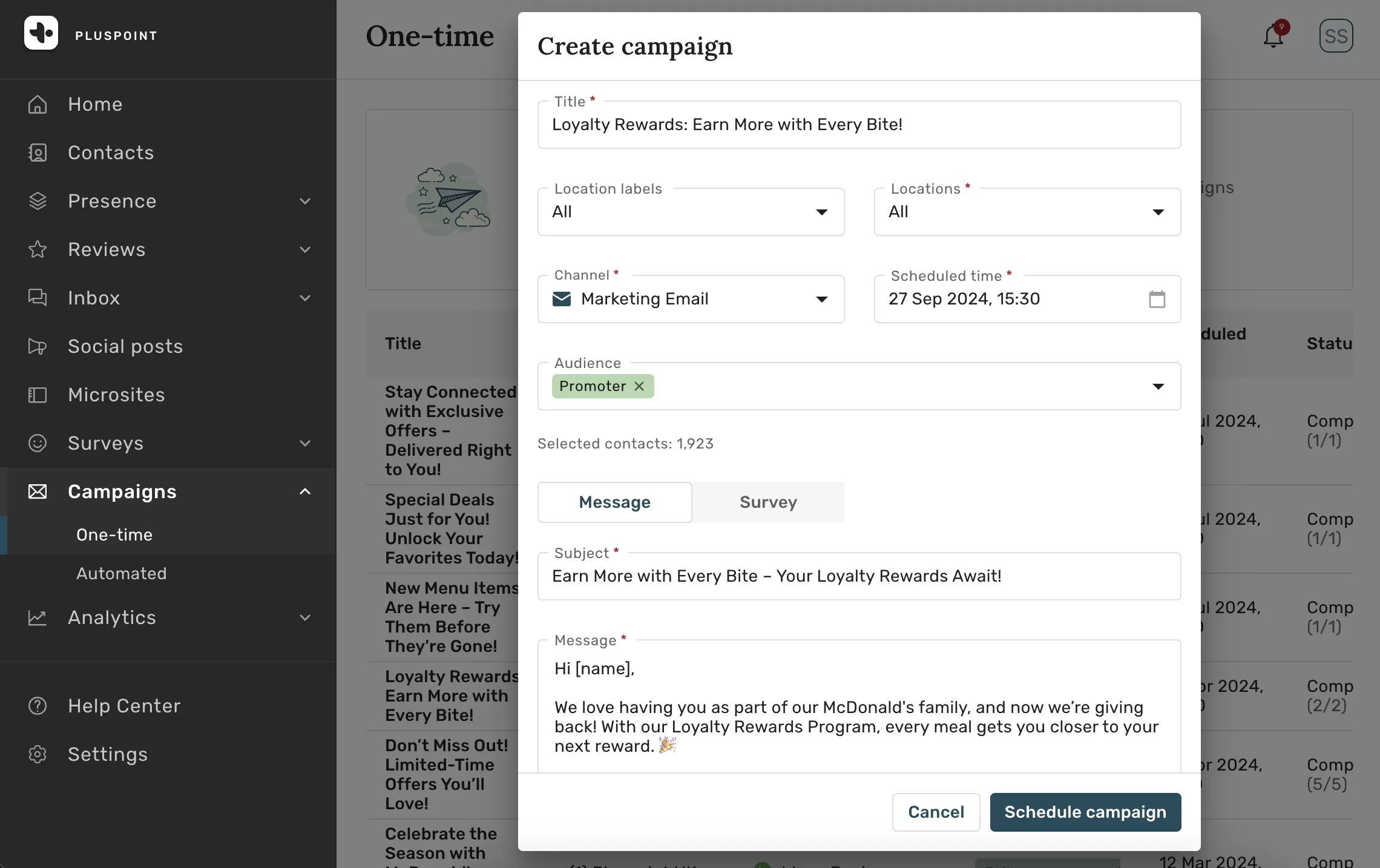
Pluspoint runs SMS, email and WhatsApp campaigns with segmentation by behaviour and NPS category, so a promoter list and a detractor list get different messages.
What users actually say
Feature tables miss the things that make people leave. What follows recurs across unrelated operators on Reddit, Trustpilot and G2 rather than coming from one loud story. Read it as sentiment, not measurement (forum posts skew angry, and the quietly satisfied write nothing), but the recurring parts tell you what to ask on the call.
Contract terms come up more than any feature. Podium and Birdeye draw the same complaint: a twelve-month commitment presented in monthly language, with a cancellation notice window people discover too late. Operators consistently describe 30 days’ notice for Podium and 90 days for Birdeye, and several report an automatic renewal increase of around 8% on Birdeye contracts, described in one account as an “innovation fee”.
Neither company publishes its terms, so none of that is verifiable from a vendor page, and your contract may differ. Get the term length, the notice period and the renewal price in writing before signing. That goes for Pluspoint too.
For Podium, integrations and staffing continuity. Operators describe phone-system porting that took far longer than quoted, and account managers changing often enough that they re-explained the same open ticket more than once. Several mention bills rising through metered messaging they hadn’t modelled.
For Birdeye, silent failures. The complaint that recurs most is an integration dropping its authorisation without alerting anyone, so review requests quietly stop going out while the subscription keeps billing. If you buy Birdeye, ask what happens when a sync breaks and who gets told.
Both get real praise, and it clusters. Podium users like the mobile inbox and consistently report that text review requests pull far better than email. Birdeye users like the directory coverage and the executive reporting across locations.
Pluspoint’s public record is smaller and newer: 4.9 out of 5 on G2 across 51 reviews, 5.0 on Capterra, 4.4 on Trustpilot. The praise clusters around consolidation and price. A restaurant chain CEO on G2 describes streamlining local marketing across 19 locations “at a great price”, a 50-store retail chain runs everything from one dashboard, and a specialty coffee group on Trustpilot counts about eight new Google reviews a week per cafe. The complaint that recurs is the one covered above: replies that reach Google and iFood but nowhere else.
What to ask before you sign anything
This is the part buyers say they got wrong, and it costs more than picking the wrong platform. The pattern in the regret threads is consistent: people over-weight the feature list, under-weight the contract, then spend a year paying for the half they never switched on.
Six questions, worth asking all three.
- What exactly is the cancellation notice, and how do I submit it? Thirty days and ninety days are both in circulation here. Get the number, get the method, and put a calendar reminder two weeks before that date on the day you sign.
- Is there an automatic renewal increase, and will you cap it at zero in writing? Escalators are normal in this category. They’re also negotiable, and operators report that giving notice inside the window often produces a retention offer that removes the increase.
- What happens if the integration never works? Ask for a clause letting you leave without penalty if the platform fails to sync with your POS, CRM or scheduling tool within 30 to 60 days. The complaint that recurs most across both vendors is paying full price during months when the thing simply wasn’t running.
- Who owns the phone number, and how fast do you release it? Anyone taking a business number into a platform’s telephony should get the porting-out timeline in the contract. Getting a number back later is where exits get ugly.
- What are the messaging caps and the overage rate? SMS-metered plans produce the surprise invoices. Ask for the monthly allowance and the per-message price past it.
- Will my customers actually leave public reviews? Therapists, clinics and anyone in a confidential field should answer this before buying any of these tools. A platform that works beautifully for a car dealership can be structurally wrong for a mental health practice, and no feature fixes that.
Pluspoint’s answers to the six, for the record: three locations minimum, no auto-renewal escalator, monthly billing available, and cancellation happens in the app rather than by registered letter.
Side by side
| Podium | Birdeye | Pluspoint | |
|---|---|---|---|
| Published pricing | No, quote only (last listed $399 / $599) | No, quote only | Yes, $29 per location |
| Contract term | Not published; buyers report 12 months, 30 days’ notice | Not published; buyers report 12 months, 90 days’ notice | None. Monthly available, cancel in-app |
| Minimum purchase | Not published | Not published | 3 locations |
| Listings management | None | 100+ sites | 100+ sites |
| Review sites | 24+ named, no Yelp | 200+ | 14 native + public API |
| Review replies posted back | Google, Facebook | Google, Facebook, Yelp | Google, iFood |
| Social publishing | None | 9 networks | 6 networks |
| No | Yes | Yes | |
| Team seats | Unlimited | Not published | 3 included, then $19 |
| Self-serve signup | No | No | Yes, to 30 locations |
Sources: each vendor’s own pricing pages, help centres and product documentation, checked July 2026.
How to choose
Four questions settle it. Answer them here, or read on below.
Answer all three and a pointer appears here.
Do you need listings? If directory accuracy across locations matters, Podium’s out; it doesn’t do this, and no add-on changes that. Birdeye and Pluspoint both do, Birdeye across more sites, Pluspoint with a published price on the add-on.
Does Yelp drive your business? Restaurants, bars and some home services live there. Birdeye is the only one of the three that can reply from the dashboard.
Is WhatsApp how your customers talk? In Brazil, Spain and much of Latin America and Asia the answer is obviously yes, which removes Podium from the running and leaves Birdeye and Pluspoint, both on the official WhatsApp Business API.
Can you wait for a quote? Birdeye won’t price without a call, and Podium now works the same way. If you need a number this week, Pluspoint is the only one of the three with a published rate and a checkout: $29 a location, $87 at the three-location floor.

A restaurant group living on Yelp should get the Birdeye quote and negotiate hard. A single-site dealership drowning in unanswered texts is Podium’s home turf. And an operator running a dozen locations who needs listings kept straight, WhatsApp answered and a bill that doesn’t need a meeting lands on Pluspoint, which is exactly the buyer it was built for.
FAQ
How much does Podium cost per month?
Podium no longer shows prices on its pricing page; plans are quoted through sales. The last publicly listed tiers were Core at $399 a month and Pro at $599, per month with unlimited team members, not per location. Phone seats add $30 per user for the first four and $25 after, and Podium Phones carries a $500 per-location network optimisation fee.
How much does Birdeye cost per month?
Birdeye doesn’t publish prices. The pricing page collects your location count and phone number and routes you to sales. Public discussions on Reddit and review sites put single locations around $300 to $400 a month, with per-location rates falling at volume, though no figure is verifiable against a Birdeye page.
Who competes with Podium?
Birdeye, Pluspoint, Thryv, Broadly, Signpost and Reputation.com. Which is the real alternative depends on whether you want Podium’s texting and phone stack or the listings and social tools it doesn’t have.
What is better than Birdeye?
On breadth, not much: 200+ review sites, Yelp replies and nine social networks is the widest coverage here. On price, Pluspoint publishes $29 per location while buyers publicly report paying Birdeye roughly $300 to $400 a month for a single location, so the transparent option is also the cheaper one to verify.
Does Birdeye work with Yelp?
Yes, uniquely among the three. Connect your Yelp account and you can monitor and reply from the Birdeye dashboard. No bulk replies, no emojis, and no asking customers for Yelp reviews, which Yelp prohibits for everyone.
Is Podium a CRM system?
No. It keeps contacts and conversation history, and its 2026 vertical products add clinical and field-service software, but it isn’t a general CRM and doesn’t replace Salesforce or HubSpot.
Is Podium worth it?
For a business whose problem is answering inbound messages fast, the unlimited seats and phone system earn the price. For a multi-location brand needing listings and social, you’d be paying for a partial stack.
Which platform is best for multi-location businesses?
Pluspoint is built for exactly this case: a published $29 per location rate, bulk listings and social updates across locations, and self-serve to 30 locations, so a footprint can be live the same week. Birdeye covers more review sites and prices by band after a call. Podium is the weakest fit, missing both listings and social posting.