How Google Maps' Ask Maps Is Changing Local SEO: A 12-Step Guide (2026)
Your next customer just asked Google Maps a question, and the AI answered with a short list of recommended businesses. Either yours is on it or it's invisible. Twelve steps, built from real-world tests, to get picked.

Tonight somebody within a mile of your business will open Google Maps and type a question instead of a keyword: a table for six that can handle a wheelchair, a plumber who won’t oversell, a quiet room to work from at 4 pm. Ask Maps will answer with three to eight names and a reason for each. Twenty-plus listings used to split that attention. Now a few businesses take all of it, and the AI decides who they are by reading your profile data, your customers’ words, and a fair amount of the old internet.
Winning a slot is operational work, not keyword work. The AI checks whether your data is complete and consistent, quotes what customers wrote about the visit, and reads your website when the question gets serious. The twelve steps below cover exactly that. They start earlier than most advice does, because the model also believes whatever the old internet remembers about you: one Portland dive bar is currently famous for pizza it has never sold.
What Google Maps’ Ask Maps Actually Does
Ask Maps is a conversational layer inside Google Maps, powered by Google’s AI (the same Gemini technology behind the company’s chatbot). Tap the button below the search bar, ask a full, messy, real-life question, and instead of a ranked list you get a direct answer: a handful of recommended places with photos, AI-written reasoning, review summaries, and action buttons to book, save, share, or navigate. It draws on 300 million places, the contributions of half a billion people, and live signals like hours, busyness, and traffic.
One exchange shows the shift better than any definition:
Quiet cafe where I can work this afternoon: strong Wi-Fi, outlets, and not a 20-minute walk?
Three nearby fit, going by what recent reviewers describe:
A simulated exchange, businesses invented. Notice what the AI quotes as proof: not star counts, review sentences.
The companion launch, Immersive Navigation, added a 3D driving view with lane markings, translucent buildings, and Street View destination previews. Google called it the biggest navigation upgrade in over a decade. For local marketers it matters mostly as context: Maps is being rebuilt as a place where decisions happen, not just directions.
What’s Changed Since Launch
The feature has grown from a US-and-India experiment into Google’s default answer for complex local questions in three countries, and the entry points keep multiplying.
| When | What happened |
|---|---|
| March 12, 2026 | Launch in the US and India, Android and iOS, with desktop announced as “coming soon” |
| March 31, 2026 | Wide US availability; Google publishes usage guidance while early reviews flag accuracy misses |
| April 14, 2026 | Search Engine Land publishes the first structured test: answers name 3–5 businesses depending on question type |
| May 21, 2026 | Google Marketing Live brings Demand Gen ads to Maps; Ask Maps answers stay ad-free |
| June 11, 2026 | Brazil launch with full Brazilian Portuguese support, the third country |
| July 2026 | App teardowns show Ask Maps prompt bubbles wired into route planning; desktop still unreleased |
Two of those rows deserve a second look. Brazil matters because it proves the rollout template: full natural-language support per market, mobile first. And the route-planning integration matters because it moves Ask Maps from a destination you tap into a suggestion that meets users mid-task. Each new entry point is more questions asked, and more recommendations handed out.
Why Ask Maps Breaks Traditional Local SEO
Google’s local ranking documentation still lists the same three factors it always has: relevance, distance, and prominence. What changed is who does the evaluating. A ranked list asks you to beat nineteen competitors on a score. A conversational answer asks a language model to justify why you fit this specific person’s specific situation, and to name only a few businesses it can defend.
The most-cited structured tests of the feature so far belong to Rich Sanger, and he compressed the shift into one line:
“Ask Maps changes local visibility from ranking in a long list to being confidently recommended.”
Rich Sanger, Streetlight Local, on Search Engine Land, May 2026
His testing found answers surface roughly three to eight businesses, against the twenty-plus a map scroll used to offer. The math is brutal and clarifying. Fewer slots, chosen on evidence.
Consumers are already there. A year ago, 6% of them used AI tools to find local businesses. In BrightLocal’s 2026 survey it’s 45%, and only Google and Facebook rank higher. Google’s own share of review reading slid from 83% to 71% over the same year. Pew now counts half of US adults as AI chatbot users. People aren’t reading fewer reviews. A machine is reading them first.
Here’s the practical translation of everything published testing has shown so far:
| The map pack game | The Ask Maps game | |
|---|---|---|
| Query | ”plumber near me" | "which plumber can fix a burst pipe today and won’t oversell me” |
| Output | 20+ listings, ranked | 3–8 businesses, each with a written justification |
| Star rating | Aggregate score competes | Review sentences are quoted as evidence |
| Your website | Mostly a citation signal | Read directly for complex questions |
| Winning move | Rank higher | Give the model evidence it can defend |
The losers in this table aren’t low-rated businesses. They’re well-rated businesses with generic evidence: the 4.8-star profile whose 200 reviews all say “great place” gives the model nothing to quote. When early Reddit threads claimed the feature “cares less about quantity of 5-star reviews,” practitioners pushed back, and the pushback deserves a hearing:
“Average rating is still important. If you have 100 reviews at 4.8, of course that will outrank 110 reviews at 3.9.”
u/Tech4EasyLife on r/localseo, April 2026
Both camps are describing different layers of the same machine. The rating still gates you in: 31% of consumers won’t consider anything under 4.5 stars, nearly double a year ago. But once a handful of businesses clear that gate, the words decide who gets recommended. That’s the 4.5-star economy with a chat interface bolted on.
How Ask Maps Decides Which Businesses to Recommend
Worth holding one comparison in mind while reading this section. Ask Maps leans on Google’s own place data, which is not how the chat assistants behave: a count of who decides which local businesses AI names found ChatGPT never cited a Google, Bing, Apple or Yelp page as its reason for naming anyone.
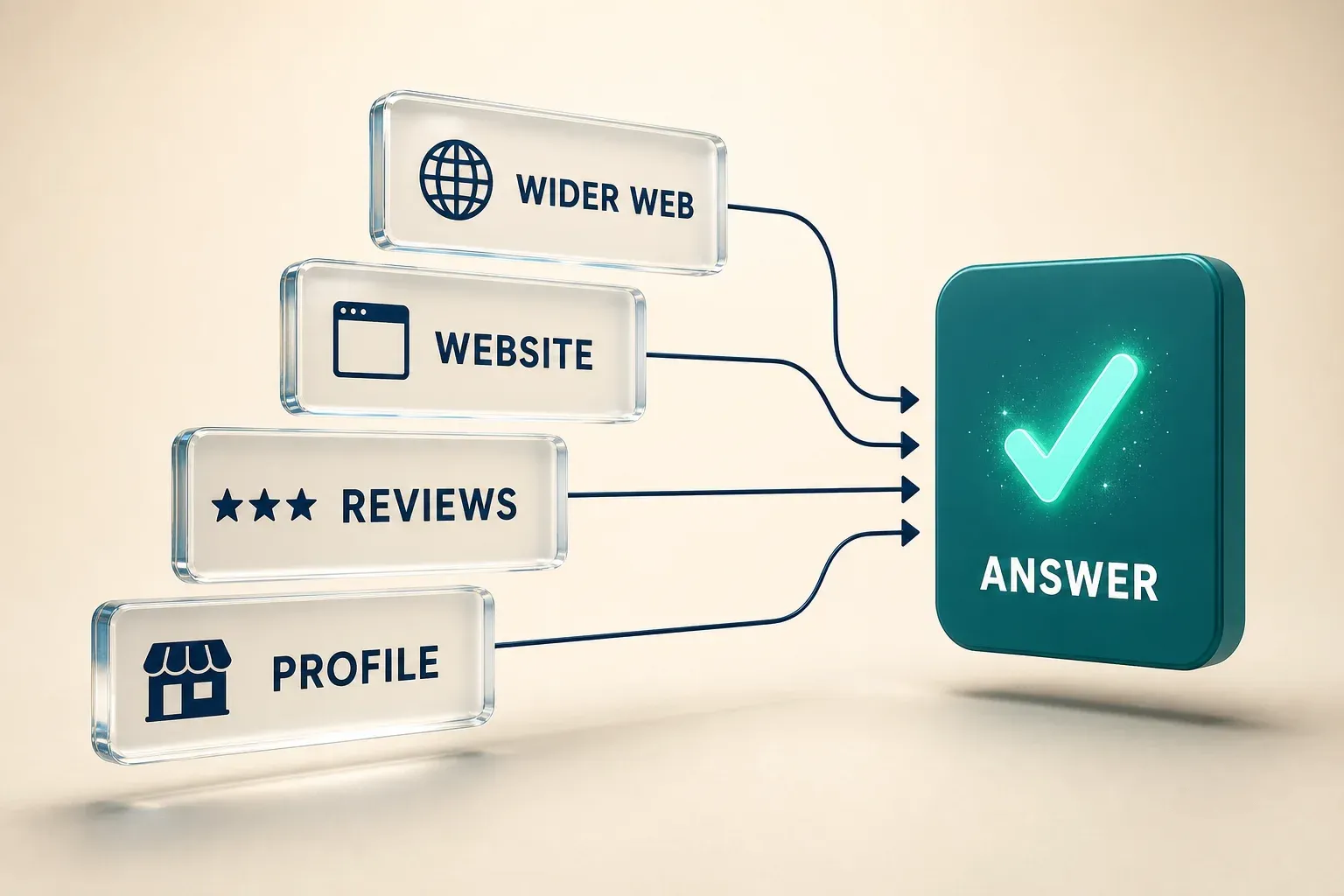
Ask Maps performs what amounts to an automated vibe check, and months of published testing have mapped its layers. Business Profile data works as the eligibility filter: category, hours, attributes, operational status. Review text supplies the situational evidence the model quotes. Your website gets read when the question is complex or expensive. The wider web, from directories to decade-old listicles, fills any gaps, whether you’d like it to or not. And on top of everything sits personalization: Google says answers draw on places the user has searched and saved, so two people asking the identical question can get different recommendations.
Review text is retrieval fuel, not just social proof
When someone asks for “a quiet cafe to work from with strong Wi-Fi,” the model scans review text across hundreds of businesses for semantic matches. The cafe whose customers wrote “quiet,” “good for working,” and “fast Wi-Fi” surfaces. Its rival with 500 five-star raves that say “love this place” does not, because five words and five stars can still add up to zero retrievable facts.
Recency compounds this. 74% of consumers only value reviews from the last three months. A third now want something from the last two weeks, twice as many as a year ago. The model and the human have converged on the same prejudice: old praise is weak evidence.
Attributes fill the gaps reviews don’t cover
Structured profile attributes, from wheelchair accessibility to outdoor seating to payment methods, give the model matching surface that review text might miss. Every blank field is a question Ask Maps can’t answer about you, and an answer it can confidently give about a competitor who filled the field in.
Photos feed a model that can see
Google’s AI looks at pictures as readily as it reads text, so “cozy aesthetic” isn’t matched only against the word “cozy” in reviews. It’s evaluated against your uploaded imagery: lighting, seating, the state of the dining room. Fifty specific, well-lit, recent photos beat two hundred blurry ones from 2023, because the model is grading what the place actually looks like.
How much each layer matters depends on the question being asked. This is the part most coverage flattened, and it’s where the levels from Search Engine Land’s April testing earn their keep:
What Ask Maps reads at each level of question
The same plumber gets judged on different evidence depending on how the question is phrased. Tap through the five levels.
The basic search
Plumbers near me
What the AI reads
- Your Business Profile category, hours, and rating
- Distance from the user, same as the old map pack
- Little else. Simple question, simple evidence.
Your move
Get the fundamentals exact: primary category, service area, hours that match reality. At this level Ask Maps behaves like the map pack wearing a chat interface.
Streetlight Local’s test saw about 3–4 businesses named per answer here.
The specific service
Who installs tankless water heaters?
What the AI reads
- The services list on your Business Profile
- Review text that names the actual job
- Service pages on your website
Your move
Name every service explicitly, on the profile and on the site. A review that says “replaced our tankless unit in a day” is retrieval fuel a generic five-star can never be.
Specific-service answers surfaced the most businesses after trust questions: about 4 per answer.
The situational problem
Water is coming through my kitchen ceiling. Who can come right now?
What the AI reads
- Open-now status and after-hours availability
- Review stories about speed and emergencies
- Whether your profile signals someone will answer
Your move
Keep hours ruthlessly accurate, list the emergency line, and let customers who got same-day help say so in their reviews. The AI interprets the problem before it picks a business.
Situational answers were the narrowest in testing: closer to 3 businesses per answer.
The trust question
Which plumber won’t oversell me?
What the AI reads
- Sentiment and phrasing across your review corpus
- Words like “honest,” “explained options,” “didn’t push”
- How you respond when someone is unhappy
Your move
You can’t write these reviews, but you can earn them and ask at the right moment. Reply to criticism like future customers are reading, because now a language model is.
Trust questions produced the widest answers: 5 businesses on average. The AI hedges when reputation is the question.
The advisory question
Should I repair or replace a 12-year-old water heater?
What the AI reads
- Educational content on business websites
- Third-party guides and external sources
- Who taught it the answer it just gave
Your move
Publish the plain-language answer pages your customers actually ask about. At this level Ask Maps stops ranking listings and starts citing whoever explained the decision best.
At level 5, Streetlight Local found it works “less like traditional local search and more like a system designed to help users make decisions.”
Where Ask Maps Gets It Wrong (and Why That’s Your Problem)
Ask Maps fails in one specific, repeatable way: it reads stale web content as current fact. In March, a Droid-Life editor asked for “new pizza restaurants with party cut pizza” in Portland and got, as the top result, a dive bar whose owner says it has never sold pizza. Third on the list: a restaurant closed for almost two years. In April, panelists at Near Media watched Ask Maps describe a jeweler using an orphaned page and a 2015 listicle, presenting watch brands the store dropped years ago as current stock.
The sentence every multi-location operator should pin to the wall came from Mike Blumenthal:
“They don’t care how old the review is or how old the blog post was.”
Mike Blumenthal on the Near Media panel, April 2026
The internet never forgets, and now it has a spokesperson. A discontinued service on a page you forgot exists, a menu PDF from two owners ago, a “best of 2019” listicle: any of it can be quoted to a customer today as fact. Consumers have noticed too; “turn off Ask Maps” is already a measurable Google query. The model will get better. Your stale data won’t fix itself while you wait.
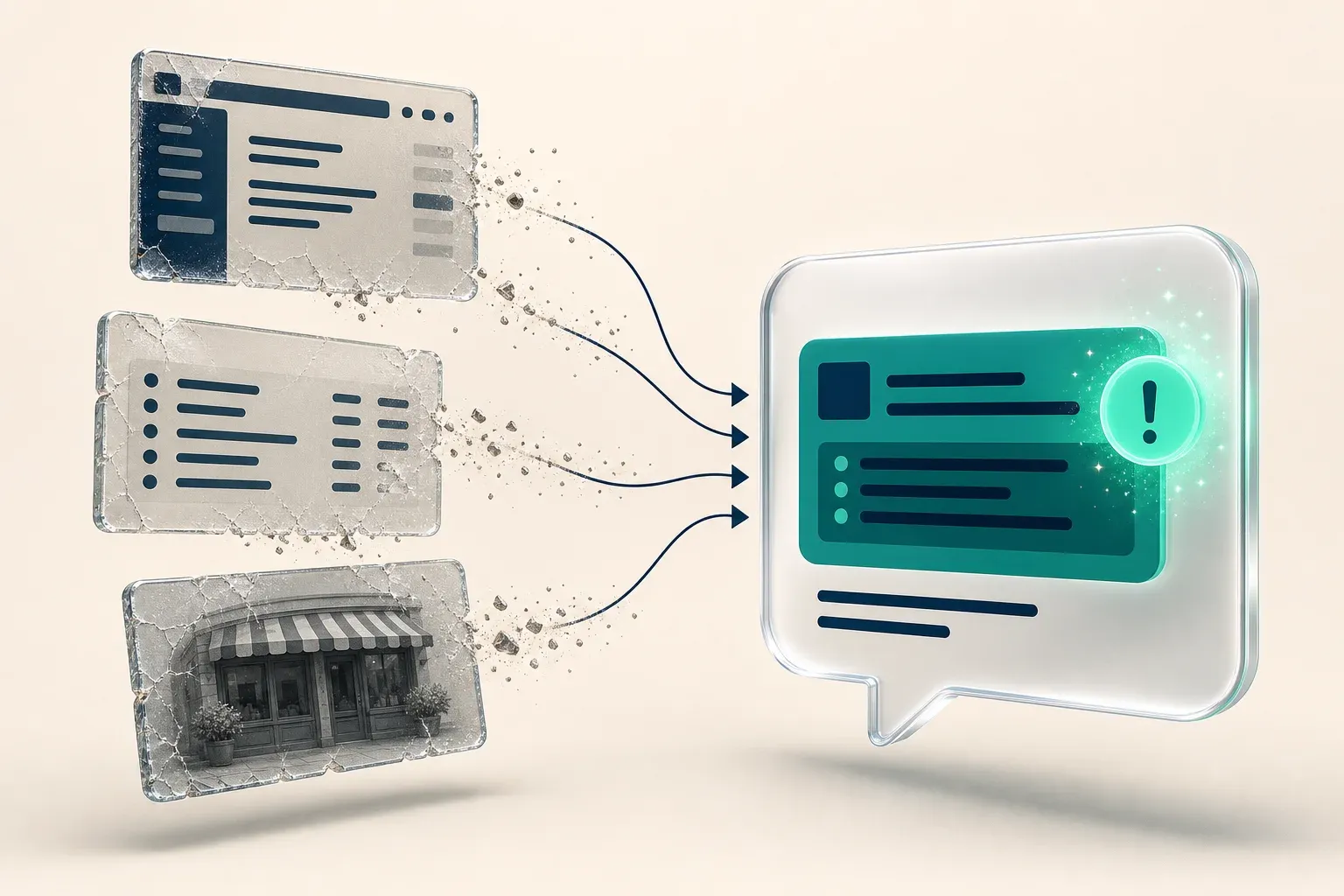
Which is exactly why the twelve steps below now start earlier than your Business Profile: they start with everything the model can read.
The 12-Step Guide to Getting Recommended by Ask Maps
Before the steps, a two-minute honesty check. Score one location you know well:
Is your location ready for Ask Maps? A 10-signal check
Tick what is true today, per location. Guessing counts as a no.
Signals in place: 0 of 10
Mostly invisible to conversational queries. Start with data accuracy: attributes, hours, and the review stream.
Ten yes/no questions can’t audit a hundred locations. They can tell you which of the twelve steps below to start with.
The twelve steps sort into three tiers, in the order the model meets you: your data decides whether you are eligible, your evidence decides whether you get chosen, and your conversion surfaces decide whether any of it pays. Work them in that order. Evidence built on wrong opening hours is evidence for a business Google is not confident exists.
Steps 1, 3, and 4: locked listing data, one honest audit of what the old web says about you, and a stream of reviews that describe specifics. Those three move more Ask Maps visibility than the other nine combined, and a regional manager can start all of them on a Monday.
Tier 1: Fix the data
Eligibility, not advantage. None of this wins a recommendation on its own; all of it decides whether you are in the pool the model picks from. Do it once properly, then re-audit quarterly.
1. Lock your listing data across every directory
Ask Maps pulls from a distributed data graph, and conflicting information reads as unreliable data. If your hours disagree across Google, Yelp, Apple Maps, and your own site, the model’s confidence in your entity drops, and low confidence gets you skipped for a competitor with cleaner records.
For brands managing 10, 50, or 150+ locations, manual directory management stopped being realistic years ago. Pluspoint, a reputation and customer-engagement platform for multi-location brands, synchronizes hours, addresses, amenities, categories, and holiday schedules across 100+ directories from one dashboard, which turns “one source of truth” from a slogan into a setting. See how Listings Management works.
2. Complete every attribute field in your Google Business Profile
Wheelchair accessibility, outdoor seating, Wi-Fi, parking, payment types, reservations: each completed field is matching surface for a constraint somebody will type tonight. Treat attributes as a quarterly audit, not a setup task. Google keeps adding fields; your operations keep changing. The full workflow for doing this across dozens of locations is in our guide to managing Google Business Profiles at scale.

3. Audit what the wider web says about you, then fix it
Honestly, this may be the most useful hour a location manager spends this quarter. Ask Maps quotes the broader web as if it were current, so you need to know what’s out there before your customers do.
The audit itself is simple:
- Ask Maps (plus the Gemini app and ChatGPT) about your own business: “what does [name] offer,” “is [name] good for groups,” the questions your customers actually ask.
- Search your brand name next to your oldest discontinued services and see what surfaces.
- Hunt down the sources of anything wrong: orphaned pages on your own site, stale menu PDFs, directory entries from a previous owner, listicles describing 2019.
Update what you control. Request corrections on what you don’t, and mark closed locations closed everywhere. One wrong answer found this way is worth more than ten new blog posts.
Tier 2: Build the evidence
Recommendations are won here. Ask Maps quotes specifics back to the person asking, so the work is producing specifics worth quoting: reviews that describe situations, photos that show the actual room, pages that answer the actual question. Plenty of brands finish tier one, stop, and wonder why they never surface.

4. Shift your review strategy from volume to narrative depth
Stop optimizing for star count alone. The goal is a steady stream of recent reviews that mention specifics: service speed, ambiance, dietary accommodations, parking, the technician’s name. Those details are what the model quotes when it recommends you.
You can’t script what customers write, and since Google’s April 2026 policy update you’re explicitly banned from trying: review quotas for staff and requests for specific keywords are now named violations. What you can control is timing and ease. Ask at the moment of satisfaction, through the channel the customer actually reads, with a QR code at the counter or an automated SMS an hour after the appointment. Happy customers describe details on their own; your job is removing the friction between the experience and the write-up.
5. Respond to every review with specificity, not templates
89% of customers expect a reply to their review, and one in five now wants it the same day. Templated responses put half of them off. The model reads your replies too: how a business handles criticism is trust evidence for the exact “which one won’t burn me” questions where Ask Maps names the most alternatives.
At multi-location scale, personalized responses to hundreds of monthly reviews is a real staffing problem. AI-assisted reply tools that reference each reviewer’s specific points solve the volume without the canned tone. Fake review instead of a harsh one? Different playbook entirely, covered in our guide to getting reviews removed.
6. Catch negative themes before the AI encodes them
Ask Maps surfaces recurring complaints as readily as recurring praise. If “long wait” starts trending in one location’s reviews, that phrase is on its way into an AI-generated summary shown to prospects. Pluspoint’s sentiment engine categorizes review text across all locations and flags emerging negative themes in real time, so a regional manager hears about the parking problem from a dashboard alert this week, not from an AI answer next quarter. Plans start at $29 per location per month, which is cheaper than finding out the other way.
7. Upgrade your visual content for a model that can see
Replace generic storefront shots with specific, recent, well-lit imagery: the dining room at 8 pm, the patio in summer, a finished project, the interior from a customer’s seat. Multimodal evaluation means your photo library answers aesthetic questions before any human sees it. Short vertical video helps too; it feeds Google’s immersive mobile layouts and gives the model motion and context that stills can’t.
8. Restructure your website around atomic answers
For complex and high-stakes questions, published testing shows Ask Maps reads business websites directly. Give it something to find: clear, factual, 40-to-60-word answers under question-shaped headings on every location page. “What insurance do you accept?” followed by the list. “Do you offer gluten-free options?” followed by specifics.
The questions worth answering first are the ones people actually ask nearby, which skew heavily toward price, policy and opening hours rather than anything aspirational.
Keep LocalBusiness structured data per location while you’re in there, with one caveat the SEO industry took too long to admit: the model reads your rendered text, not your markup. Schema clarifies your entity; the visible answer is what gets quoted. Write for the reader, mark up for the machine, in that order.
Andrew Shotland of Local SEO Guide reached the same conclusion from the consumer side, after testing Ask Maps on a New York gallery hunt:
“Your suggestion about describing everything in detail is spot on. The LLMs need to be spoon-fed!”
Andrew Shotland, Local SEO Guide, on r/SEO_for_AI, April 2026
9. Give every location a page worth quoting
Two audiences read your location pages now, and neither one is you. The model reads them for the complex questions covered in step 8. Humans read them after the recommendation: BrightLocal’s data shows a chunk of consumers keep researching on your site and social profiles before committing. Both want the same thing, which is a fast, mobile-first page confirming what the AI just claimed: same hours, same services, fresh photos, a visible booking path, real reviews. Pluspoint Microsites exist for exactly this layer, and they rank for local queries on their own.
Tier 3: Capture the demand
A recommendation you can’t convert is a recommendation for somebody else. Ask Maps answers end in buttons, and what happens after the tap is entirely your infrastructure.

10. Switch on every in-app conversion surface
Every Ask Maps answer ends in buttons: directions, save, share, book, order. Connect a booking provider through Reserve with Google if you take appointments, and switch on messaging so questions reach a person. Restaurants, one correction to advice still floating around: Google retired its own end-to-end Order with Google checkout in mid-2024, so the order button now hands diners to whatever ordering links your profile lists. Point those links at your direct ordering page first, ahead of the marketplaces that take a cut. A recommendation that can’t convert inside the app converts somewhere else, usually at the competitor whose buttons work.
11. Deploy omnichannel messaging to catch post-discovery leads
Not every recommendation ends in an instant booking. People save your location, share it with the group chat, and come back with questions at 9:40 pm. Pluspoint consolidates WhatsApp, SMS, Facebook, Instagram, and live chat into one inbox, with an AI agent handling the after-hours “do you have space for six on Friday” messages that decide where Friday actually happens. Explore the Inbox solution.
12. Turn one AI-driven visit into a repeat customer
Discovery through Ask Maps is top-of-funnel; margin lives in the return visit. Segment customers by visit frequency, satisfaction score, and review history, then run the boring, effective plays: a VIP offer by SMS to your promoters during slow weeks, a win-back message to resolved detractors, appointment reminders through WhatsApp. One restaurant brand running Pluspoint Campaigns grew reviews 500% and its rating from 4.1 to 4.9 within two months, and that fresh review velocity feeds straight back into the evidence Ask Maps reads. The loop compounds.
What About Paid Placement in Ask Maps?
There is none, still. As of late July 2026, Ask Maps recommendations carry no sponsored slots, and Google’s Maps ad push went around the feature rather than into it: May’s Google Marketing Live brought Demand Gen formats to the Maps surface while conversational answers stayed organic. Google has pointedly not ruled ads out.
Read the sequencing the way an operator should. Every high-intent surface Google has built eventually grew an ad layer, and when this one does, businesses with strong organic evidence will pay less for reinforcement than laggards will pay for rescue. The window where recommendation slots are earned rather than bought is open now. It won’t be the cheap acquisition channel forever; Google’s AI transformation of search has never worked that way.
Measure What Matters in the Ask Maps Era
There’s no “Ask Maps report” anywhere in Google’s tooling, and impressions from the feature flow into standard Business Profile metrics undifferentiated, a limitation Glenn Gabe flagged in the first week. So measurement is triangulation, not dashboard-reading. Build the stack around signals you can actually pull:
| Layer | Track | Where |
|---|---|---|
| Discovery | Profile impressions, search query types, AI share of voice vs competitors | GBP performance + manual AI audits |
| Engagement | Direction requests, calls, messages, menu views, booking clicks | GBP performance dashboard |
| Reputation | Review velocity per location, attribute mentions per review, response time | Review platform analytics |
| Revenue | In-app bookings, offer redemptions, repeat-visit rate | POS + campaign tracking |
The one metric with no automated source is the one that matters most: what the AI actually says about each location. That’s a monthly manual audit. Ask the same questions in every market, log what comes back the way rank positions used to get logged, and budget about twenty minutes per market for ten prompts, the same discipline behind asking AI the same question twice in a row for restaurant recommendations. You’ll know more about your AI visibility than competitors running on vibes. For the broader playbook on showing up in AI answers beyond Maps, see how local businesses rank in ChatGPT.
Don’t Try to Game the System
The enforcement math got worse for shortcuts, again. Google blocked or removed 292 million reviews in 2025, with detection models tuned for unnatural bursts. The April 2026 policy update added named violations for staff review quotas and keyword-mandated review requests.
Regulators are pressing from the other side. The UK’s CMA extracted binding fake-review commitments from Google. In the US, a single fake review can cost up to $53,088 under the FTC rule in force since late 2024.
With Ask Maps quoting reviews as recommendation evidence, a fake-review penalty now costs you twice: the profile restriction, and the AI narrative built on whatever suspicious pattern got flagged. Earn the reviews through systematic, policy-clean outreach. The compounding works fine without shortcuts.
FAQ
What is Google Maps Ask Maps?
Ask Maps is a conversational feature inside Google Maps, powered by Google’s AI and launched March 12, 2026. Users tap the button below the search bar and ask natural-language questions; the AI answers with a small set of recommended businesses drawn from over 300 million places, contributions from 500+ million people, and live signals like hours and busyness.
Where is Ask Maps available?
The United States, India, and Brazil as of late July 2026, on Android and iOS. Brazil arrived June 11, 2026 with full Brazilian Portuguese support. Desktop is still “coming soon,” and July app teardowns show route-planning integration in testing.
How does Ask Maps decide which businesses to show?
In layers: Business Profile data filters who’s eligible, review text provides the situational evidence, and websites get read for complex, high-stakes questions. Published tests show each answer names only three to eight businesses, so completeness and specific review language decide who’s in.
Does Ask Maps replace the Google Maps local pack?
No. Standard keyword searches still return the classic map pack under the classic relevance, distance, and prominence factors. Ask Maps handles conversational, multi-constraint questions, and its share of local discovery grows with every new entry point Google wires it into.
Can businesses pay to appear in Ask Maps results?
Not as of late July 2026. Answers are organic; Google Marketing Live’s May announcements put Demand Gen ads on the Maps surface but left Ask Maps untouched. Google hasn’t ruled out ads later, which is the strongest argument for building organic evidence now.
How accurate is Ask Maps?
Documented failures exist: a Portland bar recommended for pizza it never sold, a restaurant closed two years still being suggested, a jeweler described from a 2015 listicle. The pattern is stale web content treated as current. Businesses should audit what AI tools say about them and fix the sources.
How should multi-location businesses prepare for Ask Maps?
Lock data consistency across directories, build a stream of recent, detailed, well-answered reviews, switch on booking and messaging surfaces, and audit AI answers about every location monthly. Platforms like Pluspoint centralize the data, review, and messaging layers across 100+ locations from one dashboard.